stewmac.com
27
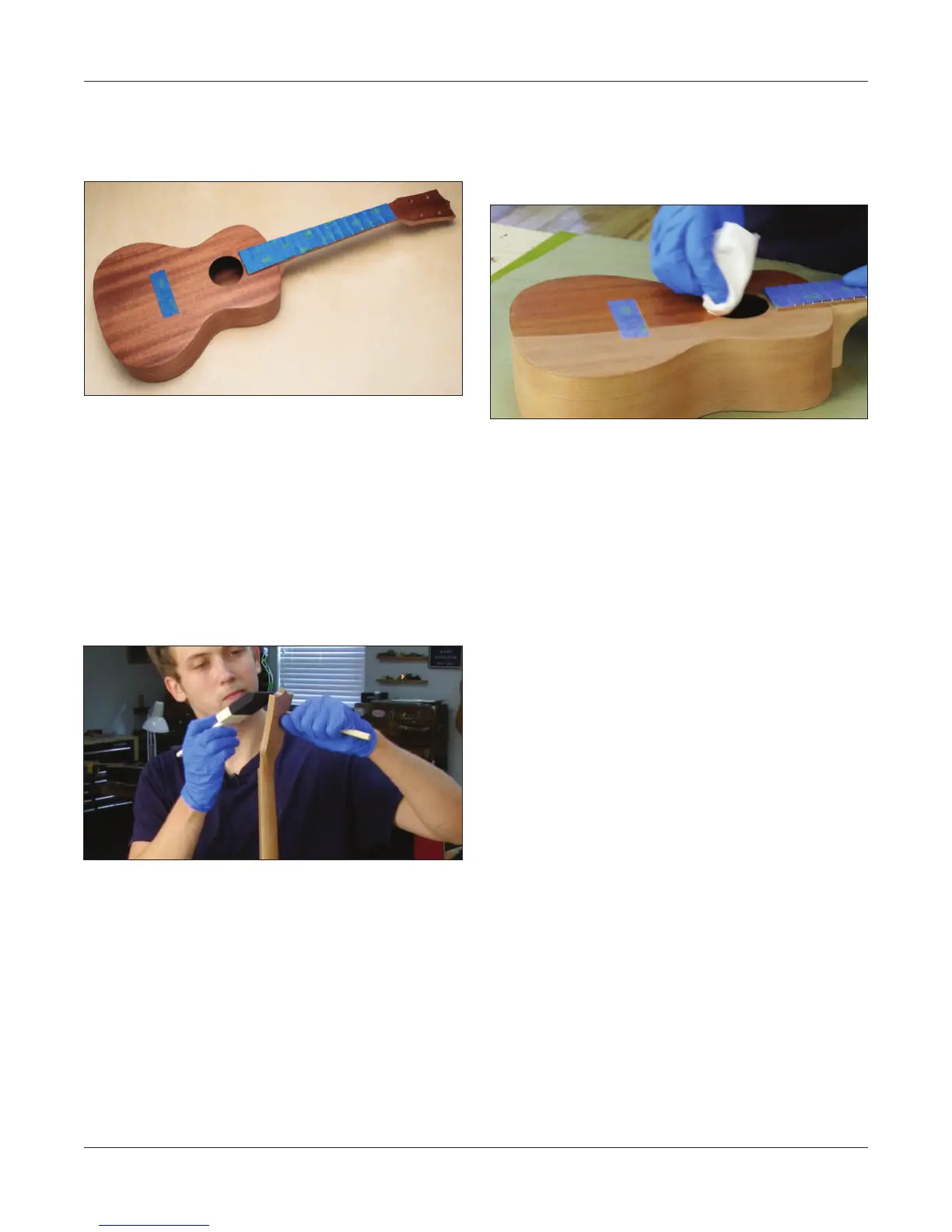
Tape o the ngerboard to avoid getting nish on it. If there
is a gap between the neck and body, ll it with ColorTone
Grain Filler. A mix of our Mahogany and Ash colors made a
good match for the light mahogany of this unstained kit.
Tape o both sides of the gap, then use a knife to press the
ller into it. Wipe o the excess with a damp paper towel and
peel away the tape. Clean up with paper towel if needed.
Allow to dry, then sand with 400-grit paper.
Wear nitrile or other protective gloves when handling the
uke now, to keep the surface dry and clean for nishing.
Make a holder peg
You can hold the uke by the neck while nishing the body,
but by the time you’re nishing the peghead you’ll need a
hand grip.
Sand a taper onto the end of a dowel, so it will press-t into
one of the tuner holes, like a violin peg. This gives you a
handle while adding the last stroke of nish. You can also
clamp this peg to your table when leaving the uke to dry.
Wipe on the rst coat
Using ColorTone Wipe-On Poly nish, apply the rst coat
using the pad made of cotton wrapped in a piece of t-shirt
cloth. The wood will soak up this rst coat very quickly; it’s
basically a sealer coat. Allow to dry.
Scu-sand with 400-grit
When the coat is dry, lightly sand it with 400-grit paper, to
remove surface imperfections.
Brush on the second coat
A foam brush lays down more nish than a cloth pad, so
brushing builds the nish more quickly while still being
very easy to do.
Scu-sand again with 400-grit
When dry, lightly sand again with 400-grit paper.
Apply the nal coat
Add a third coat for a complete nish. Allow to dry for a day.
Shiny or satin?
The nish will have a nice sheen. If you’d rather have a satin
look, you can dull the nish by rubbing it with 0000-grade
steel wool.
Apply the nish


 To Next Page