
 Need help?
Do you have a question about the Strider MX 3 and is the answer not in the manual?
Covers general safety guidelines and warnings for operating the scooter.
Explanation of symbols used to highlight hazards and important information.
Details the purpose and user requirements for operating the scooter.
Important general guidelines and responsibilities for manual users.
Critical safety advice and hazards to avoid while driving the scooter.
Guidelines for safe handling during transport, assembly, and maintenance.
Precautions for safe handling and charging of scooter batteries.
Information regarding electromagnetic interference and electronic safety.
Details the items included in the scooter package upon purchase.
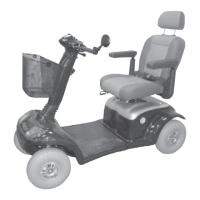
An illustrated overview of the main parts of the Strider scooter.
Identifies and explains the functions of the dashboard instruments and controls.
Step-by-step guide for initial operation and getting started with driving.
Instructions on how to set the drive levels (H and L) for speed.
Guide on adjusting the scooter's maximum speed using the speed controller.
How to operate the drive lever for acceleration, speed control, and braking.
Explanation of how to apply the brakes by releasing the drive lever.
Instructions for using turn signals, horn, hazard lights, and headlights.
Detailed steps for dismantling the Strider for transport.
Detailed procedure for adjusting the seat height using specific tools.
Instructions on modifying the forward/backward position of the seat.
Procedure for widening or narrowing the armrests.
Steps to raise or lower the armrests to the desired height.
How to adjust the recline angle of the backrest in three stages.
Procedure for raising and lowering the headrest.
Instructions on how to adjust the tiller's angle for reach and comfort.
Guidelines and safety precautions for navigating inclines and slopes.
Advice on safely maneuvering over obstacles like kerbstones.
Detailed steps and safety tips for safely climbing kerbs.
Explanation of the overload protection system and how it functions.
Understanding the battery charge display and its relation to the driving range.
How to read the battery charge display and its accuracy.
Information on factors influencing the scooter's driving range.
Explanation of battery protection against over-discharging.
Safe procedures for mounting and dismounting the scooter.
Instructions for adjusting the seat belt length and fastening it securely.
How to rotate the seat to different positions for ease of access.
Procedure for powering on the scooter using the keyswitch.
Understanding the dashboard indicator for operational status and faults.
Setting the maximum driving speed to either H (12 kph) or L (6 kph).
How to variably adjust the speed using the speed controller.
Essential checks to perform before starting to drive the scooter.
How to steer and control the scooter's movement forwards and in reverse.
Explanation of the motor brake and handbrake operation.
How the motor brake is engaged when the drive lever is released.
Details on using the handbrake for parking or emergency situations.
How to operate the turn signals and switch them off.
Instructions for operating the scooter's headlights.
How to activate the scooter's audible warning horn.
Procedure for safely shutting down and parking the scooter.
How to apply the wheel lock for securing the scooter.
How to mount the shopping basket onto the tiller.
Steps for connecting the battery charger to the power supply.
Detailed procedure for connecting the charger and initiating the charging process.
Steps to follow after the battery charging process is complete.
Explanation of how the battery charger works to charge the scooter's batteries.
Information on battery types, cyclic use, maximum performance, and lifespan.
Explanation of the auto switch-off function to protect batteries.
Details the components of the rear drive unit.
Description of the drive motor, gearbox, and rear axle components.
Information about the programmable electronic regulating unit.
Details on the headlight, rear lights, and indicators for 3-wheel and 4-wheel versions.
Explanation of the function and importance of anti-tipping wheels.
Information on the size and type of wheels and tyres used on the scooter.
Detailed explanation of the motor brake and handbrake mechanisms.
How the motor brake engages automatically when the drive lever is released.
Details on using the handbrake for parking or emergency situations.
Information regarding the necessity of a driver's license for operation.
Recommendations and advice on obtaining insurance for the scooter.
Important considerations and safety precautions for transporting the scooter.
Steps for safely loading and securing the entire 3-wheel scooter.
Detailed steps for dismantling the 4-wheel Strider into components.
Overview of the steps required to dismantle the Strider for transport.
Procedure for safely detaching the seat from the scooter.
Steps to remove the rear casing of the scooter.
Procedure for safely disconnecting and removing the scooter batteries.
Instructions for disconnecting the handbrake cable.
How to lower the tiller for compact transport.
Procedure for separating the drive unit from the main chassis.
Instructions for reassembling the Strider after transport.
Steps to reconnect the drive unit to the scooter chassis.
How to raise the tiller back into its operational position.
Procedure for reconnecting the brake cable.
Steps for reinstalling the scooter batteries.
Procedure for reattaching the rear casing.
How to reinstall the seat onto the scooter.
Checks to perform before each use of the scooter.
Procedure for checking tyre pressure and performing weekly inspections.
Schedule and checklist for annual servicing by a dealer.
Precautionary steps to take before attempting to diagnose issues.
Table listing common faults, their causes, and recommended remedies.
Important safety precautions and hazards to be aware of during repairs.
List of necessary tools for carrying out scooter repairs.
Procedure for adjusting the clamping tightness of drive unit bolts.
Step-by-step guide for removing and refitting wheels on a 3-wheel model.
Procedure for removing and refitting wheels on a 4-wheel model.
Detailed instructions for replacing the inner tube and tyre.
Procedure for adjusting the handbrake for optimal performance.
Procedures for replacing headlight bulbs on 3-wheel models.
Step-by-step guide for replacing the headlight bulb.
Instructions for replacing bulbs in the front indicator lights.
Refers to sections for replacing rear lighting and indicator bulbs.
Procedures for replacing bulbs in headlights and indicators on 4-wheel models.
Guide for replacing bulbs in the front lighting and indicators.
Instructions for replacing the bulb in the rear light assembly.
Procedure for replacing bulbs in front and rear indicators.
Details on scooter fuses, their ratings, and how to replace them.
Instructions for replacing Type 1 and Type 2 battery fuses.
Procedure for replacing the Type 3 battery fuse, with safety warnings.
Details on battery specifications, disposal, and handling precautions.
Guidelines for the proper disposal of scooter batteries.
Procedure for safely reconnecting battery terminals and cables.
Details found on the scooter's nameplate, including model and manufacturer.
Technical specifications of the Strider scooter, including dimensions and performance data.
Key technical data such as application class, version, speed, and weight.
Detailed dimensions and measurements for the 3-wheel Strider model.
Detailed dimensions and measurements for the 4-wheel Strider model.
Recommended torque values for various nuts and bolts during repairs.
Guidelines for environmentally responsible disposal of the scooter and its components.
Explains the 12-month warranty, exclusions, and important conditions.

 To Next Page
 General