b
a
60
240
4
a
b
Stûv 30-compact - installation [en] - 01/13
PREPARATION OF THE AREA
If you exceed these guidelines, you
must compensate with a greater
diameter and/or a smoother duct.
Careful not to crush the flue.
The stove requires air for combustion.
(particularly when working in open-
fire mode).
The ideal solution
The Stûv 30-compact is designed to
be directly connected to an outside
air inlet (independent of the air in the
house). We recommend this set-up.
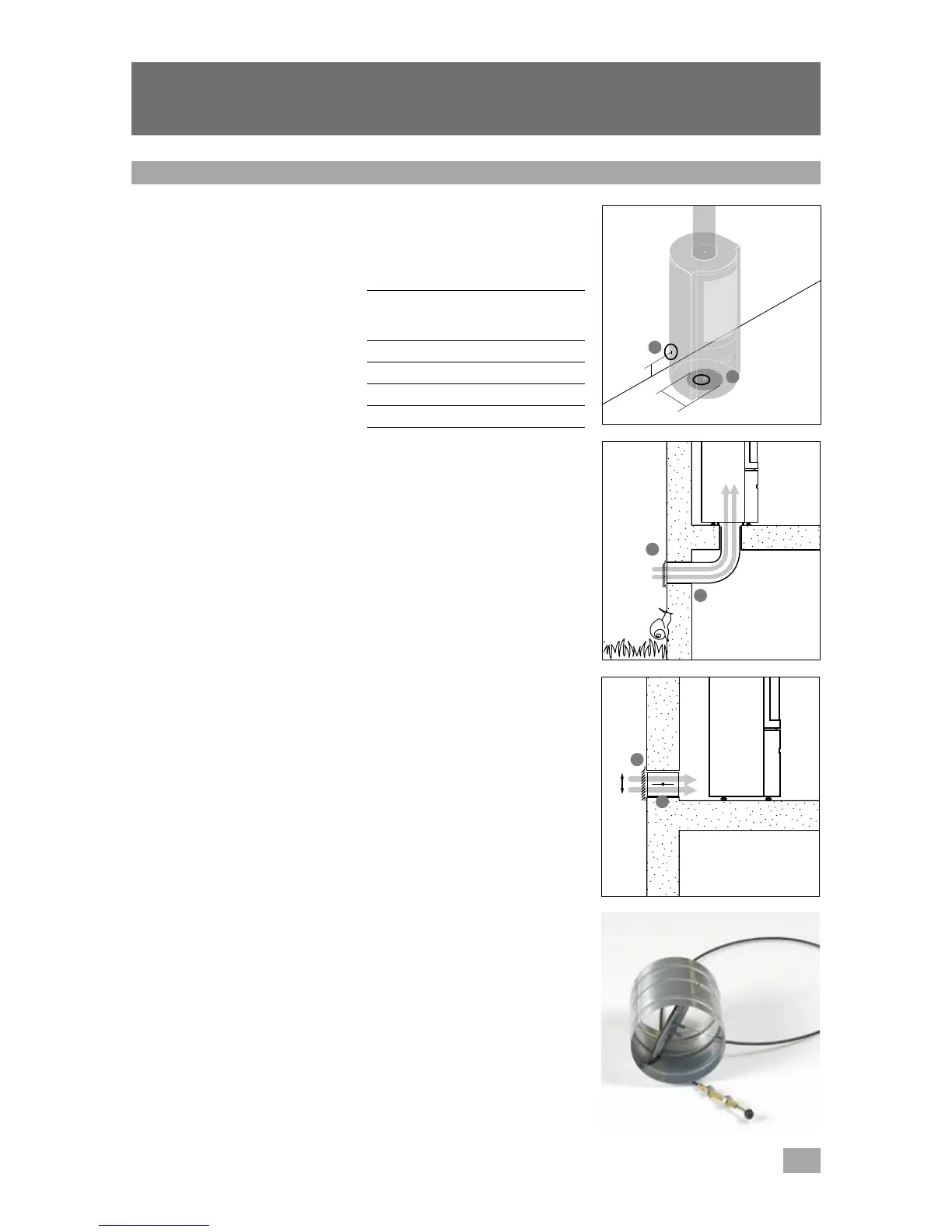
The connection can be made below
the stove [diagrams 1/a et 2] or at the
back [diagram 1/b].
If the stove is not connected
directly to an outside air inlet...
A sufficient air inlet (Ø 120mm)
should ideally be created close to the
stove [diagram 3].
This air inlet comes from a ventilated
empty space, a ventilated room
(cellar) or from outside (mandatory
regulation in some countries)
[diagram2].
The flue that brings in outside
air… (whether it is connected to
the stove or not)
...will be protected on the outside
by a grill [diagram2/a-3/a] the free
passage section of which is at least
equivalent to the section of the air
inlet. Please note that the infiltration
of water and the effect of the wind
can damage the system.
...will ideally be fitted with a closure
valve (for example, the Stûv valve –
see below) [photo4] to prevent the
room from becoming cold when the
stove is not in use.
...will be as short as possible to
prevent pressure loss and to prevent
making the house cold.
If you use our standard flexible
Ø 63mm flue, we recommend a
maximum length of 2m and no more
than 4 elbows (see table below).
Combustion air inlet
Length of flue
max. permitted
number of
elbows
1m 4 elbows
2m 4 elbows
3m 2 elbows
4m 0 elbow
The external valve
[diagram 2/b and photo3] prevents
the house from becoming cold when
the stove is not in use.
This system is optional if you choose
a connection directly to the stove
[diagram 1]. However, it is still a good
idea if the ducts are too long to reach
the stove or if it is being installed in an
energy-efficient house.
It should ideally be located as close as
possible to the outside wall. It can be
controlled from inside if it is not too
far away from the stove (length of the
flexible of the valve control =1.2m).
If it is not possible to bring in
outside air near the stove
(most unfavourable case)...
...ensure there is sufficient
replenishment of air in the room when
the stove is in use.
Please note
Be careful with air extraction systems
(kitchen hoods, air conditioning,
mechanically-controlled ventilation,
other stoves) in operation in the same
space or in an adjacent room. They
also use lots of air and can cause a
depression in the room and prevent
the stove from operating correctly
(risk of draughtback). They can affect
the operation of the stove even if it is
connected to an outside air inlet.


 To Next Page