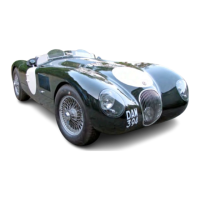
Suffolk C-type
Origins
In 1951,Jaguar Cars Limited entered three cars for the Le Mans 24 Hour Race. This was their first attempt at the greatest endurance event in motorsport.
Aerodynamic expert Malcolm Sayer and chassis expert Bob Knight had designed the XK C-type in secret, powered by the all-new Jaguar 3.4 litre XK 120 engine
designed by Walter Hassan and Claude Bailey, the unit produced 200bhp.
In night practice for the historic race, driver Peter Walker shattered the existing lap record with an average speed of 104mph. In the race he and Peter Whitehead
triumphed with first place for Jaguar in a race that became the forerunner for two more Le Mans victories in 1953 and 1954.
In 1960, Roger Williams commenced a management-training course in Ipswich with Jaguar distributer Botwoods Limited. Days at the Jaguar factory in Browns
lane and collecting Jaguar E-types from the works were all parts of life and memorable highlights of five years with the Jaguar dealership.
In 1995, Roger Williams created Suffolk Sportscars Engineering to manufacture modern reproductions of the 1936 Jaguar SS100. To date over 180 cars have
been built for discerning Jaguar enthusiasts all over the world. The idea of recreating the C-type has been a dream ever since Peter Walker crossed the line in “774
RW”. Suffolk Sportscars has built several C-types already including a car for demonstrations and test drives and will be building a limited number of cars each
year.
On The Road
The Suffolk C-type is as visually close as one can practically achieve to the original cars that won Le Mans in 1951 and 1953. The original Jaguar C-type XKC
039 was used to form all our body moulds and is therefore dimensionally perfect.
At the Jaguar speed trial in 2006, our demonstrator 662 EBY, a 3.4 litre car achieved 138mph, and was still accelerating as it passed the timing beam. The
handling is taut and true to the C-type tradition. The suspension and brakes are all modern versions of the components used by Jaguar in 1953.
This car will give the owner a driving experience equal to that felt by Tony Rolt and Duncan Hamilton when they won Le Mans in 1953.
Personal Thoughts
History tells us everything, books like Philip Porter’s 1995 ‘Jaguar Sports Racing Cars’ inspire many readings to absorb the wonderful atmosphere. A few lucky
guys like myself have the team and the tools to recreate the amazing Jaguar C-type. Can any other reproduction of a Le Mans winning car inspire so much and yet
come at a price that is such a small fraction of the original’s value.
Our car is created to be exact in its dimensions and rewarding in its dynamic performance. The prototypes have been raced, toured and used on track days so are
well tested and give performance and handling every bit as good as the original. We have marginally improved the driver’s comfort but this is a no nonsense, no
heater, no hood and no prisoners’ car.
In The Cockpit
The view and the layout are exactly as the original 1953 C-types. Every effort has been made to ensure the Suffolk C-type looks and feels correct. Leather seats
and Hardura coverings to the transmission tunnel contrast with the bare alloy and black instruments and steering wheel. Storage space for light luggage items and
tools is included. All cars have improved legroom, driver comfort in the cockpit, servo brakes, safety steering column and fitted seatbelts.
Construction and Purchase
We are pleased to fully build the Suffolk C-type to customer’s requirements. New factory built cars can be supplied with an SVA certificate and a UK MoT
certificate. Age related number plates are available and cherished numbers can be transferred.
The Suffolk C-type can be purchased in component form or as a part built rolling chassis for customer completion. Suffolk Sportscars can supply every
component necessary for a self-build program and maintains a full after sales and works support program.
We welcome visits to our workshop to see our demonstrator and other cars currently being built. Additional information about Suffolk Sportscars’ builds can be
found on our website.
Bodywork and Interior
The body is made of reinforced GRP incorporating alloy panels wherever possible to keep them looking as original as possible. Louvres to the bonnet are in alloy,
Leather seats, Hardura over transmission covers, Lexan main screen and Mohair tonneau cover.
Typical Specification
Chassis Mig welded 16swg steel tubes with square and folded sections-all visually exact to the 1953 Jaguar design
Front suspension Jaguar E-type torsion bar and shock absorbers with Anti-roll bar
Rear suspension Jaguar MkII live axle with trailing links and A bracket reaction plate (or link with Panhard rod)
Steering Rack and pinion
Brakes Lockheed 11inch discs (servo optional)
Wheels 16inch 5J 72 spoke wires
Tyres Blockley 6.00 x 16 High Performance
Engine Jaguar XK
Displacement 3.4, 3.8 or 4.2
Bore and stroke To suit engine
Compression ratio Various (8.4:1 typical)
Power From 200bhp
Exhaust As per 1953 Jaguar works car
Transmission Jaguar or Tremec
Gear ratios Various 4 and 5 speed options
Final drive Live axle 3.54 or 3.31. LSD optional
Dimensions Exactly as 1953 Jaguar XK120 C-type
Length 13′ 1 ½″
Width body 5′ 0″
Width with spinners 5′ 3″
Height 3′ 6 ½″
Ground clearance 5″
Frontal area 13.81sq.ft
Wheelbase 8′ 0 ½″
Front track 4′3″
Rear track 4′3″


 To Next Page