EasyManua.ls Logo

Teac A-5500 - Page 42

Teac A-5500
109 pages
Print Icon
To Next Page IconTo Next Page
To Previous Page IconTo Previous Page
Loading...
io
MONOPHONIC
RECORDING
1.
2:
3.
ERASE
EFFICIENCY
CHECK
PWNH
uw
6.
ta
LEVEL
DEVIATION
(
RECORD-PLAYBACK
}
1
De
2
ee
|
i
if
i
1
or
=eman
20
40
100
200
$00
1K
2K
SK
10K
15K
20K
30K SOK
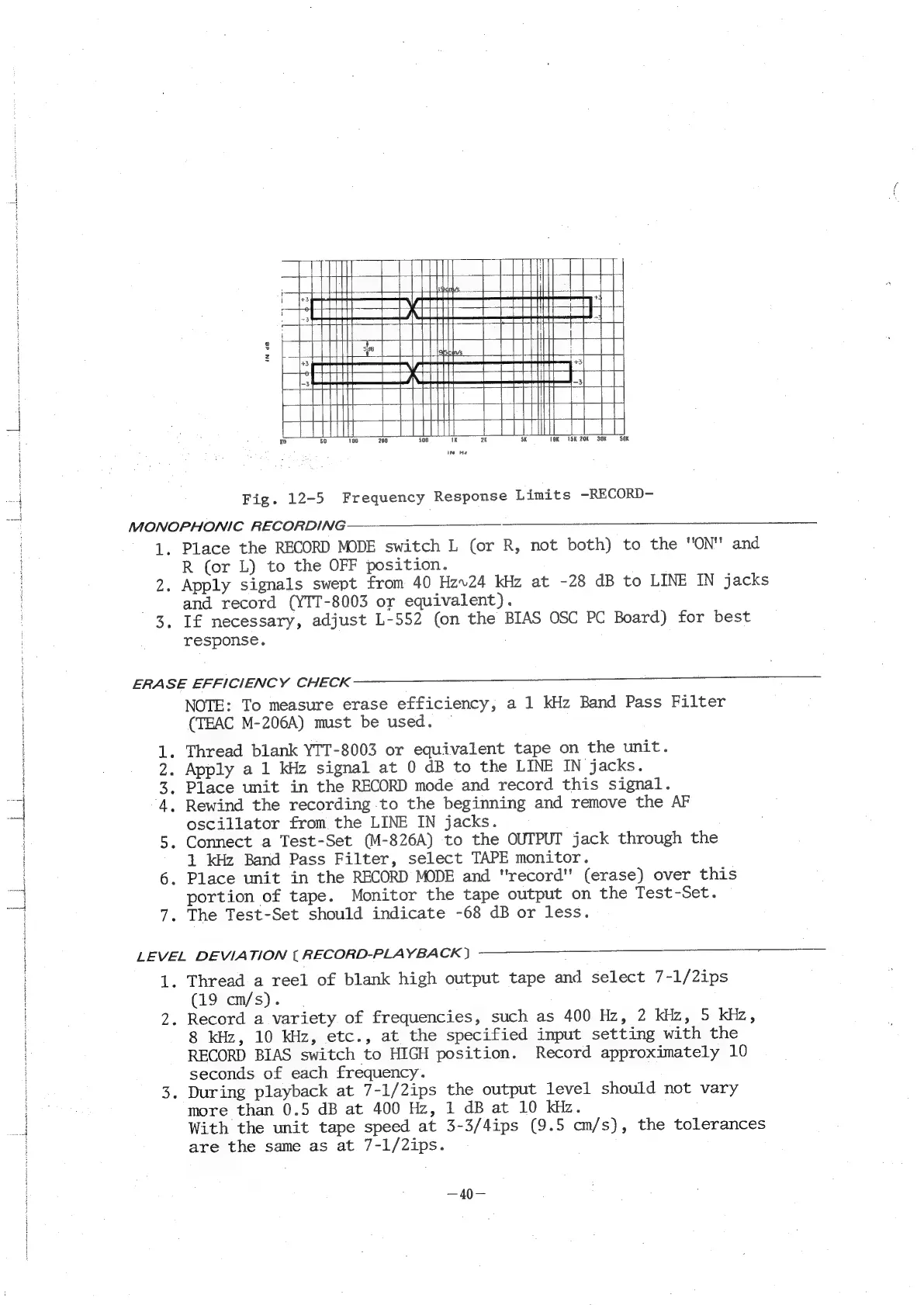
Fig.
12-5
Frequency
Response
Limits
-RECORD-
Place
the
RECORD
MODE
switch
L
(or
R,
not
both)
to
the
"ON"
and
R
(or
L)
to
the
OFF
position.
Apply
signals
swept
from
40
Hzv24
kHz
at
-28
dB
to
LINE
IN
jacks
and
record
(YTT-8003
or
equivalent).
If
necessary,
adjust
L-552
(on
the
BIAS
OSC
PC
Board)
for
best
response.
NOTE:
To
measure
erase
efficiency,
a
1
kHz
Band
Pass
Filter
(TEAC
M-206A)
must
be
used.
Thread
blank
YTT-8003
or
equivalent
tape
on
the
unit.
Apply
a
1
kHz
signal
at
0
dB
to
the
LINE
IN
jacks.
Place
unit
in
the
RECORD
mode
and
record
this
signal.
Rewind
the
recording
to
the
beginning
and
remove
the
AF
oscillator
from
the
LINE
IN
jacks.
.
Connect
a
Test-Set
(M-826A)
to
the
OUTPUT
jack
through
the
1
kHz
Band
Pass
Filter,
select
TAPE
monitor.
Place
unit
in
the
RECORD
MODE
and
"record"
(erase)
over
this
portion
of
tape.
Monitor
the
tape
output
on
the
Test-Set.
The
Test-Set
should
indicate
-68
dB
or
less.
Thread
a
reel
of
blank
high
output
tape
and
select
7-1/2ips
(19
cm/s).
Record
a
variety
of
frequencies,
such
as
400
Hz,
2
kiz,
5
kKiz,
8
kHz,
10
KHz,
etc.,
at
the
specified
input
setting
with
the
RECORD
BIAS
switch
to
HIGH
position.
Record
approximately
10
seconds
of
each
frequency.
.
During
playback
at
7-1/2ips
the
output
level
should
not
vary
more
than
0.5
dB
at
400
Hz,
1
dB
at
10
Ki.
With
the
unit
tape
speed
at
3-3/4ips
(9.5
cm/s),
the
tolerances
are
the
same
as
at
7-1/2ips.

Related product manuals