VOT1; Rev 1.5; EN; 5.11.2015
TKT66 – Installation and maintenance
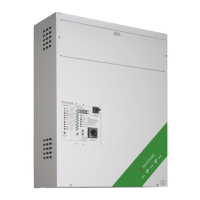
Central battery unit
type
Total load capacity in battery use with 1-
hour and 3-hour operating time
(8x350W/ 4x700W/2x1400W)
or 1,6A circuit, Max. 2580VA
(8x350W/ 4x700W/2x1400W)
or 1,6A circuit, Max.2800VA
(8x350W/ 4x700W/2x1400W)
or 1,6A circuit, Max.2580VA
(8x350W/ 4x700W/2x1400W)
or 1,6A circuit, Max.5600VA
(8x350W/ 4x700W/2x1400W)
or 1,6A circuit, Max.2580VA
(8x350W/ 4x700W/2x1400W)
or 1,6A circuit, Max.8400VA
1 h 6000 W 18x65 Ah
3 h 3340 W 18x65 Ah
The central battery unit is equipped with a mains fuse F1 in the connecting terminal and with battery
circuit fuses F2 and F3. The output circuits’ fuses are on the top end of casing at connectors 1-2.
For more information, see chapter 5.2.1 Parts layout
The charging system of the central battery unit is equipped with a temperature compensation of the
battery charging voltage, which is approximately 0.06 V/°C (5 mV/°C/cell).
NOTE: The luminaires used with the central battery unit must be suitable for both AC and DC supply.
3.8 Directives and standards
The following directives and standards were applied in designing and manufacturing the central battery unit:
Quality: ISO 9001: 2008; (certified quality system)
Environment: ISO 14001: 2004; (certified environment system)
Electrical safety: 2006/95/EY LVD directive
Device standard: EN 50171: 2001; Central power supply systems
EN 50272-2: 2001; Safety requirements for secondary
battery installations Part 2:
Stationary batteries
EN 60439-1 + A1: 2005; Distribution units. Part 1:
Requirements for type tested and
partly type tested units.
IEC 62034: 2006; Automatic test systems for battery
powered emergency escape lighting


 To Next Page