INSTALLATION PROCEDURES 3-8 Manual 0-2844
5. Make sure work cable and ground cables are properly
connected. The work cable must have a solid connec-
tion to the cutting table. The work and ground connec-
tions must be free from rust, dirt, grease, oil and paint.
If necessary grind or sand down to bare metal. Use
lock washers to keep the connections tight. Using elec-
trical joint compound to prevent corrosion is also rec-
ommended.
6. The plasma power supply chassis is connected to the
power distribution system ground as required by elec-
trical codes. If the plasma supply is close to the cutting
table (see NOTE) a second ground rod is not usually
needed, in fact it could be detrimental as it can set up
ground loop currents that cause interference.
When the plasma power supply is far away from the
ground rod and interference is experienced, it may help
to install a second earth ground rod next to the plasma
power supply. The plasma power supply chassis
would then be connected to this ground rod.
NOTE
It is recommended that the Plasma Power Supply be
within 20 - 30 ft (6.1 – 9.1 m) of the cutting table, if
possible.
7. The plasma control cable should be shielded with the
shield connected only at the cutting machine end. Con-
necting the shield at both ends will allow ground loop
currents which may cause more interference than with
no shield at all.
C. Creating An Earth Ground
1. To create a solid, low resistance, earth ground, drive a
1/2 in (12 mm) or greater diameter copper clad ground
rod at least 6 - 8 ft (1.8 - 2.4 m) into the earth so that the
rod contacts moist soil over most of its length. Depend-
ing on location, a greater depth may be required to
obtain a low resistance ground (see NOTE). Ground
rods, typically 10 ft (3.0 m) long, may be welded end to
end for greater lengths. Locate the rod as close as pos-
sible to the work table. Install a ground wire, 1/0
AWG (European 50 mm
2
) or greater, between the
ground rod and the star ground point on the cutting
table.
NOTE
Ideally, a properly installed ground rod will have a
resistance of three ohms or less.
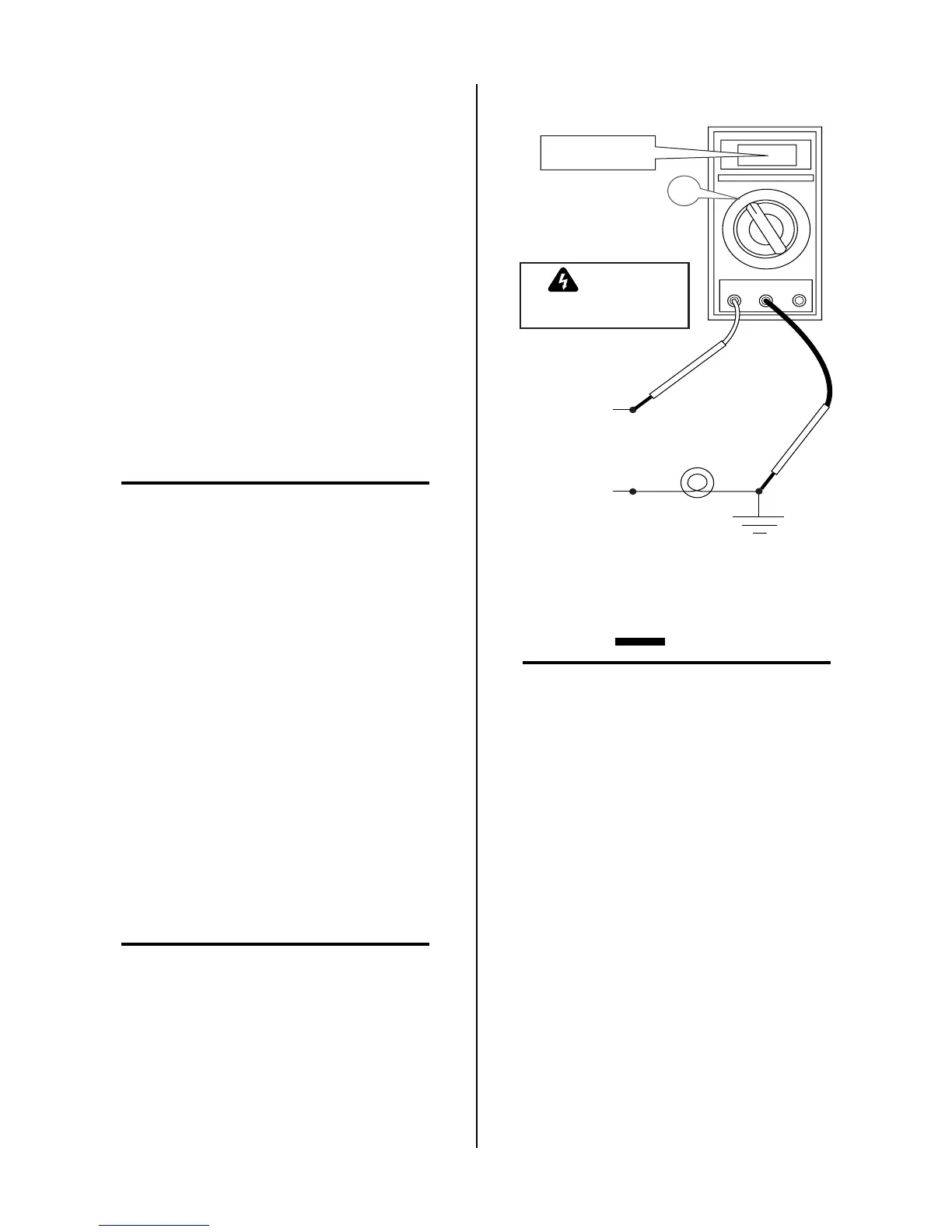
To test for a proper earth ground, refer to the following
diagram. Ideally, the reading on the multimeter should
be as follows:
• For 115VAC: 3.0 VAC
• For 230VAC: 1.5 VAC
Art # A-02971
+
_
Meter set to
VAC setting
Neutral
Line (Hot)
100W
Light Bulb
115 or 230VAC
WARNING
Use extreme caution. This
test uses live voltage.
115VAC: 3.0 VAC
230VAC: 1.5 VAC
V
~
V
~
VR COM A
Ground
Rod
Ground Testing
CAUTION
No other connections should be made at the ground
rod being tested. This test assumes that the 115 or
230-VAC source neutral is connected to the utility
earth ground.
2. Increasing the ground rod length beyond 20 - 30 ft (6,1 –
9,1 m) does not generally increase the effectiveness of
the ground rod. A larger diameter rod which has more
surface area may help. Sometimes keeping the soil
around the ground rod moist by continuously running
a small amount of water into it will work. Adding salt
to the soil by soaking it in salt water may also reduce
its resistance. When these methods are used, periodic
checking of the ground resistance is required to make
sure the ground is still good.
D. Routing Of Torch Leads
1. To minimize RF interference, position torch leads as
far as possible from any CNC components, drive mo-
tors, control cables, or primary power lines. If cables
have to pass over torch leads, do so at an angle. Do
not run the plasma control or other control cables in
parallel with the torch leads in power tracts.
2. Keep torch leads clean. Dirt and metal particles bleed
off energy, which causes difficult starting and in-
creased chance of RF interference.



 To Next Page