EasyManua.ls Logo

Thermal Dynamics ULTRA-CUT 400 XT - User Manual

Thermal Dynamics ULTRA-CUT 400 XT
214 pages
Print Icon
To Next Page IconTo Next Page
Loading...
Thermal-Dynamics.com
®
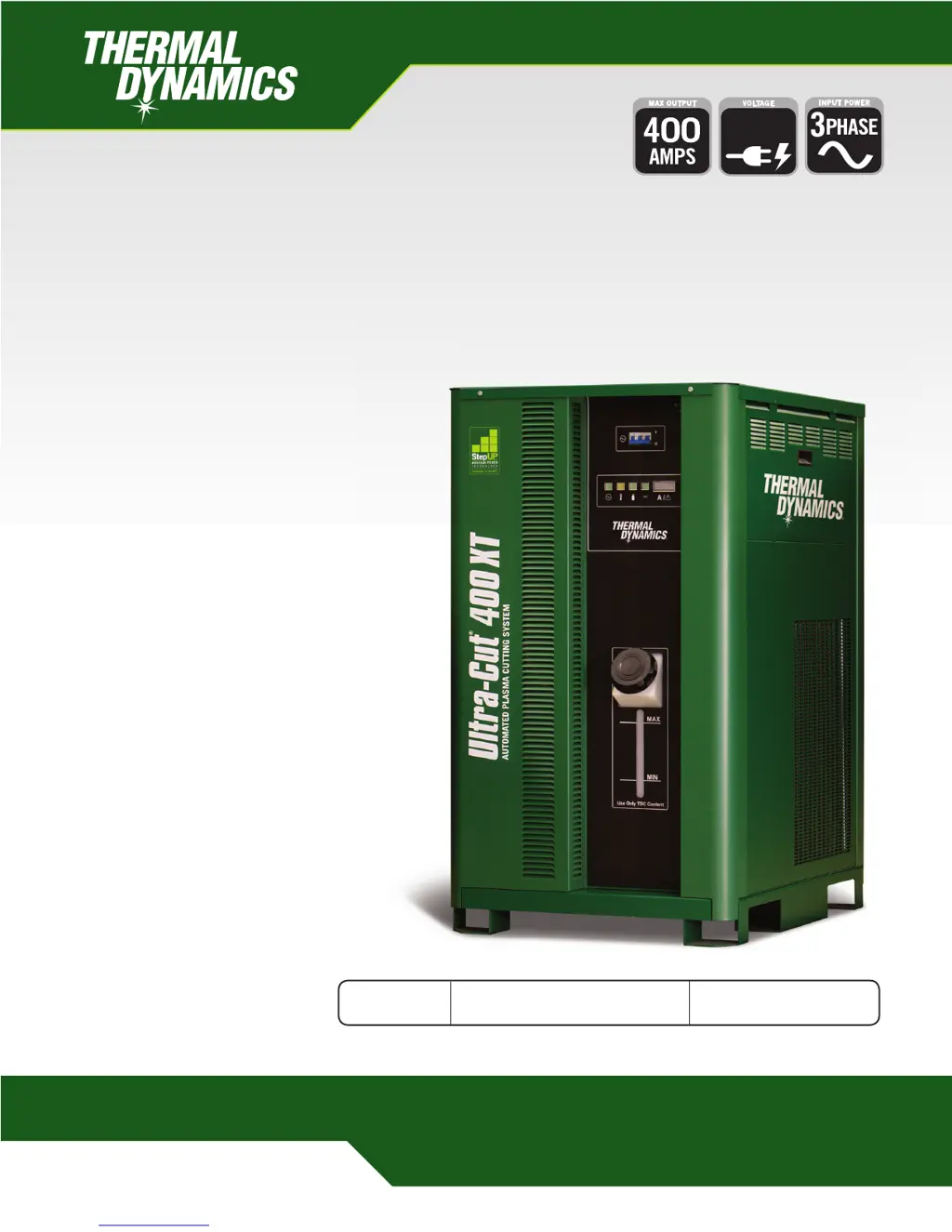
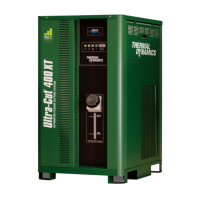
ULTRA-CUT 400 XT
PLASMA CUTTING SYSTEM
Operating
Manual
Revision: AH Issue Date: May 27, 2015 Manual No.: 0-5275
8
480V

Table of Contents

Questions and Answers

Summary

Section 1: Safety

1.01 Safety Precautions - ENGLISH

Summarizes essential safety information and warnings for operation.

Section 2: Specifications

2.01 General Description Of The System

Outlines the main components included in a typical system configuration.

2.02 Plasma Power Supply

Details the function of the power supply in providing current and managing coolant.

2.03 Remote Arc Starter

Explains the purpose and function of the remote arc starter in initiating the pilot arc.

2.04 Gas Control Module

Describes the module's role in controlling gas selection, pressure, and flow.

2.05 Precision Plasma Cutting Torch

Explains how the torch delivers controlled current for cutting metal.

2.06 Specifications & Electrical Requirements

Lists technical specifications, design features, and electrical input requirements.

2.07 Power Supply Dimensions

Provides physical dimensions and weight of the plasma power supply unit.

2.08 Power Supply Rear Panel Features

Identifies and locates various connectors and features on the rear panel.

2.09 Gas Requirements

Details the required gases, their quality, pressures, and flow rates.

2.10 Gas Applications

Specifies gas types for different materials and operations (preflow, plasma, shield).

2.11 XT Torch Specifications

Provides dimensions and technical data for the XT plasma torch.

Section 3: Installation

3.01 Installation Requirements

Outlines prerequisites for electric supply, gas, and cooling system setup.

3.02 System Layout

Illustrates the interconnection of system components for optimal setup.

3.03 Recommended Gas Supply Hose

Specifies the recommended type and catalog number for gas supply hoses.

3.04 Leads and Cables All Amperage

Details various leads and cables, their types, and connections.

3.05 Lift the Power Supply

Provides instructions and warnings for safely lifting and moving the power supply unit.

3.06 Connect Input Power and Ground Cables

Guides on connecting the primary input power and system ground cables.

3.07 Connect Work Cable and Pilot and Negative Leads

Explains how to connect the work cable, pilot, and negative/torch leads.

3.08 Ground Connections

Details critical grounding procedures to minimize EMI and ensure safety.

3.09 Connect Coolant Leads

Instructs on connecting the color-coded coolant supply and return lines.

3.10 Connect Cables for CNC, Remote Arc Starter, GCM and HE 400

Guides on connecting various control and interface cables to the power supply.

3.11 Handling and Installation of Fiber Optics

Provides instructions and precautions for safely handling and installing fiber optic cables.

3.12 Set Switches on the Command - Control Module

Details the procedure for setting DIP switches on the Command-Control Module.

3.13 Height Control Connections

Explains connections for height control systems to the terminal strip.

3.14 Gas Control Module Installation

Guides on selecting a suitable location and mounting the Gas Control Module.

3.15 Fiber Optic Cable Installation

Details the steps for routing and connecting the fiber optic cable into the module.

3.16 Gas Control Module: Control, Input, and Output Connections

Covers connecting gas/water inputs and control cables to the GCM rear panel.

3.17 HE400 XT COOLER

Explains the purpose and placement of the HE400XT additional cooling unit.

3.18 Install Remote Arc Starter

Provides site selection criteria and mounting dimensions for the Remote Arc Starter.

3.19 Torch Valve Installation

Guides on mounting and connecting the torch valve assembly near the torch head.

3.20 Connecting Torch

Details the procedure for assembling and connecting the torch head to the leads.

3.21 Install Consumable Torch Parts

Explains how to install consumable parts for proper torch operation.

3.22 Voltage Divider for iHC Torch Height Control

Guides on installing the Voltage Divider Board for iHC Torch Height Control.

3.23 Complete the Installation

Covers filling the coolant tank and checking system operation after installation.

Section 4: Operation

4.01 Power Supply Control Panel

Identifies and explains the functions of indicators on the power supply control panel.

4.02 System Operation

Describes the step-by-step process for operating the plasma cutting system.

4.03 Gas Selection

Details choices for plasma and shield gases based on material and cut quality.

4.04 GCM 2010 Gas Control Module Operation

Explains the functional overview and controls of the GCM 2010 Gas Control Module.

4.05 GCM 2010 First Time Operation Matching Gas Control to Lead Length

Guides initial setup for matching gas control to lead length for GCM2010.

4.06 GCM 2010 Sequence Of Operation

Provides a sequence for operating the GCM 2010, including gas settings and start-up.

4.07 Power Supply Status Codes

Lists and explains diagnostic status codes for the power supply and CCM.

4.08 Remote Arc Starter Trouble Shooting

Provides troubleshooting steps for common issues with the Remote Arc Starter.

Cut Quality

Discusses factors affecting cut quality like bevel angle, dross, and nitride buildup.

Direction of Cut

Explains how torch movement direction affects cut edge squareness and swirl effect.

Section 5: Maintenance

5.01 General Maintenance

Outlines a schedule of periodic checks for power supply performance.

5.02 External Coolant Filter Cleaning Procedure

Details the steps for cleaning or replacing the external coolant filter canister.

5.03 Coolant Replacement Procedure

Provides instructions for safely draining and replacing coolant in the system.

Section 6: Replacement Assemblies & Parts

6.01 Replacement Power Supply

Lists catalog numbers for complete power supply units and interface options.

6.02 System Layout

Illustrates the interconnection of system components and their part numbers.

6.03 Recommended Gas Supply Hose

Specifies the recommended gas supply hose and its catalog number.

6.04 Leads And Cables All Amperages

Provides a detailed key and catalog numbers for various leads and cables.

6.05 Power Supply External Replacement Parts

Identifies external replacement parts for the power supply unit with catalog numbers.

6.06 Power Supply Replacement Parts - Upper Right Side

Lists replacement parts located on the upper right side of the power supply.

6.07 Power Supply Replacement Parts - Lower Right Side

Lists replacement parts located on the lower right side of the power supply.

6.08 Power Supply Replacement Parts - Rear Panel

Lists replacement parts and components found on the rear panel of the power supply.

6.09 Power Supply Replacement Parts - Left Side

Lists replacement parts located on the left side of the power supply unit.

6.10 Gas Control Module (GCM-2010) Replacement Parts

Lists replacement parts for the GCM-2010 Gas Control Module and associated components.

6.12 Remote Arc Starter (RAS-1000 XT) Replacement Parts

Lists replacement parts for the RAS-1000 XT Remote Arc Starter.

6.13 HE400 XT Heat Exchanger - Replacement Parts

Lists replacement parts for the HE400XT Heat Exchanger unit.

6.14 XTL Torch Valve Assembly External Replacement Parts

Lists external replacement parts for the XTL Torch Valve Assembly.

6.15 XTL Torch Valve Assembly Internal Replacement Parts

Lists internal replacement parts for the XTL Torch Valve Assembly.

Section 7: Torch Maintenance

7.01 Consumable Removal

Details the procedure for removing consumables from the torch cartridge assembly.

7.02 O-Ring Lubrication

Explains the importance and method of lubricating O-rings on torch components.

7.03 Parts Wear

Describes how to identify worn torch parts like the gas distributor, tip, and electrode.

7.04 Torch Consumables Installation

Guides on the correct sequence for installing torch consumable parts.

7.05 Coolant Leak Trouble-Shooting

Provides a flowchart for diagnosing and resolving coolant leaks from the torch head.

Appendix 1: Remote Arc Starter Schematic

Appendix 2: Gas Control and Torch Valve Schematic

Appendix 3: Gas Control Module Plumbing Diagram

Appendix 4: Gas Control Module PCB Layout

Appendix 5: Gas Control Display Module PCB Layout

Appendix 6: CNC - Control Module PCB Connections

Appendix 7: CNC

CNC functions

Explains the functions of CNC I/O circuits and galvanic isolation.

CNC Input; Output Descriptions

Describes various CNC input/output signals and their configurations.

Simplified CNC Circuit

Presents a simplified schematic illustrating CNC circuit interconnections.

CNC Connections

Details the wiring connections between the CNC cable and the power supply.

CNC Cable Color Code

Provides a table mapping wire colors to specific CNC signals and functions.

Appendix 8: CCM CPU PCB Layout

Appendix 9: CCM I;O PCB Layout

Appendix 10: Pilot PCB Layout

Appendix 11: Relay and Interface PCB Layout

Appendix 12: Display PCB Layout

Appendix 13: System Bias PCB Layout

Appendix 14: Main Inverter Bottom PCB Layout

Appendix 15: Main Inverter Top PCB Layout

Appendix 16: Control and Fault PCB Layout

Appendix 17: Cap Bias Bottom PCB Layout

Appendix 18: Cap Bias Top PCB Layout

Appendix 19: Suppressor PCB Layout

Appendix 20: Cooling Diagram

Appendix 21: System Schematic 400 A, 480 V PG 1

Appendix 22: System Schematic 400 A, 480 V PG 2

Appendix 23: Advanced Troubleshooting

Appendix 24: SL100 Interconnection

Appendix 25: HE 400 XT Connection

Appendix 26: SL100 Torch Option

Torch Parts Selection

Discusses parts selection and features for the SL100 torch.

Drag cutting with 1 Torch

Provides guidance on drag cutting techniques for optimal consumable life.

Parts - In - Place (PIP)

Explains the PIP circuit and its function for torch operation.

Preflow

Describes the preflow function of the torch after trigger activation.

Postflow

Explains the postflow function after the torch trigger is released.

Pilot Arc

Describes pilot arc behavior when the torch leaves the workpiece.

Foldback Feature

Explains the automatic current drop feature to protect the tip.

Appendix 27: Publication History

Summary

Section 1: Safety

1.01 Safety Precautions - ENGLISH

Summarizes essential safety information and warnings for operation.

Section 2: Specifications

2.01 General Description Of The System

Outlines the main components included in a typical system configuration.

2.02 Plasma Power Supply

Details the function of the power supply in providing current and managing coolant.

2.03 Remote Arc Starter

Explains the purpose and function of the remote arc starter in initiating the pilot arc.

2.04 Gas Control Module

Describes the module's role in controlling gas selection, pressure, and flow.

2.05 Precision Plasma Cutting Torch

Explains how the torch delivers controlled current for cutting metal.

2.06 Specifications & Electrical Requirements

Lists technical specifications, design features, and electrical input requirements.

2.07 Power Supply Dimensions

Provides physical dimensions and weight of the plasma power supply unit.

2.08 Power Supply Rear Panel Features

Identifies and locates various connectors and features on the rear panel.

2.09 Gas Requirements

Details the required gases, their quality, pressures, and flow rates.

2.10 Gas Applications

Specifies gas types for different materials and operations (preflow, plasma, shield).

2.11 XT Torch Specifications

Provides dimensions and technical data for the XT plasma torch.

Section 3: Installation

3.01 Installation Requirements

Outlines prerequisites for electric supply, gas, and cooling system setup.

3.02 System Layout

Illustrates the interconnection of system components for optimal setup.

3.03 Recommended Gas Supply Hose

Specifies the recommended type and catalog number for gas supply hoses.

3.04 Leads and Cables All Amperage

Details various leads and cables, their types, and connections.

3.05 Lift the Power Supply

Provides instructions and warnings for safely lifting and moving the power supply unit.

3.06 Connect Input Power and Ground Cables

Guides on connecting the primary input power and system ground cables.

3.07 Connect Work Cable and Pilot and Negative Leads

Explains how to connect the work cable, pilot, and negative/torch leads.

3.08 Ground Connections

Details critical grounding procedures to minimize EMI and ensure safety.

3.09 Connect Coolant Leads

Instructs on connecting the color-coded coolant supply and return lines.

3.10 Connect Cables for CNC, Remote Arc Starter, GCM and HE 400

Guides on connecting various control and interface cables to the power supply.

3.11 Handling and Installation of Fiber Optics

Provides instructions and precautions for safely handling and installing fiber optic cables.

3.12 Set Switches on the Command - Control Module

Details the procedure for setting DIP switches on the Command-Control Module.

3.13 Height Control Connections

Explains connections for height control systems to the terminal strip.

3.14 Gas Control Module Installation

Guides on selecting a suitable location and mounting the Gas Control Module.

3.15 Fiber Optic Cable Installation

Details the steps for routing and connecting the fiber optic cable into the module.

3.16 Gas Control Module: Control, Input, and Output Connections

Covers connecting gas/water inputs and control cables to the GCM rear panel.

3.17 HE400 XT COOLER

Explains the purpose and placement of the HE400XT additional cooling unit.

3.18 Install Remote Arc Starter

Provides site selection criteria and mounting dimensions for the Remote Arc Starter.

3.19 Torch Valve Installation

Guides on mounting and connecting the torch valve assembly near the torch head.

3.20 Connecting Torch

Details the procedure for assembling and connecting the torch head to the leads.

3.21 Install Consumable Torch Parts

Explains how to install consumable parts for proper torch operation.

3.22 Voltage Divider for iHC Torch Height Control

Guides on installing the Voltage Divider Board for iHC Torch Height Control.

3.23 Complete the Installation

Covers filling the coolant tank and checking system operation after installation.

Section 4: Operation

4.01 Power Supply Control Panel

Identifies and explains the functions of indicators on the power supply control panel.

4.02 System Operation

Describes the step-by-step process for operating the plasma cutting system.

4.03 Gas Selection

Details choices for plasma and shield gases based on material and cut quality.

4.04 GCM 2010 Gas Control Module Operation

Explains the functional overview and controls of the GCM 2010 Gas Control Module.

4.05 GCM 2010 First Time Operation Matching Gas Control to Lead Length

Guides initial setup for matching gas control to lead length for GCM2010.

4.06 GCM 2010 Sequence Of Operation

Provides a sequence for operating the GCM 2010, including gas settings and start-up.

4.07 Power Supply Status Codes

Lists and explains diagnostic status codes for the power supply and CCM.

4.08 Remote Arc Starter Trouble Shooting

Provides troubleshooting steps for common issues with the Remote Arc Starter.

Cut Quality

Discusses factors affecting cut quality like bevel angle, dross, and nitride buildup.

Direction of Cut

Explains how torch movement direction affects cut edge squareness and swirl effect.

Section 5: Maintenance

5.01 General Maintenance

Outlines a schedule of periodic checks for power supply performance.

5.02 External Coolant Filter Cleaning Procedure

Details the steps for cleaning or replacing the external coolant filter canister.

5.03 Coolant Replacement Procedure

Provides instructions for safely draining and replacing coolant in the system.

Section 6: Replacement Assemblies & Parts

6.01 Replacement Power Supply

Lists catalog numbers for complete power supply units and interface options.

6.02 System Layout

Illustrates the interconnection of system components and their part numbers.

6.03 Recommended Gas Supply Hose

Specifies the recommended gas supply hose and its catalog number.

6.04 Leads And Cables All Amperages

Provides a detailed key and catalog numbers for various leads and cables.

6.05 Power Supply External Replacement Parts

Identifies external replacement parts for the power supply unit with catalog numbers.

6.06 Power Supply Replacement Parts - Upper Right Side

Lists replacement parts located on the upper right side of the power supply.

6.07 Power Supply Replacement Parts - Lower Right Side

Lists replacement parts located on the lower right side of the power supply.

6.08 Power Supply Replacement Parts - Rear Panel

Lists replacement parts and components found on the rear panel of the power supply.

6.09 Power Supply Replacement Parts - Left Side

Lists replacement parts located on the left side of the power supply unit.

6.10 Gas Control Module (GCM-2010) Replacement Parts

Lists replacement parts for the GCM-2010 Gas Control Module and associated components.

6.12 Remote Arc Starter (RAS-1000 XT) Replacement Parts

Lists replacement parts for the RAS-1000 XT Remote Arc Starter.

6.13 HE400 XT Heat Exchanger - Replacement Parts

Lists replacement parts for the HE400XT Heat Exchanger unit.

6.14 XTL Torch Valve Assembly External Replacement Parts

Lists external replacement parts for the XTL Torch Valve Assembly.

6.15 XTL Torch Valve Assembly Internal Replacement Parts

Lists internal replacement parts for the XTL Torch Valve Assembly.

Section 7: Torch Maintenance

7.01 Consumable Removal

Details the procedure for removing consumables from the torch cartridge assembly.

7.02 O-Ring Lubrication

Explains the importance and method of lubricating O-rings on torch components.

7.03 Parts Wear

Describes how to identify worn torch parts like the gas distributor, tip, and electrode.

7.04 Torch Consumables Installation

Guides on the correct sequence for installing torch consumable parts.

7.05 Coolant Leak Trouble-Shooting

Provides a flowchart for diagnosing and resolving coolant leaks from the torch head.

Appendix 1: Remote Arc Starter Schematic

Appendix 2: Gas Control and Torch Valve Schematic

Appendix 3: Gas Control Module Plumbing Diagram

Appendix 4: Gas Control Module PCB Layout

Appendix 5: Gas Control Display Module PCB Layout

Appendix 6: CNC - Control Module PCB Connections

Appendix 7: CNC

CNC functions

Explains the functions of CNC I/O circuits and galvanic isolation.

CNC Input; Output Descriptions

Describes various CNC input/output signals and their configurations.

Simplified CNC Circuit

Presents a simplified schematic illustrating CNC circuit interconnections.

CNC Connections

Details the wiring connections between the CNC cable and the power supply.

CNC Cable Color Code

Provides a table mapping wire colors to specific CNC signals and functions.

Appendix 8: CCM CPU PCB Layout

Appendix 9: CCM I;O PCB Layout

Appendix 10: Pilot PCB Layout

Appendix 11: Relay and Interface PCB Layout

Appendix 12: Display PCB Layout

Appendix 13: System Bias PCB Layout

Appendix 14: Main Inverter Bottom PCB Layout

Appendix 15: Main Inverter Top PCB Layout

Appendix 16: Control and Fault PCB Layout

Appendix 17: Cap Bias Bottom PCB Layout

Appendix 18: Cap Bias Top PCB Layout

Appendix 19: Suppressor PCB Layout

Appendix 20: Cooling Diagram

Appendix 21: System Schematic 400 A, 480 V PG 1

Appendix 22: System Schematic 400 A, 480 V PG 2

Appendix 23: Advanced Troubleshooting

Appendix 24: SL100 Interconnection

Appendix 25: HE 400 XT Connection

Appendix 26: SL100 Torch Option

Torch Parts Selection

Discusses parts selection and features for the SL100 torch.

Drag cutting with 1 Torch

Provides guidance on drag cutting techniques for optimal consumable life.

Parts - In - Place (PIP)

Explains the PIP circuit and its function for torch operation.

Preflow

Describes the preflow function of the torch after trigger activation.

Postflow

Explains the postflow function after the torch trigger is released.

Pilot Arc

Describes pilot arc behavior when the torch leaves the workpiece.

Foldback Feature

Explains the automatic current drop feature to protect the tip.

Appendix 27: Publication History

Thermal Dynamics ULTRA-CUT 400 XT Specifications

General IconGeneral
Duty Cycle100% @ 400A
Output Current Range20-400 A
Open Circuit Voltage (OCV)300 V
Cutting Capacity (Recommended)1-1/2 in (38 mm)
Cutting Capacity (Maximum)2 in (51 mm)
Max Cutting Thickness5/8 in (16 mm)
Operating Temperature14°F to 104°F (-10°C to 40°C)
Gas TypeOxygen, Nitrogen, Air

Related product manuals