18
To give those Volt motors maximum effect and reduce unwanted behaviors while panning or tilting the rig,
we take balancing one step further; dynamic balance. For each arrangement of camera, monitor position
and post length, there is only ONE combination that balances the sled both statically and dynamically.
Whenthebatteryiswithinabout.25in(6mm)ofideal,thesledwillpanatandfeel“sweet.”Thephysics
behind how connected masses rotate and balance is complicated, but the way we achieve dynamic balance
with a Steadicam is actually quite simple; we use trial and error.
Dynamic balancing requires spinning the rig, but do not spin it too fast!
• Conrmyourstandissecureorhaveanassistantholdtheotherendofthedock.
• Conrmyourstaticbalance;arigoutofstaticbalancecannotbedynamically
balanced. You want the post perfectly vertical, with a 2 second drop time.
• The Axis gimbal cable will prevent the rig from spinning, and could be damaged,
so leave the cable off until after dynamic balancing.
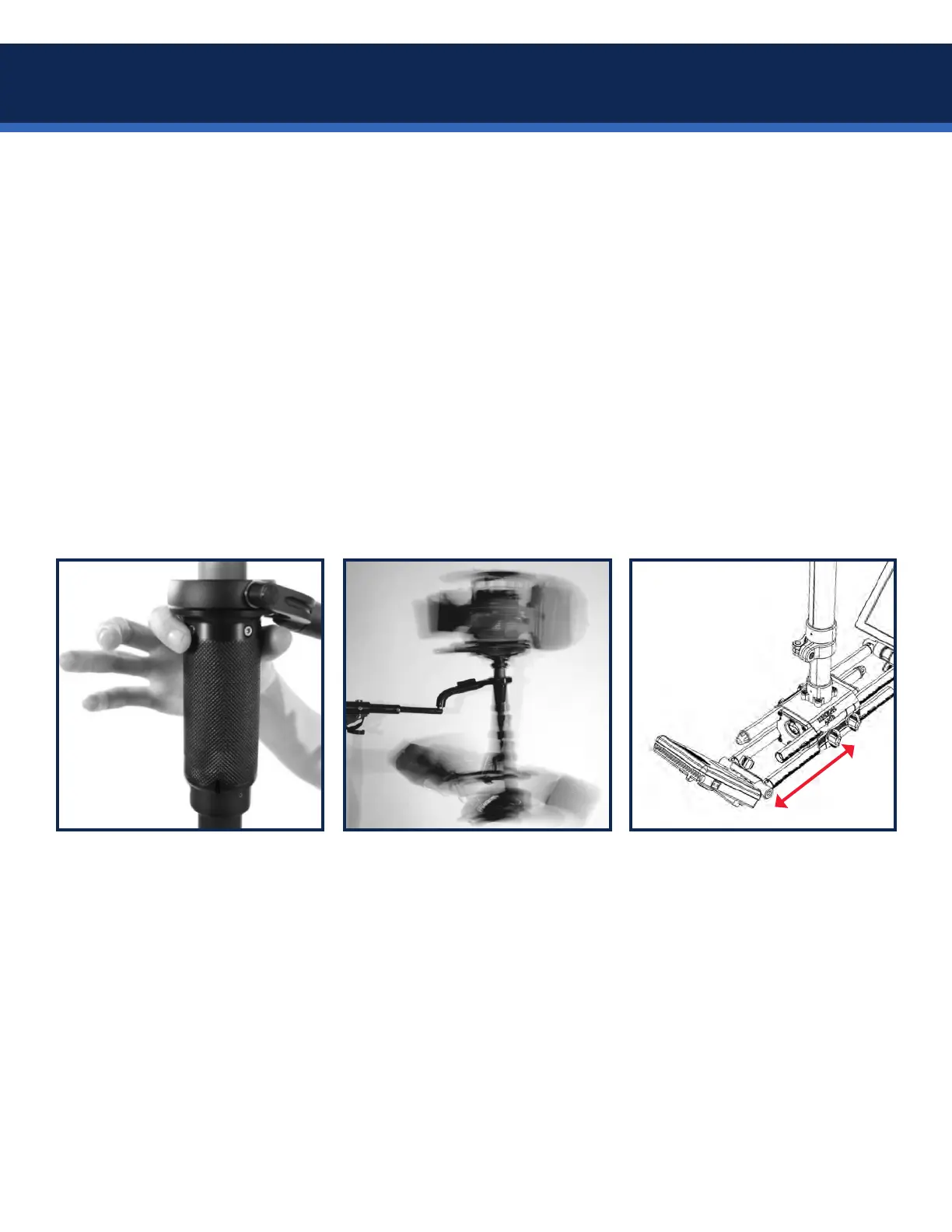
Using a light touch at the top of
the gimbal grip, lightly spin the
rig, trying not to impart any side-
to-side motion.
Let it spin two rotations.
Note the results. Does it pan
atorwobble?Isityourspin
technique or is the sled out of
dynamicbalance?
Most likely it’ll have a slight
wobble, so you’ll need to adjust.
While dynamic balancing, do not
move the monitor. Leave it where
it gives you the best viewability.
Instead, slide the battery a little
bit in either direction (take note
of which direction you choose)
and re-balance statically with the
camera fore-aft adjuster.
There are only two directions to
move the battery: out or in.
So you have a 50% chance of
choosing the right direction!
Each time you lock the battery in a
new position, you then re-balance
the sled statically at the camera.
Balance: dynamic


 To Next Page