EasyManua.ls Logo

TPS WP-80 - User Manual

TPS WP-80
46 pages
Print Icon
To Next Page IconTo Next Page
Loading...
Congratulations !
You have purchased the latest in Handheld pH-mV-Temperature
instrumentation. We trust that your new WP-80 will give you many years
of reliable service.
The WP-80 is a breeze to operate. This manual has been designed to
help you get started, and also contains some handy application tips. If at
any stage you require assistance, please contact either your local TPS
representative or the TPS factory in Brisbane.
The manual is divided into the following sections:
1. Table of Contents
Each major section of the handbook is clearly listed. Sub-sections
have also been included to enable you to find the information you
need at a glance.
2. Introduction
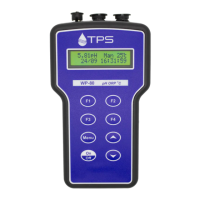
The introduction has a diagram and explanation of the display and
controls of the WP-80. It also contains a full listing of all of the items
that you should have received with your WP-80. Please take the time
to read this section, as it explains some of items that are mentioned
in subsequent sections.
3. Main Section
The main section of the handbook provides complete details of the
WP-80, including operating modes, calibration, troubleshooting,
specifications, and warranty terms.
4. Appendices
Appendices containing background information and application notes
are provided at the back of this manual.
Model WP-80
pH-mV-Temp. Meter
Version : 3.51
Date : 02/07/2003
Author : MS

Questions and Answers

  • N
    nicole40Sep 23, 2025
    Why does my TPS Measuring Instruments say 'Memory Failed Calibration Lost'?
    • T
      Tanya HowellSep 23, 2025
      If your TPS Measuring Instruments displays 'Memory Failed Calibration Lost then: Initialized MUST ReCalibrate', user calibration settings have been lost or corrupted. Re-calibrate the instrument. A full 2-point calibration will be required for pH and a 1 point calibration for temperature.
  • J
    Jenna PearsonAug 25, 2025
    What to do if my TPS WP-80 battery does not charge?
    • K
      Kim VasquezAug 26, 2025
      If the battery isn't charging, it could be a faulty charger or battery. Connect the charger and switch the power on. Display the battery volts in the battery saver menu. If the battery volts are increasing, the charger is OK. If the battery volts do not increase, then the charger is faulty. Replace the charger or the battery, as required.
  • K
    Kyle CamachoAug 27, 2025
    What to do if my TPS WP-80 meter displays the word OFF, and switches off?
    • K
      kennethwilliamsAug 27, 2025
      If your meter displays 'OFF' and switches off, the battery is likely below 5.00 volts. Recharge the battery. If this doesn't work, check the charger and replace the battery if the charger is OK.
  • B
    Benjamin MaldonadoAug 27, 2025
    Why are my TPS WP-80 readings inaccurate, even after calibration?
    • J
      Juan GoodwinAug 27, 2025
      Inaccurate readings after calibration may be due to a blocked reference junction. Clean the reference junction as per the instructions supplied with the sensor.
  • M
    Molly Clark MDNov 23, 2025
    Why are my TPS WP-80 readings unstable?
    • R
      Robert VincentNov 23, 2025
      Unstable readings can occur for several reasons: * The electrolyte chamber may need refilling; refill it with saturated KCl filling solution. * The reference junction might be blocked; clean it as per instructions supplied with the sensor. * The glass bulb may be dirty; clean it as per instructions supplied with the sensor. * There might be a bubble in the glass bulb; flick the sensor to remove it. * There could be a faulty connection to the meter; check the connectors and replace if necessary. * The reference junction might not be immersed; ensure that the bulb AND the reference junction are fully immersed. * KCl crystals might be around the reference junction inside the electrolyte chamber; rinse the electrolyte chamber with warm distilled water until dissolved, then repla...
  • A
    amartinezSep 14, 2025
    Why does the 2 point calibration fail on my TPS WP-80?
    • S
      Samuel McbrideSep 14, 2025
      A failed 2-point calibration (slope less than 85.0%) on your TPS Measuring Instruments can be due to: * Incorrect primary buffer: Ensure you're using the buffers the WP-80 is set to automatically recognize. * Dirty glass bulb: Clean the glass bulb as per instructions supplied with the electrode. * Aged electrode: Attempt rejuvenation as per instructions supplied with the electrode. If unsuccessful, replace the electrode. * Damp connector: Dry in a warm place. * Inaccurate buffers: Replace the buffers.
  • M
    Mario JonesSep 12, 2025
    What to do if my TPS Measuring Instruments displays OFF and switches off?
    • C
      Christopher FernandezSep 12, 2025
      If your TPS Measuring Instruments displays 'OFF' and switches off, the battery is below 5.00 volts. Recharge the battery. If this doesn't solve the issue, check the charger. If the charger is working correctly, replace the battery.
  • B
    brandon44Sep 13, 2025
    Why are my TPS WP-80 readings inaccurate after calibration?
    • R
      robert49Sep 13, 2025
      If your TPS Measuring Instruments gives inaccurate readings even after successful calibration, the reference junction might be blocked. Clean the reference junction, following the instructions supplied with the electrode.
  • E
    ellisamandaSep 5, 2025
    What to do if 1 Point calibration fails (Asymmetry is greater than +/- 1.00 pH) on TPS Measuring Instruments?
    • L
      Lorraine WhiteSep 5, 2025
      If a 1 Point calibration fails with asymmetry greater than +/- 1.00 pH, it could be due to a blocked reference junction or contaminated reference electrolyte. Clean the reference junction as per the instructions supplied with the sensor. Flush with distilled water and replace the electrolyte.
  • B
    Brandi ClarkSep 3, 2025
    What does it mean if my TPS WP-80 is showing flashing symbol?
    • R
      Ryan TuckerSep 3, 2025
      A flashing symbol indicates that the battery is below 5.60 volts. Recharge the battery. The unit will switch itself off when the battery falls below 5.00 volts.

Summary

Introduction

WP-80 Display and Controls

Details the display and physical controls of the WP-80 instrument.

Specifications

Provides detailed technical specifications for the WP-80, including ranges, resolution, and accuracy.

WP-80 Menu Structure

Operating Modes

Selecting pH, mV or Relative mV Mode

Explains how to select between pH, mV, and Relative mV operating modes on the WP-80.

pH Calibration

Calibration Procedure

Step-by-step guide for performing a pH calibration on the WP-80 instrument.

Calibration Notes

Provides important notes and considerations for performing accurate pH calibrations on the WP-80.

Relative mV Calibration

Temperature Calibration

Calibration Procedure

Step-by-step guide for calibrating the temperature measurement function of the WP-80.

Good Laboratory Practices (GLP)

Failed Calibration

Describes the GLP function's behavior when a calibration fails and how it affects stored data.

Notepad Function

Automatic Datalogging

RS232 Port

Selecting Buffers for Auto Buffer Recognition

Initialising the WP-80

Troubleshooting

General Errors

Lists common error messages, their possible causes, and remedies for the WP-80.

pH and mV Troubleshooting

Addresses specific troubleshooting steps for pH and mV measurement issues with the WP-80.

Temperature Troubleshooting

Provides troubleshooting guidance for temperature-related inaccuracies or calibration failures on the WP-80.

Appendices

Determining if an instrument or electrode is faulty

Provides a diagnostic test to help determine if the WP-80 instrument or its electrode is faulty.

TPS WP-80 Specifications

General IconGeneral
Accuracy±0.05% + 1 digit
Resolution0.1 RPM (2.5-999.9 RPM); 1 RPM (1000-99, 999 RPM)
Power Supply9V battery
DisplayLCD
Operating Temperature0 to 50°C

Related product manuals