- 10 -
8 MATERIAL CLASSIFICATION AND
CHOICE OF TOOL
Since the aim is to obtain excellent cutting quality, the
various parameters such as hardness of the material,
shape and thickness, transverse cutting section of the
part to be cut, selection of the type of cutting blade,
cutting speed and control of saw frame lowering.
These specifications must therefore be harmoniously
combined in a single operating condition according to
practical considerations and common sense, so as to
achieve an optimum condition that does not require
countless operations to prepare the machine when
there are many variations in the job to be performed.
The various problems that crop up from time to time
will be solved more easily if the operator has a good
knowledge of these specifications.
8.1 Definition of materials
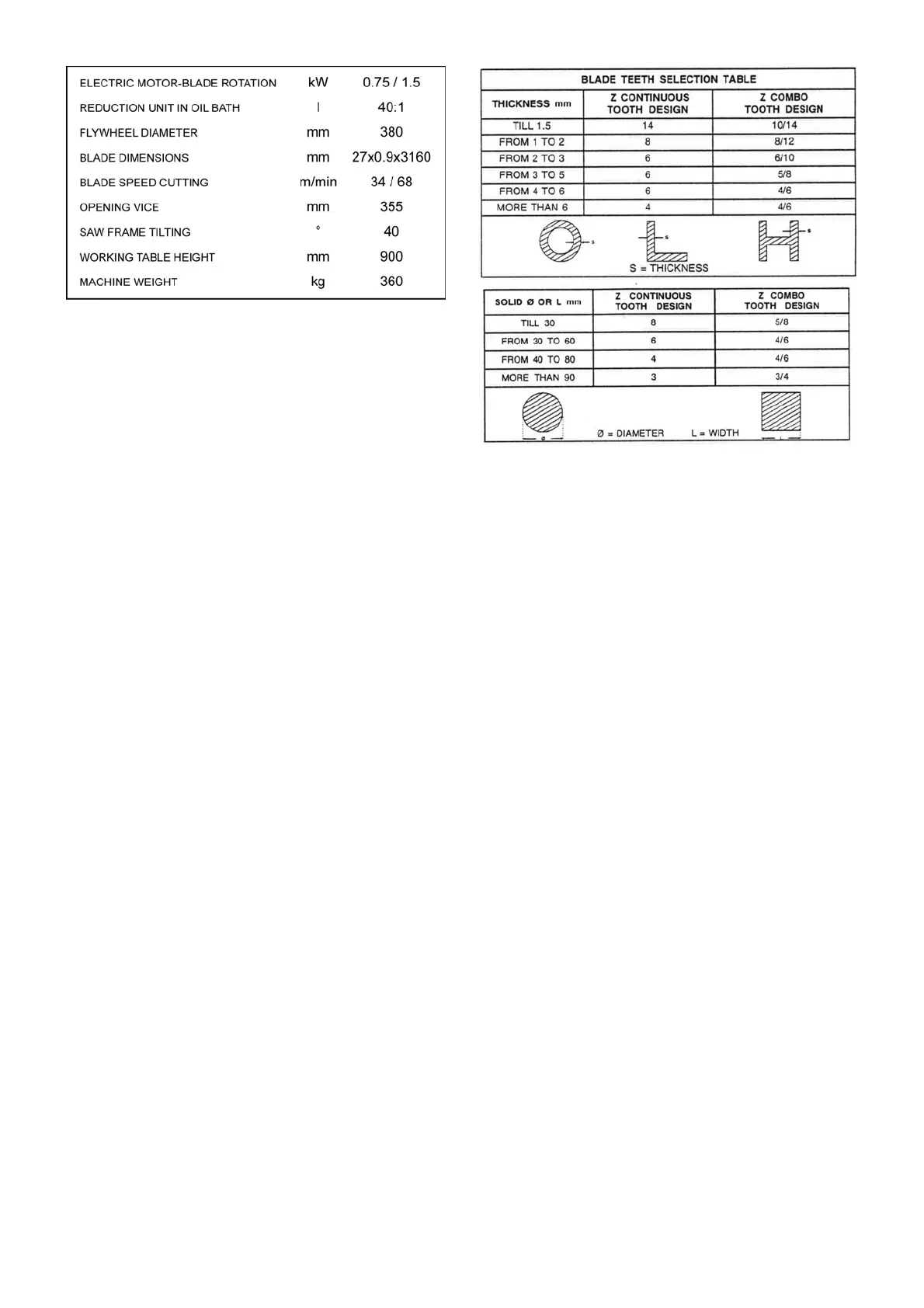
The table above lists the characteristics of the
materials to be cut. So as to choose the right tool to
use.
8.2 Selecting blade
First of all the pitch of the teeth must be chosen, in
other words, the number of teeth per inch (25,4 mm)
suitable for the material to be cut, according to these
criteria:
- Parts with a thin and/or variable section such as
profiles, pipes and plate, need close toothing, so that
the number of teeth used simultaneously in cutting is
from 3 to 6;
- Parts with large transverse sections and solid
sections need widely spaced toothing to allow for the
greater volume of the shavings and better tooth
penetration;
- Parts made of soft material or plastic (light alloys,
mild bronze, Teflon, wood, etc.) also require widely
spaced toothing;
- Pieces cut in bundles require combo tooth design.
8.3 Teeth pitch
As already stated, this depends on the following
factors:
- Hardness of the material
- Dimensions of the section
- Wall thickness.
8.4 Cutting and advance speed
The cutting speed (m/min) and the advance speed
(cm2/min =area traveled by the disk teeth when
removing shavings) are limited by the development of
heat close to the tips of the teeth.
- The cutting speed is subordinate to the resistance of
the material (R = N/mm2), to its hardness (HRC) and
to the dimensions of the widest section.
- Too high an advance speed (= lowering of the saw
frame) tends to cause the disk to deviate from the
ideal cutting path, producing non rectilinear cuts on
bath the vertical and the horizontal plane.
The best combination of these two parameters can be
seen directly examining the chips.
Long spiral-shaped chips indicate ideal cutting.
Very fine or pulverized chips indicate lack of feed
and/or cutting pressure.
Thick and/or blue chips indicate overload of the blade.
8.5 Blade running-in
When cutting for the first time, it is good practice
to run in the tool making a series of cuts at a low
advance speed (= 30-35 cm2/min on material of
average dimensions with respect to the cutting
capacity and solid section of normal steel with R =
410-510 Nimm2). Generously spraying the cutting
area with lubricating coolant.
8.6 Blade structure
Bi-metal blades are the most commonly used. They
consist of a silicon-steel blade backing by a laser
welded high speed steel (HHS) cutting edge. The type
of stocks are classified in M2, M42, M51 and differ
from each other because of their major hardness due
to the increasing percentage of Cobalt (Cc) and
molybdenum (Mo) contained in the metal alloy



 To Next Page