14
5.3.2 FREQUENTLY ASKED QUESTIONS REGARDING LUBRICATION
What is the functional detriment if the “wrong oil” is used?
The lubricant is selected based on bearing and gear speed, and operating temperature. Too light
of a lubricant increases wear by not separating the sliding surfaces and it will not remove the heat
adequately. If the lubricant is too thick, the drag in the bearings is increased causing them to run hotter.
Since it is thicker, it will not ow as readily into the gears and it will reduce the available backlash.
Lubricants at our conditions are incompressible.
What is the functional detriment if the oil is not serviced?
If the lubricant is not serviced at the proper interval the shearing action in the bearing and the gears will
begin to take their toll and the lubricant will thicken, making matters worse. The unit will run hotter and
the wear on running surfaces will increase. Generally, the lubricant will appear dirtier, this is actually
material rubbed off the unit’s components. The discoloration comes from overheating the additive
package. An indicator of the breakdown of a lubricant is the increase in the TAN (Total Acid Number),
and a change in the base viscosity of ten percent.
Several things are happening as the lubricant goes through the unit. First, it is absorbing frictional
energy in the form of heat. This heat has to be dissipated through either surface contact with cooler
materials, or in a rest volume of lubricant. While reducing the friction, the lubricant is also going through
a shearing process and the molecular structure is broken down.
The result is that the lubricant will begin to thicken because of the shorter molecular chains and the drop
out of additive packages. The thickened lubricant will cause more drag, increasing the friction and heat,
and further degrading the lubricant.
Operation of the blower (environment, run time, speed, and pressure) has a direct effect on duty cycles.
Our published cycles are based on worst-case conditions.
5.4 RECOMMENDED OIL CHANGE INTERVALS
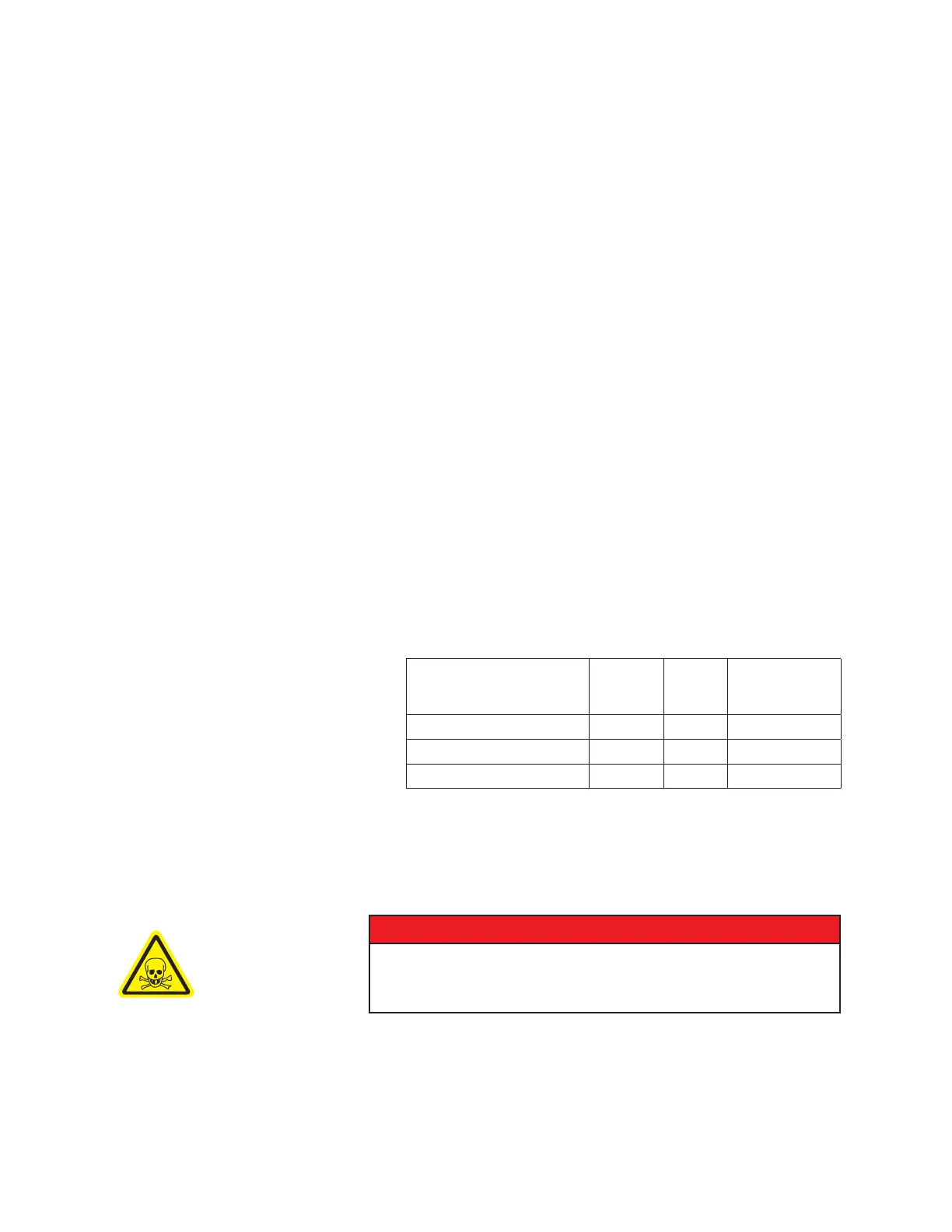
The Operating Conditions table at
the right should only be used as an
approximate guide. For best results, an
oil sampling program is recommended.
The initial oil change should occur
after the rst 200 hours of operation.
Thereafter, frequency of oil changes
will depend on the operating conditions.
Check for oil contamination periodically. Time between oil changes should never exceed six (6) months.
Recommended lubricants are shown on page 35.
5.4.1 HAZARDS ASSOCIATED WITH BREAKDOWN OR IGNITION OF LUBRICATION
DANGER
There is a risk associated with the lubrication media breaking down and
resulting in a hazardous uid or vapor. There may also be a hazard
associated with the ignition of the lubrication media. Refer to the lubrication
manufacture’s applicable instruction for safety precautions.
OPERATING CONDITIONS (PRESSURE/VACUUM)
PRESSURE RANGE (PSIG)
— OR —
VACUUM RANGE (Inches Hg)
PRESSURE
mbar
VACUUM
mbar
OPERATING TIME
BETWEEN
OIL CHANGES
Hours
1-5 70-345 34-170 1500
6-10 410-690 203-339 1000
11-15 760-1035 370-508 500



 To Next Page