• Chemicals
Chemicals in the pulp weaken the measurement signal.
Therefore, a maximum conductivity limit has been
defined for each sensor type. If conductivity exceeds
this limit, the measurement signal becomes too small
and the measurement result contains noise and errors.
A large overshoot in conductivity can cause the meas-
urement signal to disappear altogether. Fluctuatations
in the chemical concentration may also cause small
errors within the conductivity specification limits.
You can eliminate these errors by using MCA
chemical compensation (See Chapter 9 Special Func-
tions).
• Temperature
Temperature affects consistency measurement, which
MCA compensates for with its own temperature
measurement. If the measurement is nonetheless noted
to be temperature-dependent, it can be eliminted with
the help of temperature compensation (See Chapter 9
Special Functions).
• Antenna Leakage
Antenna Leakage causes a measurement error, which
appears as a slow upward or downward drift. In case
of leakage, you must change the antenna and the an-
tenna cable as well because the cable may also have
gotten wet.
In FT sensor models, a clear case of leakage can
be detected by removing the antenna cover and
checking whether water drips from between the antenna
and the connector that is connected to it.
In the Fork Sensor, a clear case of leakage can be
detected by removing the sensor electronics and
checking whether water has accumulated in the con-
necting pipe.
• Antenna Contamination
Antenna Contamination causes an upward drift in the
measurement. If the antenna is cleaned periodically,
e.g. as a result of being washed or changing the wood
species, then the error disappears. The antenna is
made of polished ceramic, so contamination may be
caused by some material that is adhering to this sur-
face. Checking for antenna contamination requires a
break in the process and removal of the device.
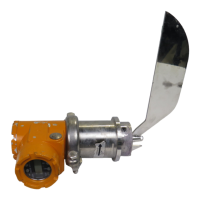
• Pieces of string, etc. wrapped around Fork Sensor
body
The Fork Sensor is inserted into the pipe, and therefore
it is not recommended to install it in a position in which
the pulp may contain strings or other such materials,
which could become wrapped around the Fork Sensor.
If these materials do become wrapped around the
sensor body, the measurement drifts upwards. The
speed of the drift is directly dependent on how rapidly
these materials build up around the sensor and it can
even by very rapid.
Checking the Fork Sensor requires it to be removed
from its process coupling.
• Broken Fork probe
The Fork Sensor is inserted into the pipe, and therefore
it is not recommended to install in in a position in which
the pulp may contain stones or other such materials,
which can damage the ceramic antenna shield at the
end of the sensor body. In order to become broken,
ceramic requires a powerful blow. In such cases, the
fault appears as a rapid level change upwards or
downwards in the measurement, followed by drifting.
Checking for a broken fork probe requires that the
sensor be removed from its process coupling.
• Sensor Electronics Failure
A typical electronics failure appears as a rapid level
change in the measurement and as a rapid reduction
in signal level after some component breaks. A refer-
ence channel failure indicates that the fault is in the
sensor electronics. Self-diagnostics includes an alarm
limit for the reference channel signal level, which de-
tects obvious cases of broken components.
If all the aforementioned possibilities can be elimin-
ated, then small errors or drifting in the measurement
might be caused by sensor electronics. In such a case,
all the self-diagnostics measurements might be within
allowed limits due to which self-diagnostics does not
detect the error.
To locate the error, it might help to analyze the
device's internal trend and sample history table and
compare these to the error results if such error data is
available (e.g. in laboratory monitoring). This requires
a deeper knowledge of the sensor and is typically per-
formed by Valmet maintenance personnel.
• Reference Channel Failure
Refer to Sensor Electronics Failure.
Installation & Owner’s manual OUL00298 V2.3 EN
42
Valmet Mircowave Consistency Transmitter


 To Next Page