10. Troubleshooting
NOTE: Before disconnecting the sensor or the flow-
through antenna, check that the process pipe is empty
and unpressurized and that disconnection is safe.
Valmet MCA does not require scheduled maintenance.
The instructions in this chapter refer to fault conditions.
10.1. Troubleshooting
Valmet MCA's self-diagnostics monitors certain internal
measurements and generates error messages if the
measurements exceed alarm limits. Self-diagnostics
also detects definite faults, which are often caused by
sensor electronics.
An erroneous measurement result may also be due
to antenna leakage, contamination, a fault in the an-
tenna cable, or a process variable that is skewing the
measurement. Self-diagnostics may not detect such a
fault.
The fault may also be in the current output sent by
the TCU. In this case, the measurement is correct, but
the current output sent to the automation system is in-
correct.
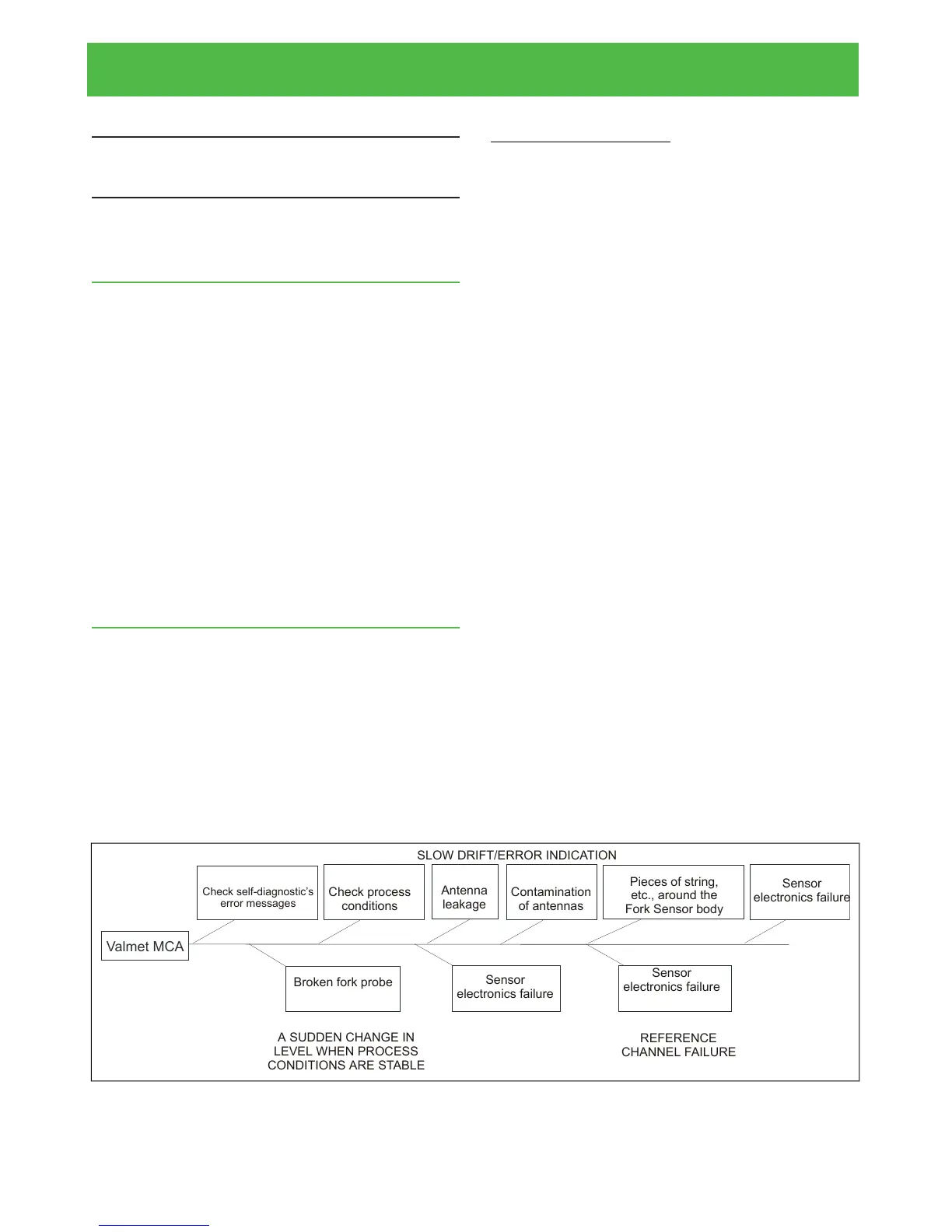
The following figure 1 contains a troubleshooting
chart for faults that appear in different ways.
10.2. Process Conditions
• Air
Air in the pulp is seen in measurements as an excess
in consistency. Air exists as bubbles of different sizes.
Small bubbles dissolve in water at pressure of approx-
imately 1.5 bar, but large bubbles may disturb pro-
cesses even at pressures higher than that. At most,
the error caused by air may be in the range of several
percentage points (percentage of consistency). Air
causes disturbances to the process itself, so the form-
ation of air bubbles should be avoided.
Air formation mechanisms
– Air is mixed with pulp, for example, when it is
dropped into the stock tank. If the level in the stock
tank is low, if the point of impact in near the pump,
or if the flow-through time in the tank is low, then air
is not able to escape properly from the pulp before
the pulp is forced into a departing flow. The best way
to put pulp in the tank is to run the input pipe under
the level of pulp in the tank.
– In addition, a strong stirring at a low surface level
can cause a whirl that causes air to be mixed into
the pulp.
– Air may also become mixed into the pulp through a
leaking joint on the pump's intake side.
– The dilution water may also contain air and cause
air bubbles in the pulp.
– Air can build up in bends in dilution or pulp pipes if
the bends are at the highest spot in the production
line. In such cases, an air pocket is formed and
continues to grow in a bend in a pipe. When the air
pocket is large enough, it begins moving with the
flow in the pipe. An air mass such as this may cause
a momentary error in consistency measurements.
– Air may be generated in the pulp through foaming
caused by chemicals as well.


 To Next Page