Need help?
Do you have a question about the Vanderbilt VR4 S-MF Series and is the answer not in the manual?
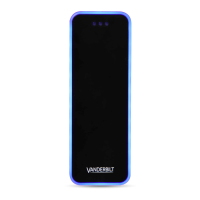
The VR10S-MF, VR11S-MF, VR40S-MF, and VR41S-MF series of card readers are designed for modern security applications, offering robust functionality and user-friendly features. These devices are engineered to provide a high level of security through an encrypted protocol, particularly when the card reader and the connected system are configured in secure mode. This secure mode ensures that communication between the reader and the system cannot be intercepted, safeguarding sensitive information.
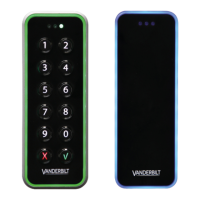
At their core, these devices function as card readers, designed to authenticate users through Mifare card technology. They support various Mifare card types, including Mifare Classic, Mifare Plus, and Mifare DESfire EV1, ensuring broad compatibility within existing security infrastructures. The readers are equipped with a multicolour light frame that serves as a visual indicator, providing immediate feedback on the status of the device or the outcome of a card read. Additionally, they feature three LEDs (red, yellow, green) and a buzzer to further enhance user interaction and provide clear indications.
The VR40S-MF and VR41S-MF models extend functionality by incorporating a keypad and a high-contrast graphic monochrome OLED display. This addition allows for more complex interactions, such as PIN entry or displaying messages, making them suitable for applications requiring multi-factor authentication or user guidance. All readers communicate via the OSDP protocol over an RS485 interface, which is a modern, secure, and scalable communication standard for access control systems.
The card readers are designed to be integrated with SiPass integrated systems, offering automatic configuration of bus addresses upon power-up. When connected to a Reader Interface Module (RIM), the first powered-up reader automatically receives bus address 1, the second receives bus address 2, and so on. This simplifies the installation process and ensures proper addressing within the SiPass integrated environment. The yellow LED flashes during the initial power-up and configuration phase, stopping once the reader is correctly configured to SiPass integrated, which can be verified by holding a card in close proximity.
The readers are built from hardwearing materials, designed to withstand most weather conditions, making them suitable for both indoor and outdoor installations. Their robust construction ensures durability and longevity in various environments.
Mounting options are versatile, allowing for both surface-mounted and back-box-mounted installations. For surface mounting, the reader is fastened directly onto a wall, with cables either fed through a small hole in the base gasket or via knock-outs for external cable routing. The base is secured with three screws, and an additional screw can be used under the tamper base for enhanced removal-from-wall tamper protection. For back-box mounting, the reader is partly installed inside a wall back box, with extra screws preventing rotation. The VR11S-MF and VR41S-MF models include an adapter plate and extension cable, specifically designed for use with square back boxes (70 mm x 70 mm), common in UK installations, to widen the mounting area.
Connecting the cables is straightforward, utilizing a pair twisted screened cable (e.g., Belden 9502). Cables are attached to a connector with clearly indicated terminals (A, B, -, +), which then snaps into place on the base. An EOL (End-Of-Line) jumper on the backside of the front is used for RS485 bus termination. By default, termination is ON, indicating the reader acts as the last device on the bus. For intermediate readers, the jumper must be removed or placed in the OFF position. Once cables are connected, the reader's front is angled onto the hinges at the top of the base and folded down until a snap lock confirms a secure attachment.
The keypad and display on the VR40S-MF and VR41S-MF models provide an intuitive interface for user input and feedback. The multicolour light frame, LEDs, and buzzer collectively offer comprehensive status indications, making it easy for users to understand the reader's state during operation.
Maintenance of these card readers is designed to be minimal and user-friendly. The hardwearing materials allow for cleaning with most domestic detergents, simplifying routine upkeep.
Disassembly of the reader, when required for maintenance or replacement, is also straightforward. An opening tool is carefully inserted into the slot between the base and the front, allowing the front to be gently pushed and lifted off the base. To remove the connector, the opening tool is inserted as indicated in the manual, pushed down gently, and tilted away from the base.
The readers are delivered with default settings, which can be customized using the Configuration Card Creation Tool (3CT). This tool allows for altering parameters such as time-outs for configuration cards and display messages, activation time-outs, hold-off times for card reads, character sets, background illumination levels, bus addresses, off-line indications, backlight behavior, buzzer volumes for key presses and card reads, and system sounds. It also allows configuration of how MIFARE Classic, MIFARE Plus SL1-SL3, and MIFARE DESFire EV1 cards are read (e.g., UID). This flexibility ensures that the readers can be tailored to specific security requirements and operational preferences.
The use of FreeRTOS, an open-source real-time operating system, provides a stable and reliable software foundation for the readers. Further information about FreeRTOS can be found on its official website, which may be beneficial for advanced troubleshooting or understanding the underlying system architecture.
Overall, the VR10S-MF, VR11S-MF, VR40S-MF, and VR41S-MF series offer a secure, durable, and adaptable solution for modern access control, with features designed for ease of installation, operation, and maintenance.
 General
| Operating Voltage | 5-16 VDC |
|---|---|
| Operating Temperature | -22° to +150° F (-30° to +65° C) |
| Technology | Proximity |
| Interface | Wiegand |
| Humidity | non-condensing |
| Dimensions | 120 x 80 x 25 mm |
| Storage Temperature | -40° to +85° C |

 To Next Page