Installation
- 22 - IQ SERIES OWNERS MANUAL
2. Route the DC positive and negative cables as close together as possible, and use cable ties to
keep them together. This reduces some electromagnetic radiation that could interfere with some
sensitive electronics.
3. On vehicle installations do not use the vehicle chassis as the DC negative conductor. Use a
cable the same size as the DC positive to go directly from the inverter to the battery negative.
4. Route the AC and DC power wiring separately, and with as much physical separation as possible,
from low voltage wiring such as audio and video signal wires.
5. DC power input cables which pass through steel or other ferrous metal walls need to pass
through the same hole. If two holes are required cut a slot connecting the two holes to prevent a
transformer effect.
WARNING: Do not allow wire fragments or metal shavings to fall
into the DC wiring compartment or to enter the
inverter in any way.
DC INPUT WIRING CONNECTIONS
A DC fuse is required to properly protect the inverter.
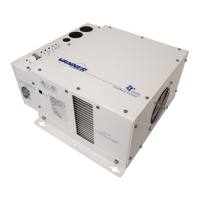
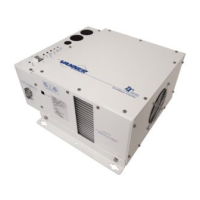
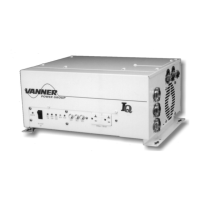
The DC wiring enclosure is located on the top right side of the inverter system to permit
connection of the two cables from the battery. Cable clamps are provided to secure the cables
after they are terminated in the wiring enclosure. A removable cover allows access to the wiring
enclosure.
DC input studs have been provided to accommodate crimp or compression lugs (Vanner part no.
04505, ILSCO part no. TZ-250 #6-250 MCM or similar) with 5/16” hole with battery cable up to
4/0 AWG cable. Good DC connections are critical for the performance and safe operation of the
inverter system. Torque the DC input stud nut to 119 – 158 in. lbs. and repeat torque procedure
after 30 days. The positive and negative cables enter the compartment through separate strain
reliefs located at the upper right side of the unit.
Table below shows the recommended minimum cable size that should be used. Wire sizing
charts published in the NEC may allow a greater amp capacity than we recommend. We have
sized the cable for a maximum voltage drop to maintain better performance of your inverter
installation. For best performance, wire the DC negative directly back to the battery, and in the
case of a mobile installation, do not use the vehicle chassis as the DC negative conductor.
The wiring of your inverter installation should conform to the National Electric Code (NEC) and
any other state or local codes in effect at the time of installation. Article 551 of the NEC requires
any DC cable from a battery, which measures longer than 18 inches along its length, be protected
by a fuse.



 To Next Page