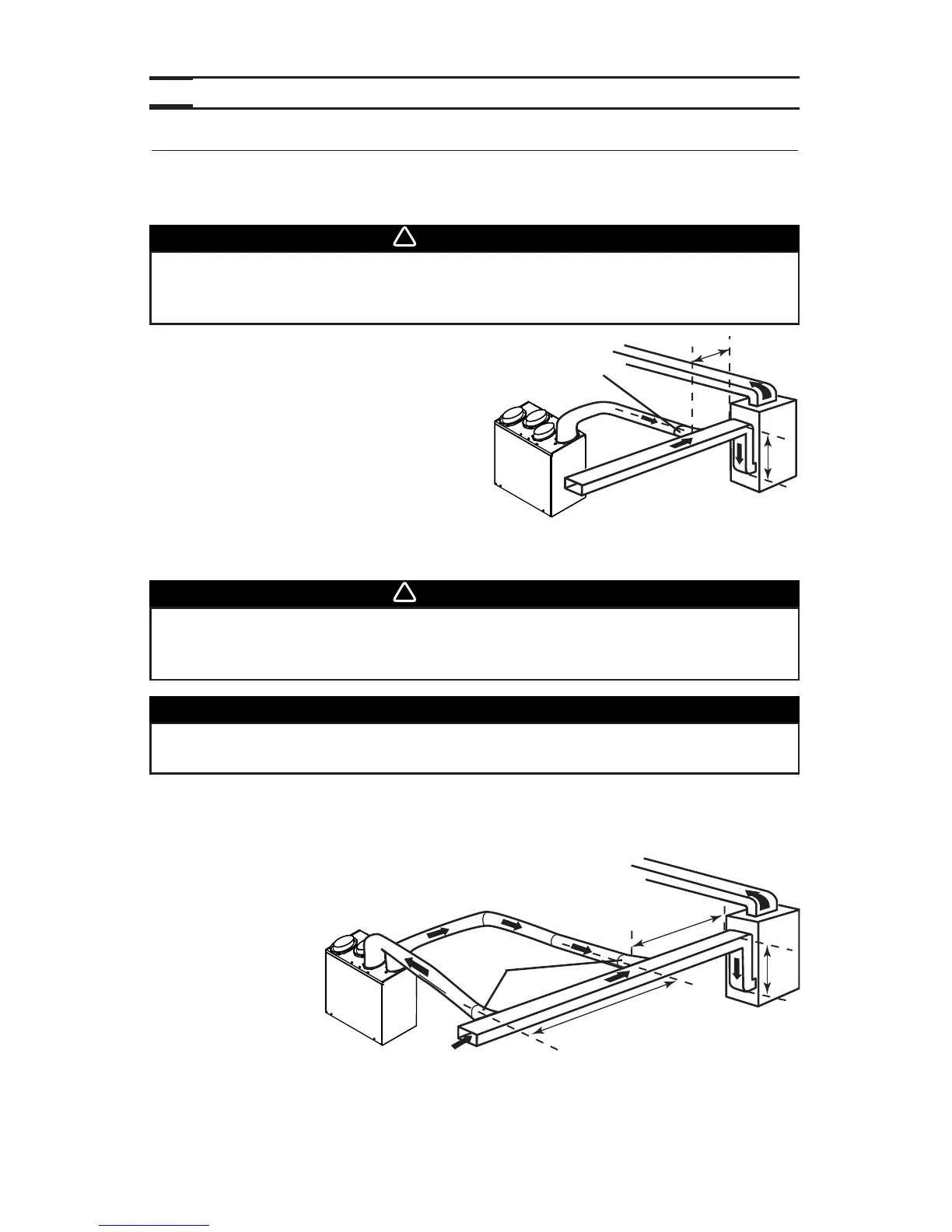
A. FRESH AIR TO BUILDING DUCT ONLY
• Cut an opening into the return duct not less
than 10 feet (3.1 m) from the fur nace (A+B).
• Use a metal transition (not provided,
available in hardware stores) to connect the
fresh air to building duct to the furnace
retur n duct.
NOTE:For this type of installation, it is not
essential that the furnace blower runs
when the unit is in operation, but we
recommend it.
4.6 INSTALLING NON-INSULATED FLEXIBLE DUCTS AND REGISTERS (CONT’D)
4.6.4 CONNECTION TO A FORCED AIR SYSTEM
10
4. UNIT INSTALLATION (CONT’D)
WARNING
When performing duct connections, always use approved tools and
materials. Respect all corresponding laws and safety regulations. Please
refer to your local building code.
METAL
TRANSITION
B. FRESH AIR TO BUILDING DUCT AND EXHAUST AIR FROM BUILDING DUCTS
Fresh air to building duct
• See point A above “Fresh air to building duct only”.
Exhaust air from building duct
• Cut an opening into
the return duct at
least at 3 feet (0.9 m)
from the fresh air
to building duct
connection to the
retur n plenum.
• Use a metal transition
(not provided, av ailable
in hardware stores)
to connect the stale
air intake duct to the furnace return duct.
WARNING
When performing duct connections, always use approved tools and
materials. Respect all corresponding laws and safety regulations. Please
refer to your local building code.
CAUTION
For this type of installation, the furnace blower must be in operation when
the HRV is in operation.
A+B = NOT LESS
THAN 10’ (3.1 M)
A+B =
NOT LESS
THAN
10’ (3.1 M)
MINIMUM 3’
(0.9 M)
M
ETAL
TRANSITION


 To Next Page