VESDA-E VEA Commissioning Guide
4 32407_01
3 NFPA72 Code Compliance
3.1 NFPA72 Requirements
VESDA-E VEA is classified as an Aspirating Smoke Detection (ASD) product and it complies with NFPA72
Initial Acceptance and Annual testing requirements with minimal testing. With full supervision and automated
centralized tests, VEA verifies end to end system operation continuously and automatically performs system
integrity tests at set times and at much shorter intervals than the annual period required by NFPA72.
The below sections are taken from the NFPA72 2013 edition.
14.2.8 Automated Testing
14.2.8.1 Automated testing arrangements that provide equivalent means of testing devices to those specified
in Table 14.4.3.2 at a frequency at least equivalent to those specified in Table 14.4.3.2 shall be permitted to
be used to comply with the requirements of this chapter.
14.2.8.2 Failure of a device on an automated test shall result in an audible and visual trouble signal.
14.2.9 Performance-Based Inspection and Testing
As an alternate means of compliance, subject to the authority having jurisdiction, components and systems
shall be permitted to be inspected and tested under a performance-based program.
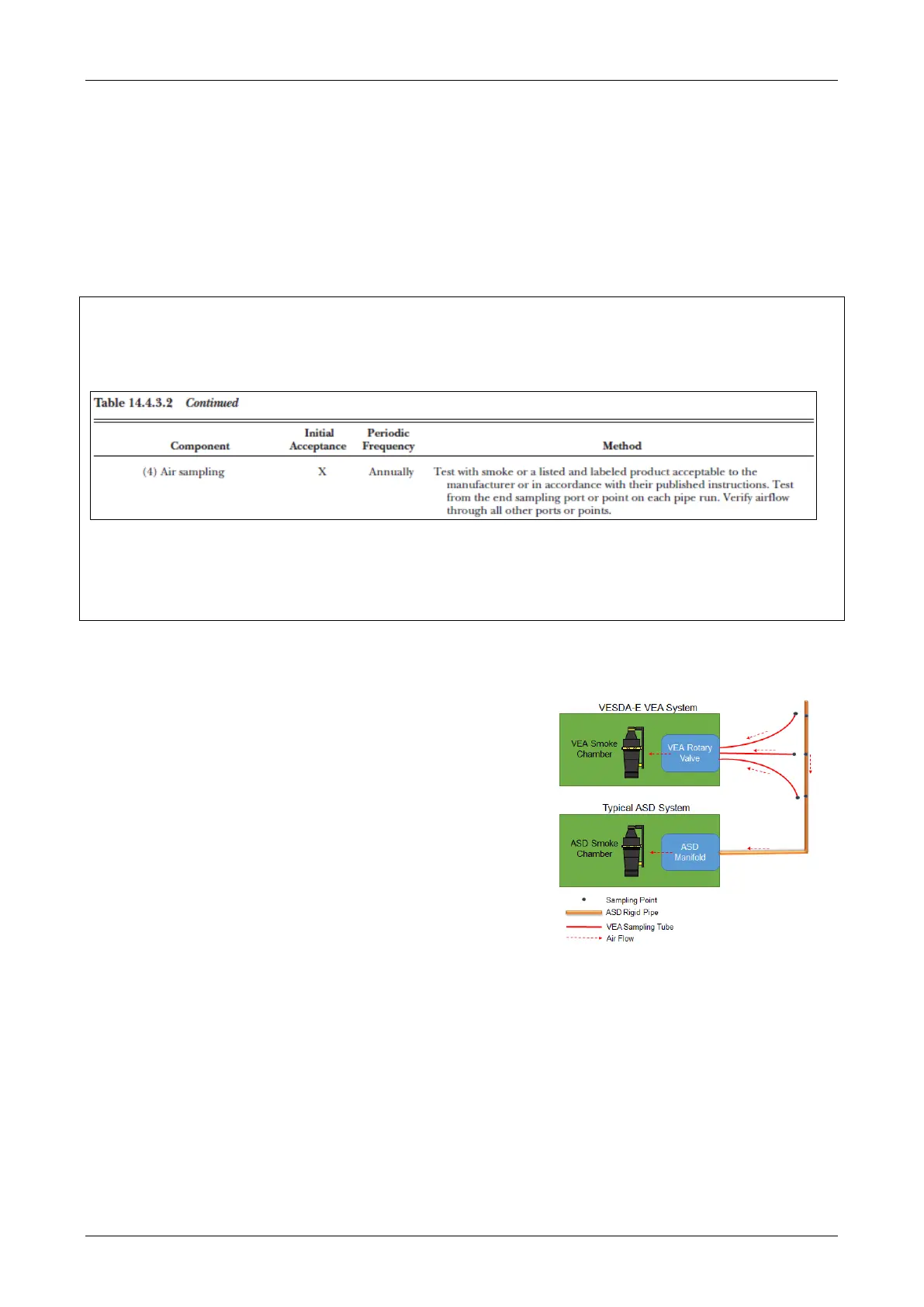
Explanation of VEA being an Air Sampling Detector (ASD):
VESDA-E VEA is an ASD system like any other.
The figure represents the two types of ASD and shows that VEA
is an ASD system that works in the same way as the other ASD
systems:
• ASD using rigid orange pipes: each pipe can have multiple
sampling holes that transfers smoke to a centralized smoke
chamber through a manifold. Hence the sample air entering
the smoke chamber is combined from all the sampling
holes from individual pipes.
• VESDA-E VEA ASD using tubes: an ASD that has a tube
for each sampling hole, smoke is transferred from all these
holes to a centralized smoke chamber through a manifold
in the rotary valve. Hence the sample air entering the
smoke chamber is combined from all the sampling points
connected to individual tubes.
So both ASD systems work exactly in the same way; the same rules apply to both the systems.
In addition:
• VEA continuously monitors airflow from each sampling point to detect clogged/broken tubes or sample
points meeting NFPA72 Table 14.4.3.2 Air Sampling requirement of verification of airflow.
• Full supervision of sampling port and microbore tube at set intervals much shorter than annual
requirement in NFPA72.
• End to end system integrity monitoring allows centralized smoke test (to test smoke chamber) which
Xtralis recommends to test during commissioning and at the time of annual maintenance.



 To Next Page