125
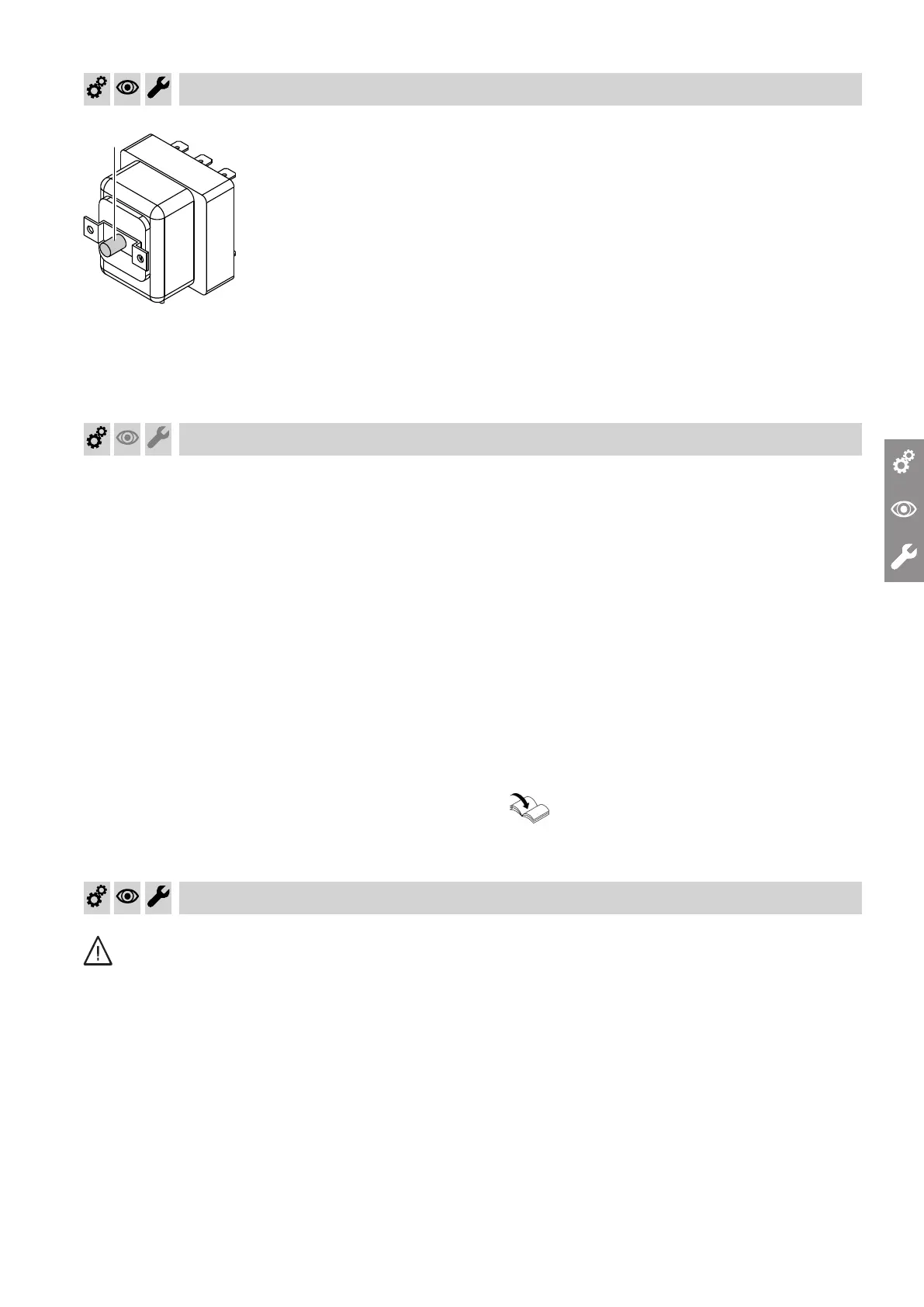
Fig. 84
A
High limit safety cut-out reset button
!
Please note
If the heat pump is exposed to temperatures
below –10 °C, e.g. during storage or transport,
the high limit safety cut-out of the instantaneous
heating water heater may respond. In this case,
the instantaneous heating water heater will not
switch on.
Heat up the high limit safety cut-out to above
20 °C. Press the reset button of the high limit
safety cut-out.
Note
The high limit safety cut-out can only be reset if the
temperature at the sensor is below 82 °C.
Setting max. flow rate manually
The max. flow rate can be restricted manually, e.g. for
hydronic balancing.
■
The setting is only possible via the actuator test in
the ViGuide app.
■
The setting is only possible for systems without an
external heating/cooling water buffer cylinder.
1. Call up the "Actuator test" in the ViGuide app.
2. Select the following settings for the "4/3-way valve
position":
Indoor unit with 1 integral heating/cooling circuit:
■
Select a setting of "0 %".
■
Indoor unit with 2 integral heating/cooling circuits:
For heating/cooling circuit 1, select the setting
"0 %".
■
For heating/cooling circuit 2, select the setting
"50 %".
3. Set the required flow rate for the two heating/cool-
ing circuits in turn using the speed of the heating/
cooling circuit pump.
During the adjustment procedure, the flow rate for
heating/cooling circuit 1 can be checked as follows:
■
On the control panel in the "Information" menu
■
In the ViGuide app in the "Operating data" menu
The flow rate for heating/cooling circuit 2 must be
determined on site.
4. Terminate the actuator test in the ViGuide app.
5. Set the calculated values in the parameters for the
max. speed of the heating/cooling circuit pumps:
Separate service instructions "System con-
figuration and diagnosis for heat pumps with
Viessmann One Base"
Closing the heat pump
Danger
The absence of system component earthing can
lead to serious injury from electrical current and
component damage in the event of an electrical
fault.
■
Before closing the indoor unit, restore all pro-
tective conductor connections.
■
Check whether equipment and pipe connec-
tions are connected to the equipotential bond-
ing of the building. Restore the connections if
required.
!
Please note
If a casing door is not securely closed this can
lead to damage from condensation, vibrations
and excessive noise.
■
Check all-round seal of front panel for dam-
age.
■
Close appliance correctly.
■
On pipe and hose outlets, ensure the thermal
insulation is seated correctly.
Commissioning, inspection, maintenance
Resetting the high limit safety cut-out
6222080





 To Next Page