4
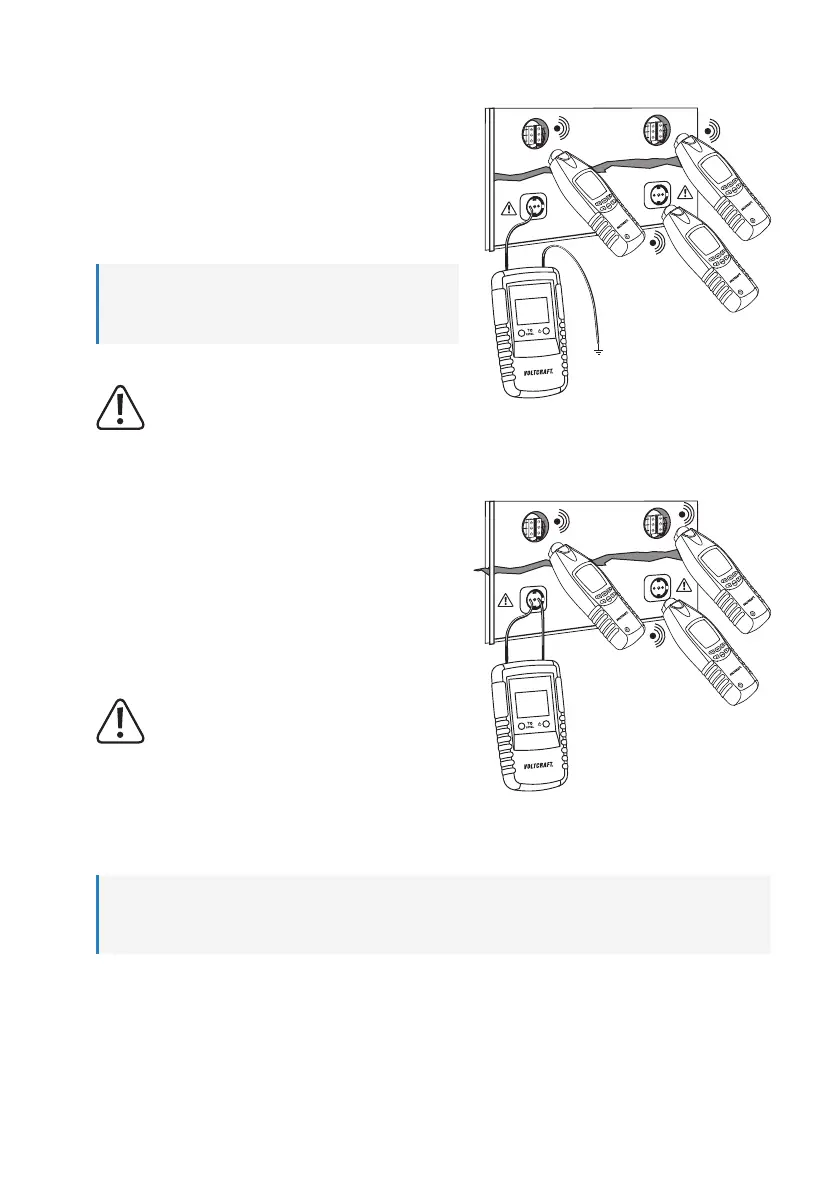
Singe-pole measurement:
The cable detector can follow a signal in interrupted circuits as
well by using a high-frequency input signal� This method makes
it possible to nd cable breaks, cable knots, loose outlets, etc.
The device is connected to a cable� The reference potential is
implemented through a known earth potential (water line, heat-
ing pipe, etc�)�
Note:
– Detection depth is 0 – 2 metres, depending on the
wall material�
The applicable safety provisions for work with volt-
age must be complied with�
5
Two-pole measurement:
Two-pole signal tracing is used for correctly connected electri-
cal circuits without an error point or for localising fuses, line
courses, etc� It can be performed on powered-down or live ca-
bles� The transmitter is voltage-proof up to 400 V�
The connection must always be between phase (L1) and neu-
tral (N) conductora� When the protective conductor (PE) must
be used, proper function of the protective conductor must be
assured� Advance tests are not required�
If the current error protection switch is triggered
when the transmitter is connected, a low error
current is probably already present and causes it
switch to trigger together with the test current� Have
the system checked by an electrician�
The applicable safety provisions for work with volt-
age must be complied with�
Note:
– Detection depth is 0 – 0�5 metres, depending on the wall material� Switching of the signal level from level to
III increases the signal range by about ve times its value.
36



 To Next Page