Loading
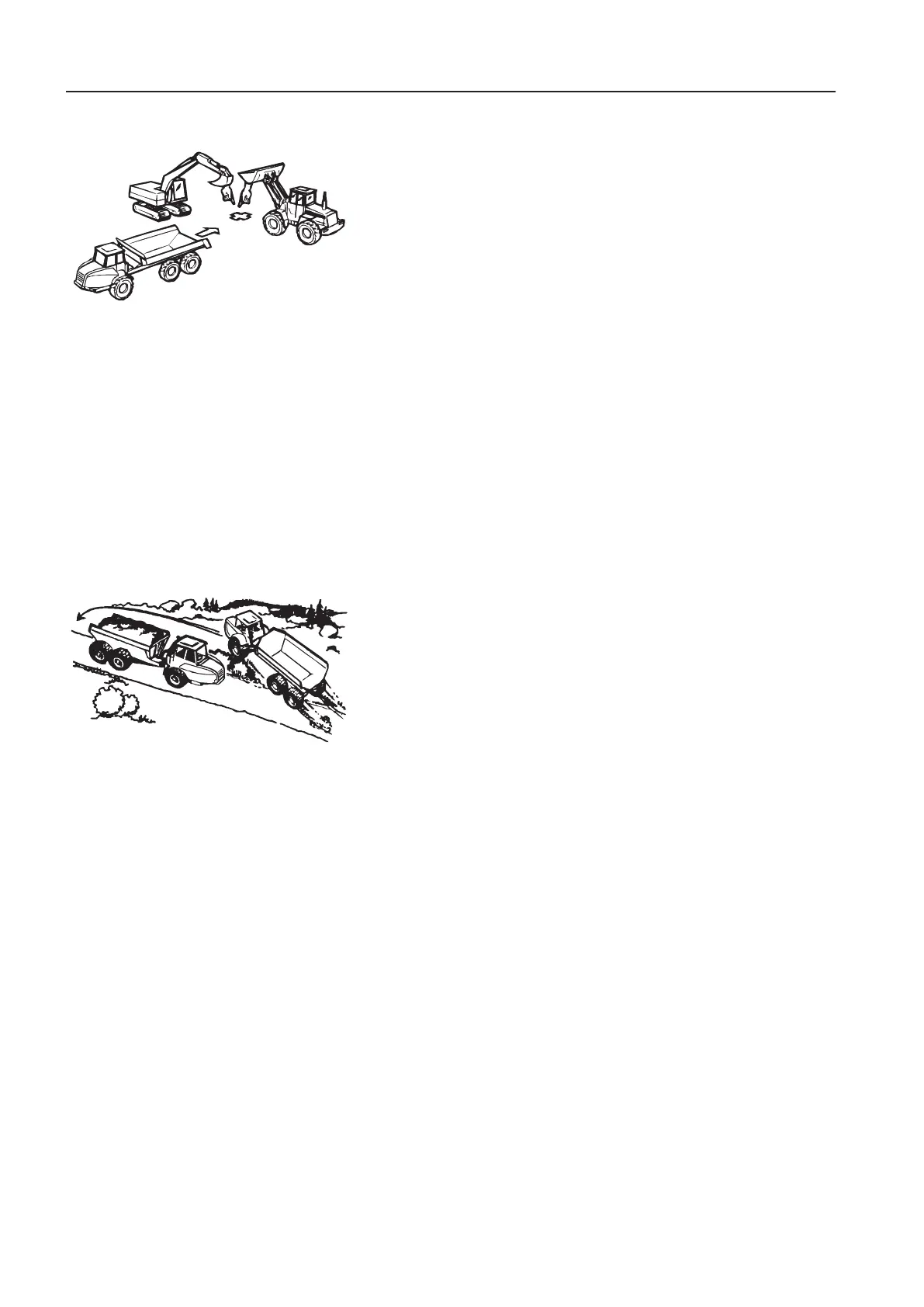
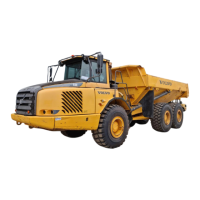
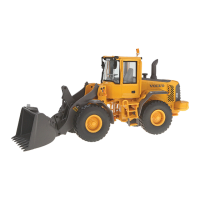
1 Place the hauler in the indicated place. Make use of the
advantages of the articulated steering and place the machine
at the best angle for loading. Use the rear-view mirrors and
maintain eye contact with the loader operator while reversing.
2 Apply the load and dump brake, see page
126
.
3 Always make sure that the load body is down when loading. If
this is not the case, the whole load will rest on the hoist
cylinders instead of on the frame.
4 Make sure that no unprotected personnel is in the machine's
risk zone. See
175
5 During loading, the operator should be in the cab or outside the
risk zone.
NOTE!
Remember that it is you as the operator, who is responsible for the
size and weight of the load, see
175
.
Before moving off, make sure that no part of the load, e.g., stumps
or stones, can fall off and cause injury or damage. Protruding
objects must be removed.
Operating
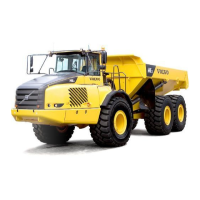
Volvo haulers have very good off-road characteristics that often
can be used to shorten haul distances and to reduce haul times.
You must follow indicated haul roads. If you consider that it is
possible to take cross-country shortcuts, or go off-road to facilitate
meeting on-coming traffic, you must always obtain the
management's permission to do so.
The condition of the haul road has a major impact on the hauler's
capacity. If the haul road is long and poorly maintained, try to
influence the management to maintain the road to a better
standard, so that you can keep a higher speed, which means a
higher capacity.
Body height extension for light material
(Optional equipment)
Machines equipped with body extensions for light material may
only be used for light material. The stability of the machine may be
jeopardized if other heavier material is loaded in the load body.
Reduce speed when hauling since the centre of gravity is located
higher than on machines without body extensions.
Decal for maximum load is located on a window in the cab.
260
Operating techniques
Loading



 To Next Page