26
Installation Manual
Notice
• If you choose this option, the neutralizing agent must be replaced
periodically. Depletion of the neutralizing agent will vary, based on
the usage rate of the water heater. During the first year of operation,
the neutralizer should be checked every few months for depletion
and replaced as needed.
(c) From the water heater into a condensate pump, and then into a
laundry tub.
Notice
A pump can be used when there is a long distance between the water
heater and the laundry tub or when the bottom of the water heater is
lower than the top of the laundry tub.
(d) From the water heater into a laundry tub.
Notice
The bottom of the water heater must be higher than the top of the
laundry tub to use this option.
The condensate line must have a negative slope to drain properly.
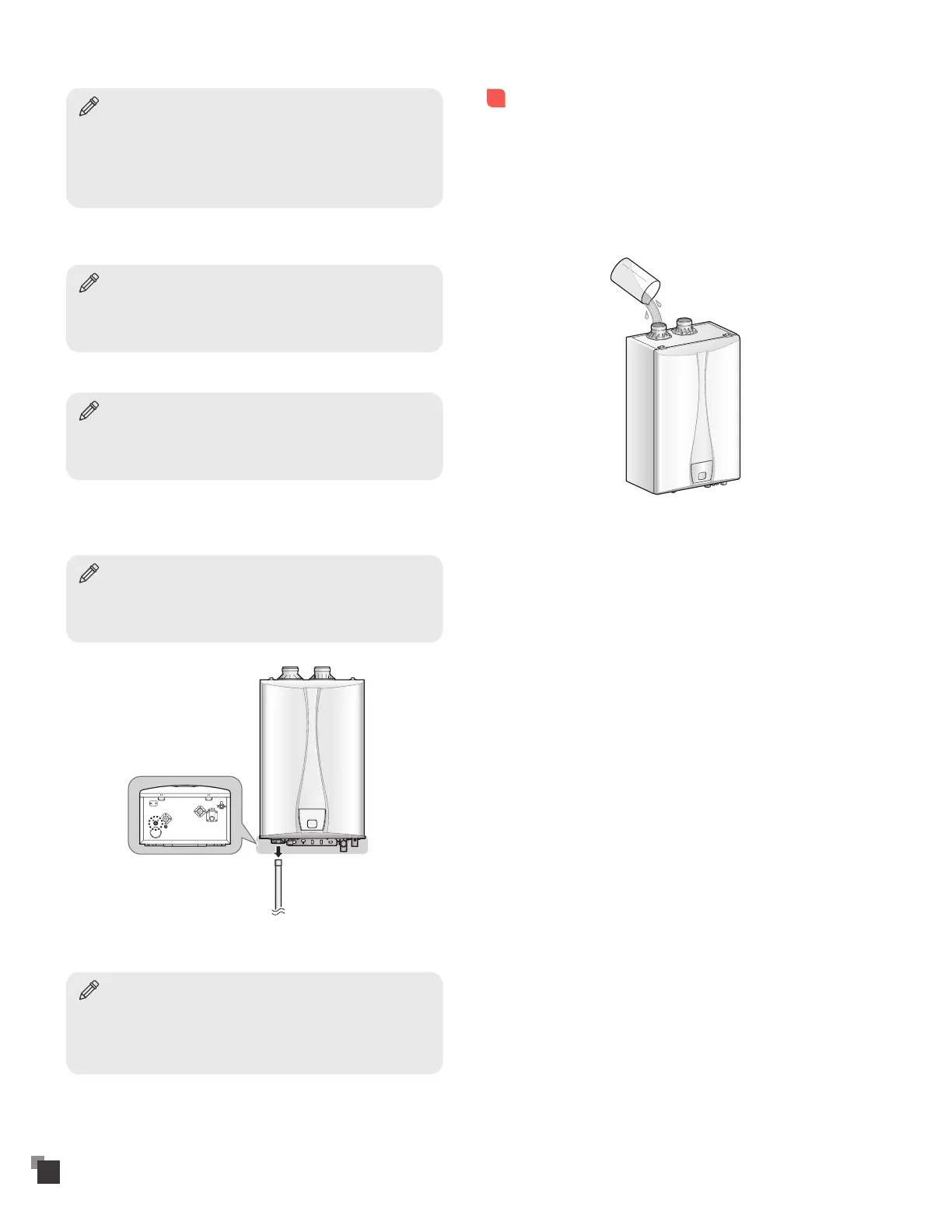
To connect the condensate drain:
1
Connect a drain line to the water heater.
Notice
Use only corrosion-resistant material for the drain line, such as PVC or
CPVC. Do not reduce the size of this fitting or the drain line to less than
1/2".
2
Place the free end of the drain line into an appropriate drain.
Notice
• If you are using a condensate pump, ensure that the pump allows for
up to 2 GPH of drainage for each water heater in the system.
• If you are not using a condensate pump, ensure that the drain line is
pitched downward at a minimum slope of 1/4" per foot.
Condensate Trap
Before operating the water heater, fill the condensate trap with
water through the flue connector. The water heater may be severely
damaged unless filled with water prior to operation. Pour more
than 0.1 gallon (400 ml) of water into the exhaust duct. Deflate air
sufficiently or equip the air vent with an outlet pipe prior to filling
the condensate trap with water (there must be no air inside the heat
exchanger).


 To Next Page