23
Connecting the Water Supply
Connecting the Water Supply
Water Piping
Warning
• Before installing the water heater, flush the water line to
remove all debris, and after installation is complete, purge
the air from the line. Failure to do so may cause damage to
the water heater.
• Do not use lead, PVC, iron or any piping which has been
treated with chromates or other chemicals.
• Do not use this appliance if any part has been under water.
Immediately call a qualified service technician to inspect the
appliance and to replace any part of the control system and
any gas control which has been under water.
• Do not reverse the hot outlet and cold inlet connections
to the water heater. This will cause the water heater to not
operate properly.
• Make sure to install a mixing/tempering valve in your water
system in order to protect against injury. When it is required
by your local plumbing code or regulation, you must install
a mixing/tempering valve accordingly.
The water fittings on the water heater are 3/4". If the installation site
has only 1/2" plumbing throughout, it is not necessary to upsize the
water lines to 3/4", if you are installing a single water heater. When
installing multiple water heaters, the number of water heaters and
pipe sizing required will depend on the total hot water demand. For
information about pipe sizing for multiple water heaters, refer to
"Piping sizes" on page 60.
When connecting the water supply, follow these guidelines:
• Do not remove the factory installed recirculation inlet cap
unless a return line is connected to this fitting. Water leakage
will occur if this cap is loose or missing ("VRP" model only).
• Use only pipes, fittings, valves, and other components (such as
solder), that are approved for use in potable water systems.
• Tighten the water heater connection valves with care to avoid
damage.
• Use unions and manual shut-off valves on the cold water inlet,
DHW outlet, and recirculation water inlet.
• Strive to make the hot water piping system as short as possible,
so as to deliver hot water to the fixtures more quickly and
reduce heat loss.
• To conserve water and energy, insulate all water piping—
especially the hot and recirculation water lines. Never cover the
drain or pressure relief valve. If the water heater is installed in
a closed water supply system, such as one having a backflow
preventer in the cold water supply line, means shall be provided
to control thermal expansion. Contact the water supplier or
local plumbing inspector for information about how to control
this situation.
• After installing the water heater, clean the inlet water filter that
is located inside the cold water inlet, and then test the water
heater for proper flow and inspect for leaks. Instruct the water
heater owner that the filter must be cleaned periodically to
maintain proper water flow.
• When all plumbing work is completed, check for leaks and take
corrective action before proceeding.
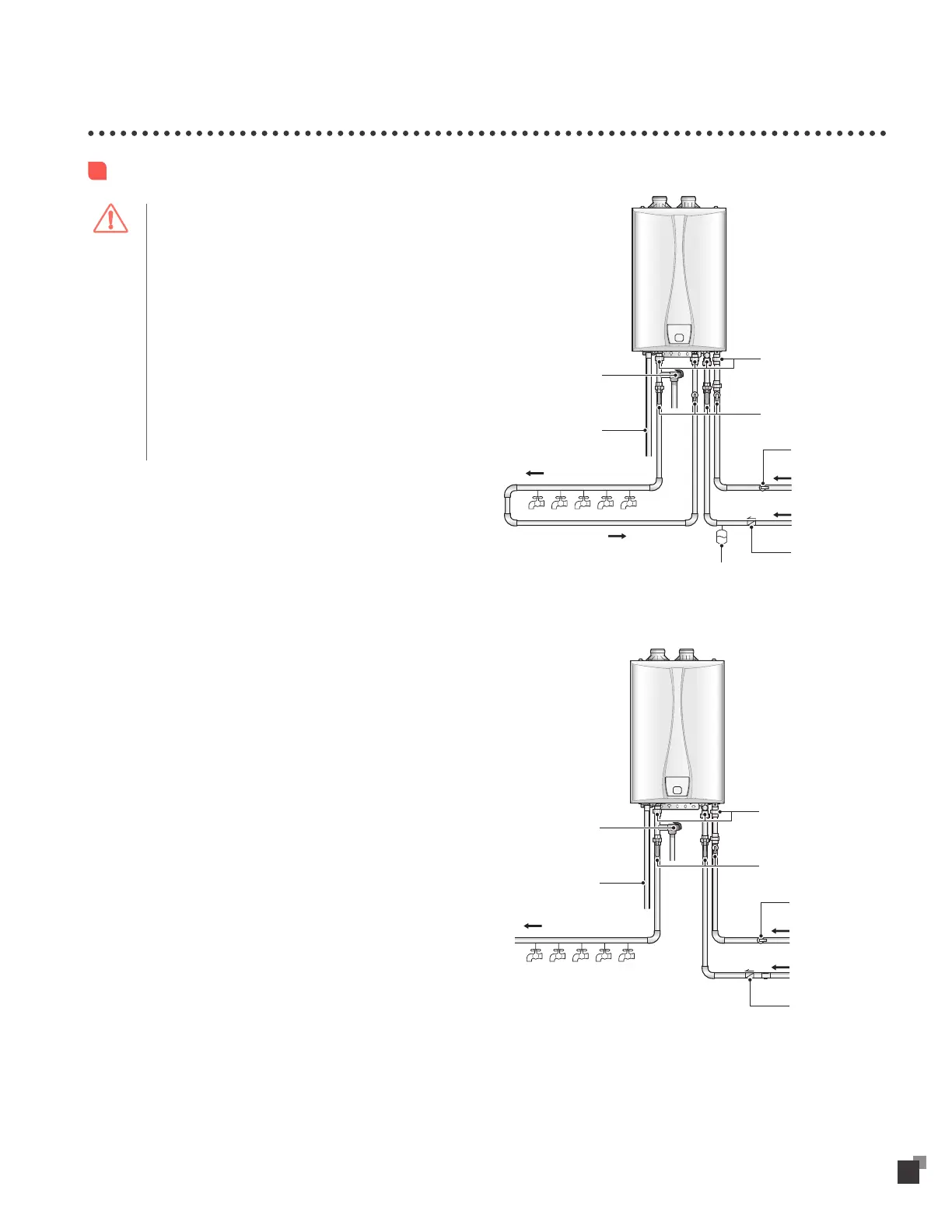
• The following is a water piping example for the water heater:
Cold Water Supply
Hot Water Supply
Expansion tank
Gas Supply
Union
Shutoff valve
Check valve
Full port gas valve
Recirculation Line
Pressure
relief valve
Condensate drain
[VRP]
Cold Water Supply
Hot Water Supply
[VRS]
Pressure relief
valve
Condensate drain
Gas Supply
Check valve
Union
Shutoff valve
Full port gas valve


 To Next Page