25
Connecting the Water Supply
Pressure Relief Valve
Warning
Improper installation of the pressure relief valve may result
in property damage, personal injury, or death. Follow all
instructions and guidelines when installing the pressure relief
valve. Only a licensed professional should install the valve.
Caution
The pressure relief valve must conform to the current edition
of ANSI Z21.22 or CAN 1-4.4 and installation must follow local
codes.
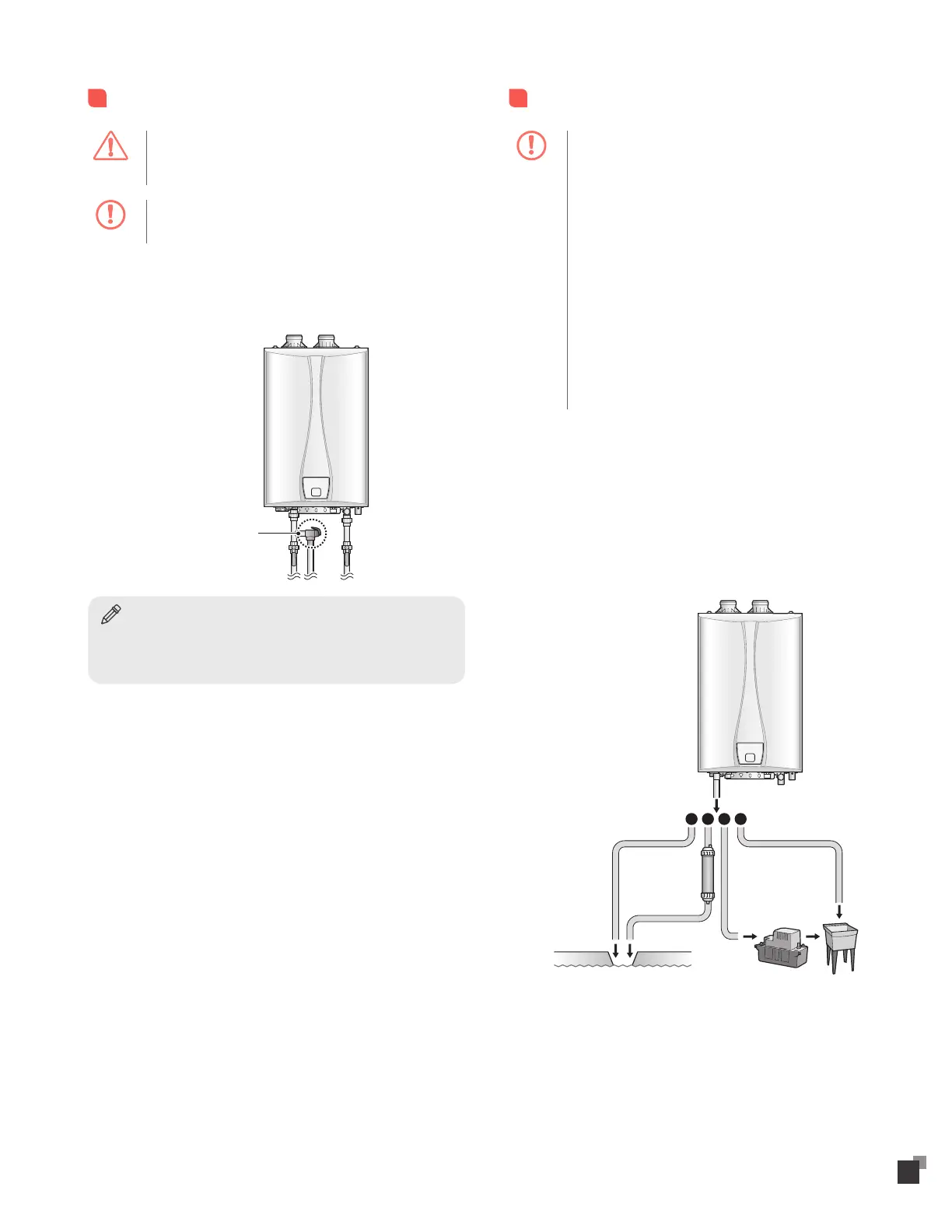
This water heater does not come with an approved pressure relief
valve. To complete the installation of the water heater, you must
install an approved ASME HV relief valve on the pressure relief valve
connector.(Size 3/4", maximum 150 PSI)
Pressure relief
valve
Notice
The pressure relief valve should be placed as close to the water heater
outlet as possible. No other valve should be placed between the
pressure relief valve and the water heater.
When installing the valve, follow these guidelines:
• Ensure that the discharge capacity of the pressure relief valve
is equal to or greater than the maximum pressure rating of the
water heater.
• Ensure that the maximum BTU/H rating on the pressure relief
valve is equal to or greater than the maximum input BTU/H
rating of the water heater.
• Direct the discharge piping of the pressure relief valve so that
hot water will not splash on any person or equipment near by.
• Attach the discharge line to the pressure relief valve and run the
end of the line to within 6-12" (150-300mm) of the floor.
• Ensure that the discharge line will allow free and complete
drainage with no restriction. Do not install a reducing coupling
or other restriction on the discharge line.
• If the relief valve discharges periodically, this may be due to
thermal expansion in a closed water supply system. Contact the
water supplier or local plumbing inspector on how to correct
this situation. Do not plug the relief valve.
• The pressure relief valve must be manually operated
periodically to check for correct operation.
• Be carefully to avoid contact with hot water coming out of the
pressure relief valve and to prevent water damage when you
operate the relief valve.
Condensate Drain
Caution
• All condensate must drain and be disposed of according to
local codes.
• Do not cap or plug the integrated condensate line. If
prevented from draining, condensate can damage the water
heater.
• The condensate line must have a negative slope to drain
properly.
• Do not run drain outdoors. Freezing of condensate can
cause property damage.
• Do not connect the condensate drain line directly to the
rain sewer.
• Do not connect the condensate drain line with an air
conditioning evaporator coil drain.
• Use only corrosion resistant materials for the condensate
drain lines such as PVC pipe or plastic hose.
• The end of the condensate drain pipe should be open to the
atmosphere. The end should not be under water or other
substances.
The VST water heater creates condensation when it operates.
This condensation has an acidic pH of 3-5. Follow all local codes
and regulations when disposing of condensate from the water
heater. We recommend draining the condensate into a laundry
tub, as the alkali in laundry detergent will neutralize the acid in the
condensate. However, other suitable waste drain locations may be
used according to local codes.
Before connecting the condensate drain, choose one of the
following disposal options:
a
b
c
d
External drain
Direct to an
external drain
To a drain via
a neutralizer
To a laundry
tub
To a laundry tub via a
condensate pump
(a) From the water heater directly into an external drain.
(b) From the water heater, through a neutralizing agent, and then
into an external drain.


 To Next Page