CHAPTER 8 COMPONENTS OF THE MINI-PAM
as this also is most strongly excited by the measuring light and emits
most of the fluorescence which is received by the fiberoptics.
For measurements with leaves the special Leaf-Clip Holder
2030-B was developed, featuring an integrated micro-quantum-
sensor and a thermocouple (see 8.3). For this holder also a 90°
fiberoptics adapter (2030-B90) is available.
The fiberoptics should be handled with care. Excessive bending,
in particular close to the connector plug, should be avoided, as it
would lead to fiber breakage with resulting loss in signal amplitude.
The fibers are protected by a steel-spiral and plastic mantle which
provides a natural resistance to strong bending.
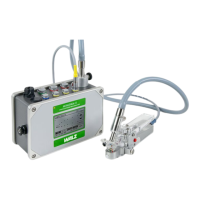
In addition to the standard fiberoptics MINI-PAM/F, with an
active diameter of 5.5 mm, a miniature fiberoptics with 2 mm active
diameter (MINI-PAM/F1) is available for small spot measurements.
This is particularly recommended for use in conjunction with the
Portable Photosynthesis System HCM-1000. For this purpose a
modified top window of the HCM-1000 can be provided which
allows to approach the clear fibertip at 60° angle close to the leaf
surface with minimal shading of the sample. Combined
measurements of fluorescence and gas exchange provide unique
complementary information on the photosynthetic performance of a
plant.
Using the Miniature Fiberoptics MINI-PAM/F1 the signal
amplitude is particularly sensitive to the distance between fibertip
and sample. A standard distance of 4 mm provides for a homogenous
field of illumination and a very satisfactory signal amplitude,
approximately equal to that obtained with the 5.5 mm Ø fiberoptics
at the standard distance of 12 mm. Signal amplitude can be further
increased at least 4 fold, when the fibertip is advanced to the sample
surface. It should be noted, however, that in this case the measuring
40



 To Next Page