CHAPTER 12 MEASUREMENTS WITH THE MINI-PAM
key operation ON + SET or in menu position 12 via SET. In the
latter case the remaining illumination time is displayed.
The MINI-PAM also features the possibility of combining actinic
illumination and YIELD-determination. In menu position 13: ACT +
YIELD, there is first actinic illumination and at the end of the chosen
period a saturation pulse is applied for YIELD-determination. This
function can be also started via the double key operation ON +
START.
The intensity of actinic illumination can be varied via menu point
15: ACT-INT which features 12 settings, with consecutive settings
differing by a factor of ca. 1.5. The effective quantum flux density at
the sample depends on the distance from the fiberoptics. Using the
Leaf-Clip Holder 2030-B at a standard distance of 12 mm the PAR
amounts to approximately 40 µmol quanta m
-2
s
-1
at setting 1 and
2800 µmol quanta m
-2
s
-1
at setting 12 (see list of relative light
intensities below). It should be noted that the absolute intensity is
also determined by battery voltage, and the quality of the individual
fiberoptics which may deteriorate with increasing time of use. Hence,
at a given setting of ACT-INT the effective intensity may vary and
for quantitative work parallel measurement of PAR is recommended.
For this purpose the Leaf-Clip Holder 2030-B in conjunction with
the LIGHT CALIB routine (MODE-menu point 8) is useful.
Intensities are approximately 20 % higher when using the 90°
fiberoptics adapter instead of the 60° adapter (see 8.3).
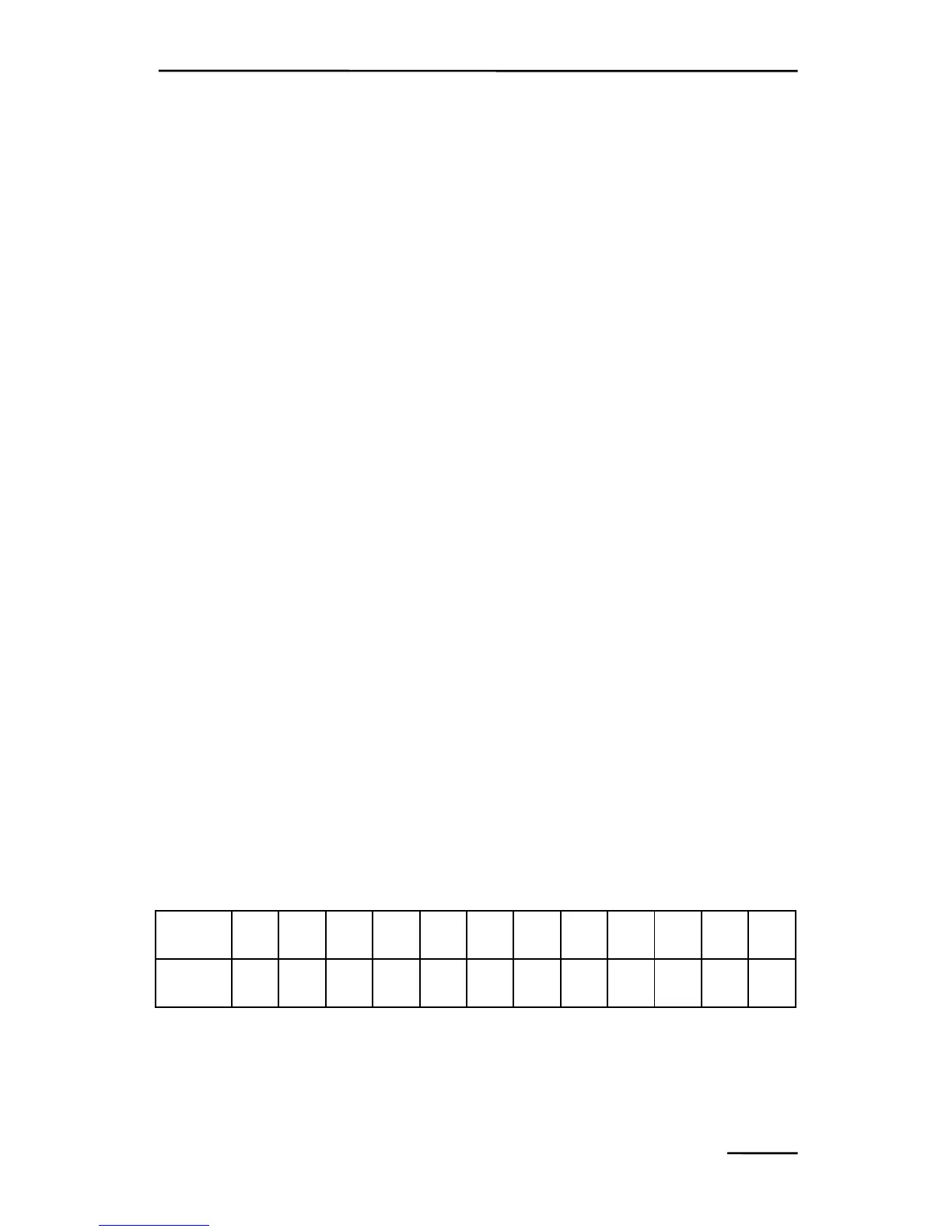
ACT-INT
Setting
1 2 3 4 5 6 7 8 9 10 11 12
Relative
Intensity
1.0 1.5 2.5 3.5 5.5 8.0 11.5 17 26 38 57 87
The range of PAR-values covered by ACT-INT settings 1-12 can
be shifted up or down via menu point 16: AL-FACT. In this way it is
possible to account for special measuring conditions (absolute actinic
77



 To Next Page