Zap
The ZAP function generates an internal +1.5 V pulse which is applied to the headstage.
The pulse duration may be adjusted from 0.1 to 10 ms as indicated. A safe/active toggle
switch arms the circuitry and the pulse is initiated when the ZAP button is depressed.
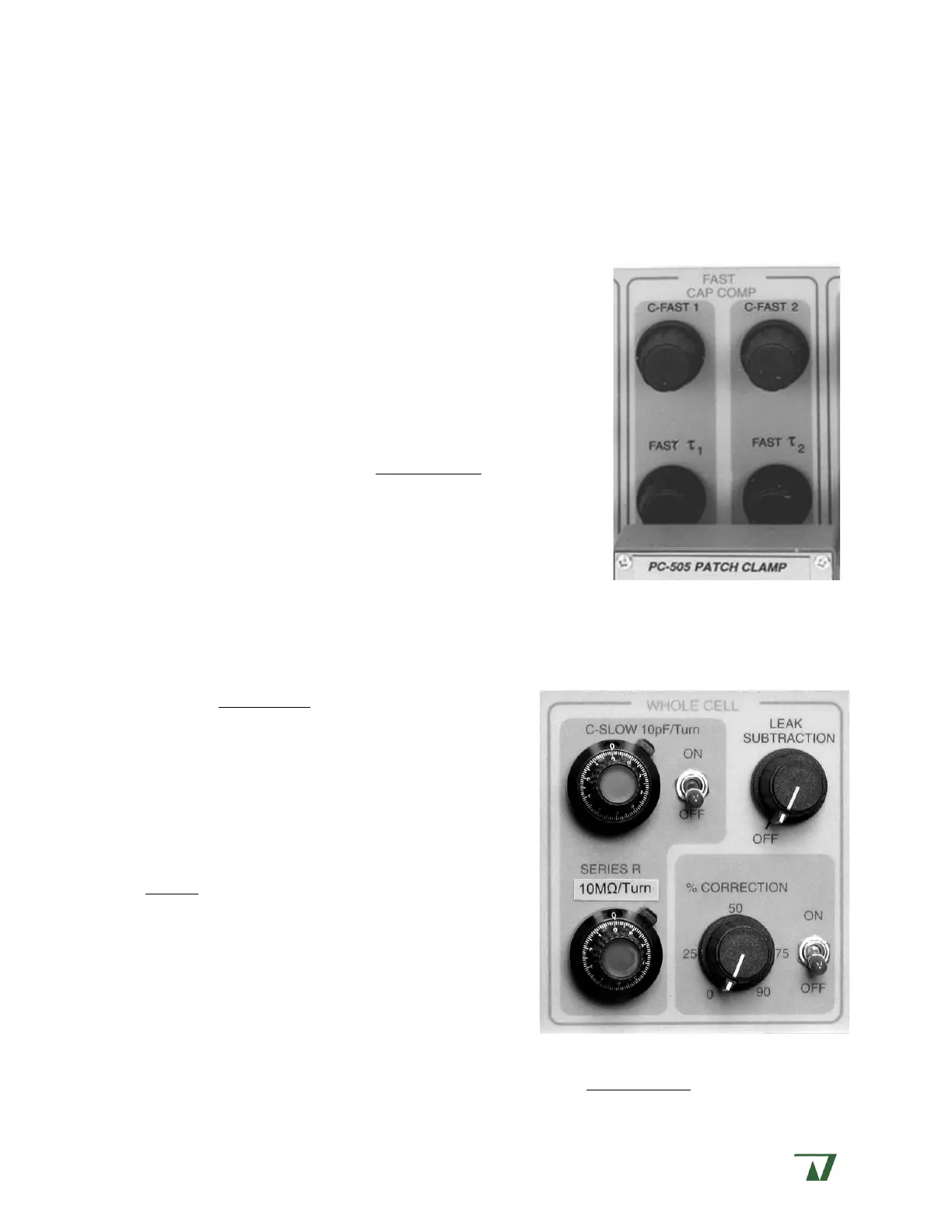
FAST CAP COMP (fast capacitance compensation)
command block
The two pairs of controls, C-FAST 1/FAST
1
and C-FAST
2/FAST
2
, are used to adjust the amplitude and time
constant (tau) of the circuitry that compensates for
capacitative currents due to the pipet and other stray
capacitances. This is achieved by applying an appropriate
capacitative countercurrent to the headstage input. These
controls are disabled in current clamp mode.
When properly adjusted, FAST CAP COMP controls have
two important functions: 1) to closely align the voltage
clamp waveform at the cell membrane to the command
signal waveform, and 2) to minimize large current
transients associated with rapid changes in applied
membrane potential. These effects, if uncompensated, can
drive the headstage amplifier into saturation, which can result in the loss of several ms of
data while the headstage recovers.
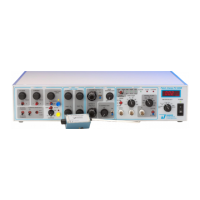
WHOLE CELL COMMAND BLOCK
The WHOLE CELL command block contains
controls for C-SLOW, SERIES R, % CORRECTION, and
LEAK SUBTRACTION. These controls are used to
compensate for the effects of membrane
capacitance and access resistance when the
amplifier is used in whole cell mode. With the
exception of LEAK SUBTRACTION, these controls are
only available when the PROBE RESISTER (in the
OUTPUT command block) is in low mode.
C-Slow
This control is used to compensate for the
whole–cell membrane capacitance. The
compensated capacitance can be read directly
from the lockable 10-turn control. The associated
toggle switch disables C–SLOW allowing comparison with the uncompensated signal.
This control is not available in patch mode since the FAST CAP COMP circuitry is used to
address capacitances in this mode.


 To Next Page