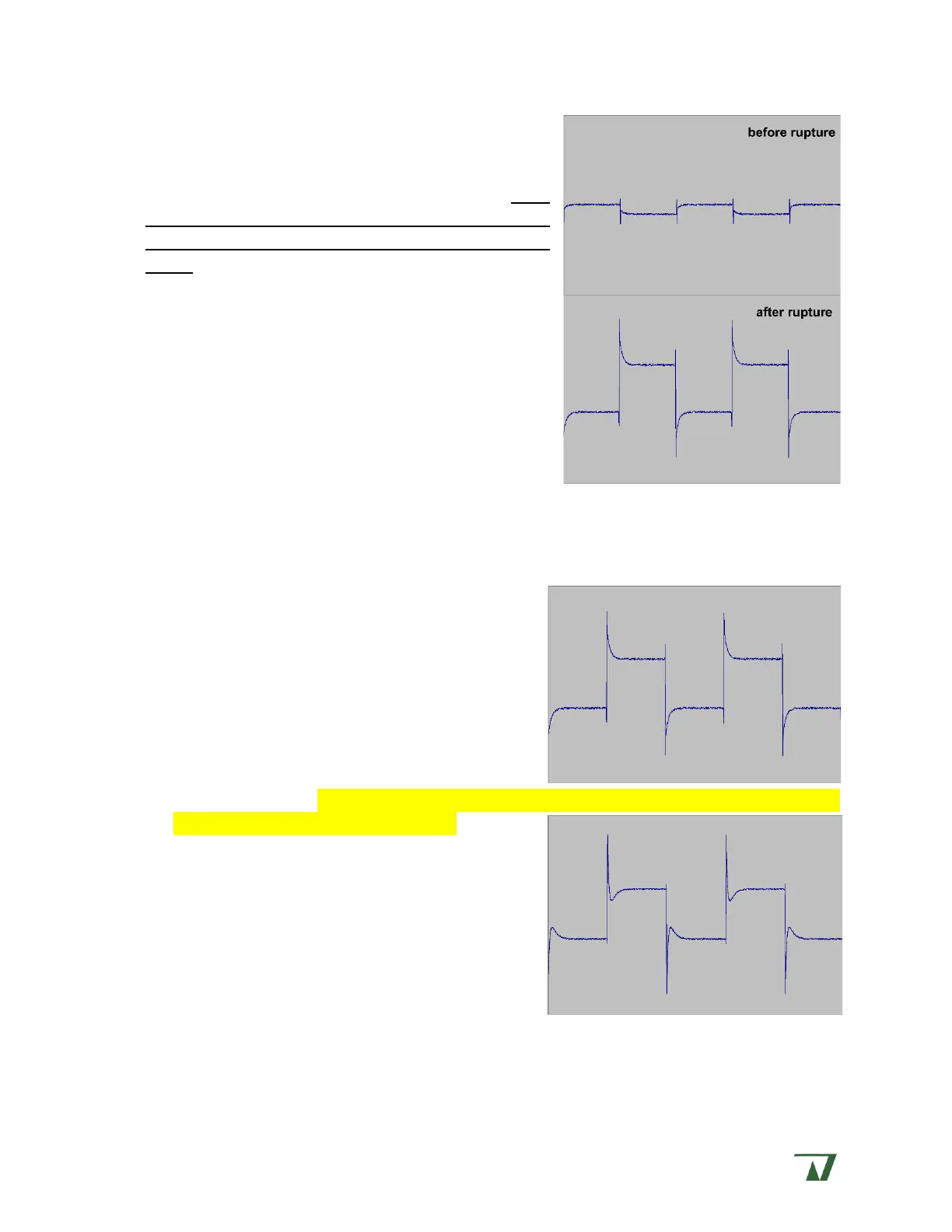
Rupture is signaled by a sudden large increase in
the TEST PULSE current when in voltage clamp mode,
or as a sudden decrease in TEST PULSE voltage at the
V
m
x10 terminal when in current clamp mode. Once
the membrane is ruptured, immediately apply a
resting holding potential appropriate to the cell under
study.
An example of a ruptured membrane signal is
shown to the right.
Whole-cell recording - Series R compensation
In single channel recording, the pipette electrode
resistance (RP) is negligible compared to the patch
and seal resistances. However, in whole cell recording
this electrode resistance becomes a significant factor
and will slow the response of the amplifer.
Series R compensation is adjusted by using the SERIES R and C-SLOW controls. The SERIES
R control compensates for the resistance of the pipette opening at the cell and the C-SLOW
control compensates for the cell membrane capacitance.
A good adjustment for Series R is important
but can be a subtle operation. A basic approach is
outlined below.
• Verify that the TEST PULSE is active and set to
x0.01. The trace should appear like the example
to the right.
• If you’ve previously measured the pipette
resistance (RP), then initially set the SERIES R
dial to this value. NOTE: The SERIES R control is calibrated to 10 M/turn, so if your
RP=4.5 M, then set the dial to 0.45.
• If you do not know the pipette resistance, then
set the SERIES R control to 5.0.
• Next, turn on C-SLOW and adjust up until a
slight overshoot appears on the leading edge of
the trace. An example is shown to the right.


 To Next Page