current on the oscilloscope. An example is shown on the previous page. Since the test pulse
has a known voltage amplitude (100 mV in this case), you can calculate RS by use of Ohm's
law (R=V/I). A good gigaseal resistance is typically in the range 1-10 G.
Patch or whole cell recording?
At this point you can perform either patch clamp or whole cell recording. The following
sections address additional setup steps to be performed prior to making measurements for
each technique.
Both patch and whole cell recording can be performed with either the LC-201B low
current or HC-202B high current headstages. In either case, whole cell recordings are
performed with the PROBE RESISTOR SELECT toggle switch set to the low position (500 M or
50 M, respectively for each headstage).
Patch recording - Leak subtraction
If RS is only a few G, it may be necessary to
compensate for membrane voltage errors lost to
the leak pathway.
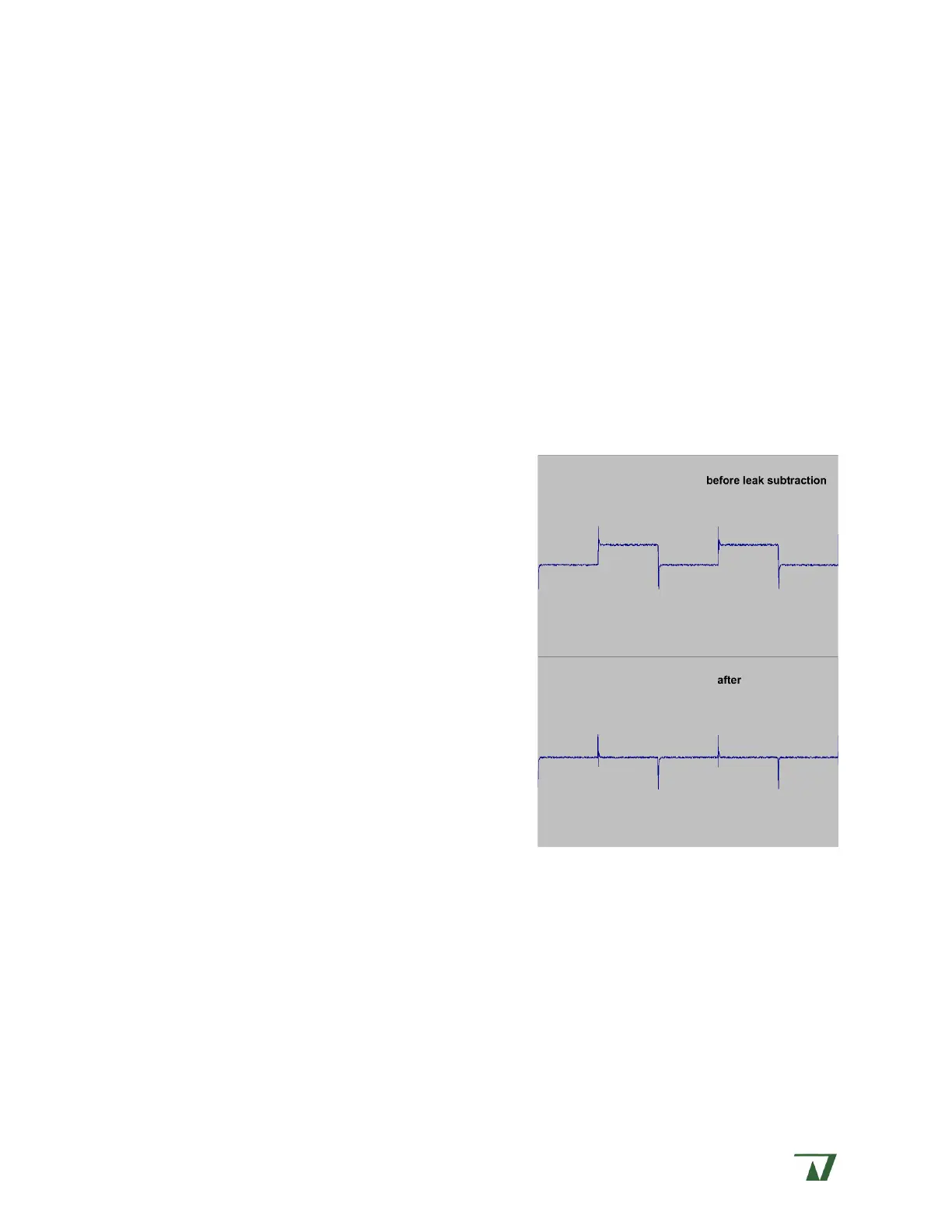
With TEST PULSE still active, turn the LEAK
SUBTRACTION control clockwise until the I
m
trace on
your acquisition system or oscilloscope becomes
flat except for residual capacitance transients.
(Alternatively, with the TEST PULSE off, run the
holding potential up and down over a range that
doesn't evoke channel currents and adjust the
LEAK SUBTRACTION control so that the current trace
on the oscilloscope remains fixed.) An example is
shown to the right.
If RS is very high, leak subtraction may not
be needed. If so, turn the LEAK SUBTRACTION control
to 0 (off).
Patch recording – Excised patch
Watch with the microscope as you excise the patch. To pull a patch, quickly move the
pipette away from the cell with the manipulator, then up and away using the fine vertical
controls. During patch excision, the cell should stay attached to the bottom of the dish. If
the excision is successful, the critical vibration-sensitive phase of the operation is complete.
If the cell remains attached to the pipette, try jiggling the micromanipulator controls, or
tap gently on the micromanipulator, or bring the cell and pipette up briefly into the air for
no more than 1 second. If the patch still does not separate from the cell, you should consider
proceeding with a cell-attached patch recording instead.


 To Next Page