3. If a seal doesn’t form within about 5-10
min, it probably will not. Take a new
pipette and start again.
4. Never attempt to clean and re-use a used
pipette. It will never make a seal.
Set electrode capacitance compensation
Once a seal has formed, apply electrode
capacitance compensation.
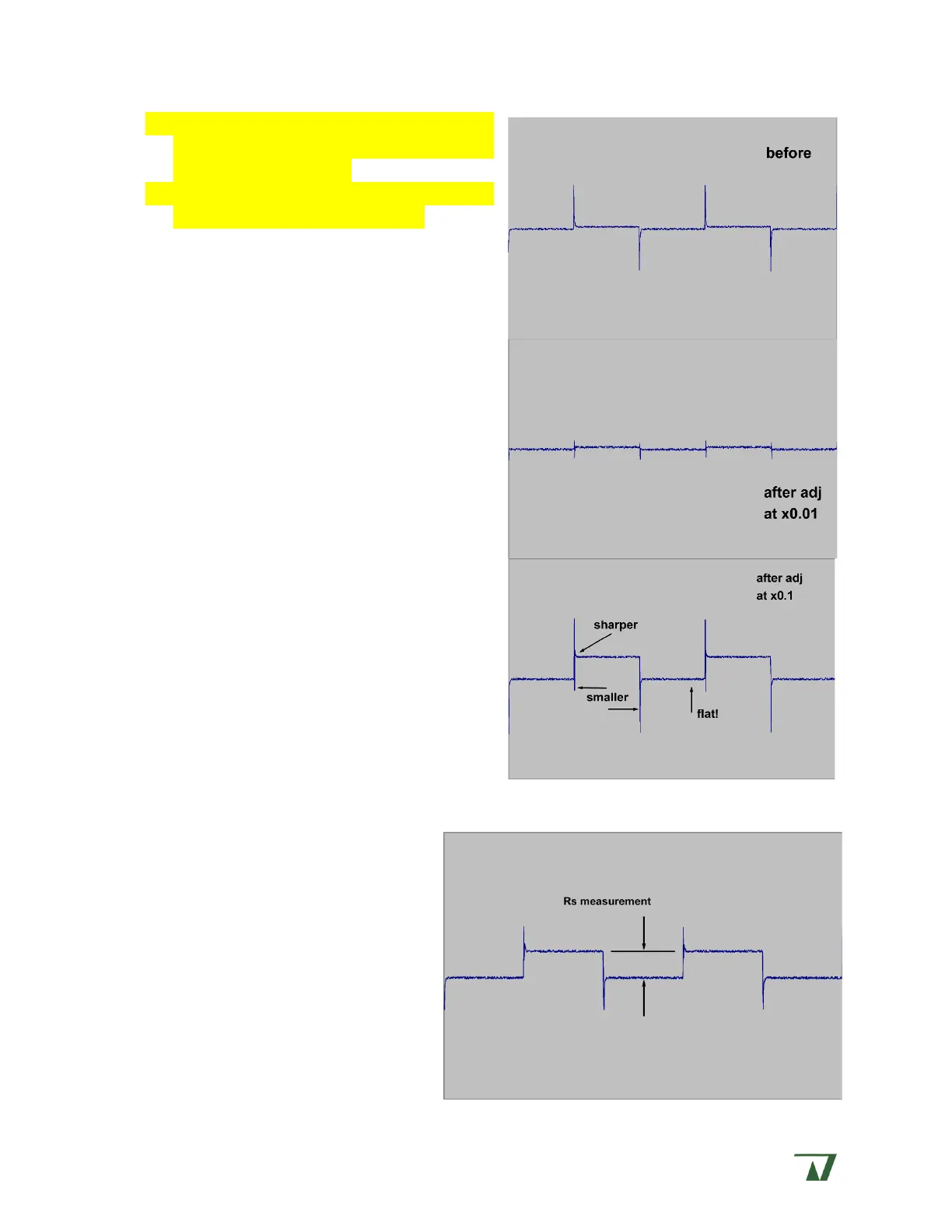
Leave the TEST PULSE active and set the
COMMAND SENSITIVITY to x0.01 (10 mV). Adjust
your recording system so you can visualize the
trace as shown in the top figure to the right.
Use the FAST CAP COMP controls (C-FAST
and FAST ) to minimize the overshoot and
balance the shape of the excursions on the
waveform. Because the two banks of CAP COMP
controls (1, 2) interact with each other, some
trial and error in making a good adjustment is
required.
Compensation is optimal when the square
wave has as sharp a rise and fall as possible,
a flat top and bottom, and minimum
overshoot. (See the bottom figure on previous
page.) Rise time improves with higher
frequency BESSEL FILTER settings, however,
higher frequency settings introduce a tradeoff
between fast response and increased noise.
Once an optimal trace has been found at the x0.01 setting, increase the COMMAND
SENSITIVITY to x0.1 (100 mV) and
repeat. An appropriately adjusted
trace is shown to the right.
Measure seal resistance (RS)
You can measure seal resistance
with the electrode still attached to the
cell or after you’ve pulled a membrane
patch (cell attached patch or excise
patch configurations, respectively).
Keep the TEST PULSE on and
measure the peak-to-peak ‘leak’


 To Next Page