Series R
Series resistance compensation is used to compensate for the voltage drop across the
electrode and access resistance in the experimental setup. This control is used to adjust the
time constant of the C–SLOW control facilitating measurement of membrane resistance which
can be read from the dial.
This control is not available in single channel recording mode since series resistances
are negligible when compared with cell membrane and single channel resistances.
% Correction
% Correction is used to apply voltage compensation to the amplifier to correct for the
voltage drops due to the series resistance. This control is adjusted until the output signal
just begins to oscillate at the leading edge (ringing) of the TEST PULSE during experimental
setup. The control is activated by a toggle switch.
Leak subtraction
Leak subtraction is used to compensate for leakage currents to the bath through the
pipet/membrane seal resistance (RS) or through the membrane patch. For ‘leaky’ seals (RS
~1 G) it is important to correct for the error caused by the shunt resistance of the leak.
This error can usually be ignored with ‘tight’ seals (RS ~10 to 100 G). Fully
counterclockwise rotation of this control switches it off.
NOTE: Do not use LEAK SUBTRACTION if using % CORRECTION in whole cell mode. The
interaction between these two controls can introduce a systematic error into your data!
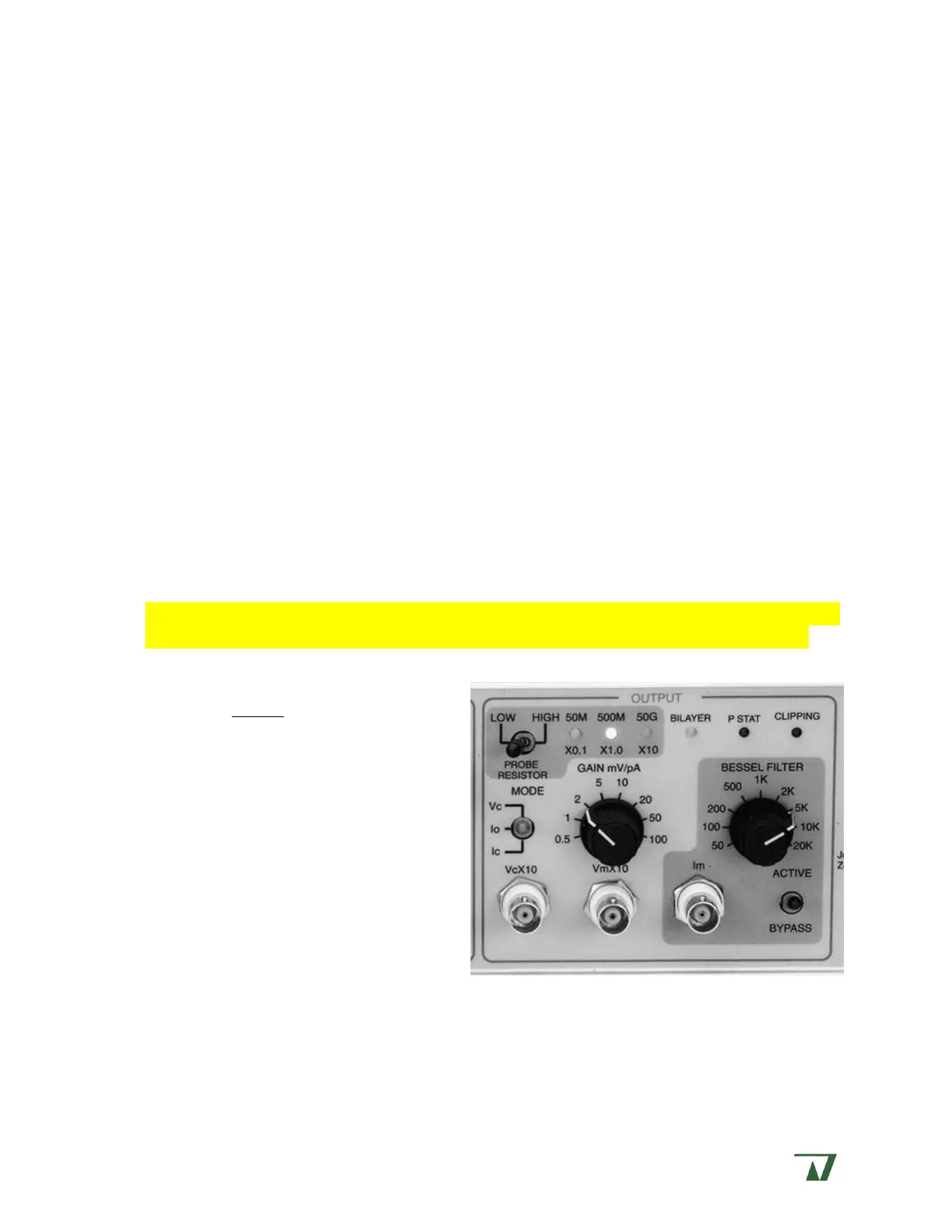
OUTPUT command block
The OUTPUT command block
contains controls for selecting different
operating modes and headstage
resistors. The instrument gain and filter
controls can also be found here.
Probe resistor select
The headstage resistor is selected
with the PROBE RESISTOR select switch.
The high position selects the 50 G
resistor for both patch and bilayer
headstages (models LC-201, HC-202, and
HB-205, respectively). The low position is
used for whole cell recording and selects the 500 M resistor in the LC-201 headstage and the
50 M resistor in the HC-202 headstage. It is not available in the HB-205 headstage.
The low resistor is automatically selected when in current clamp mode,


 To Next Page