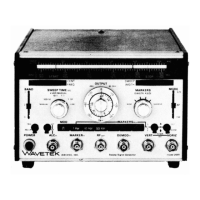
Model
2001
MAINTENANCE
other areas and should be checked when the symptom does
not clearly indicate a specific problem. The
+18, -18, and
-20V supplies are located on the rear chassis printed circuit
board and the +16 and -16 reference voltage supplies are
located in the M2H module. Performance of these supplies
are indicated in the calibration procedure.
5.6.1 TROUBLE SHOOTING HINTS
The following is a list of several typical symptoms followed
by the probable cause or a trouble shooting procedure.
INTERMITTENT OPERATION OF ANY TYPE
-
Defective
module pin sockets or loose RF cables.
selector switch. See the calibration procedure for verifying
proper operation.
NO RF SWEEP
-
First check pin 12 of the M1H module
for the presence of a 32V ramp. This ramp indicates
proper operation of the
M1H. Next check for the ramp at
the input of the M2H pin
7
(AF mode). Finally check
the output of the M2H at pin 9. It should be similar to the
input except
it
will be lower in amplitude, approximately
12V peak-to-peak, and will have an average value of OV
when the Front Panel center frequency control is set to
mid-band. If the M2H output is correct the trouble would
probably be in the
M9H or M19H sweep oscillator module.
MARKER PROBLEMS
NO RF OUTPUT
ALL THREE BANDS
-
Defective attenuator or RF
cables connecting to the input or output of the attenuator.
SINGLE BAND ONLY
-
Check for the presence of the
band switching voltages
6-1, B-2, and B-3 at module M9H,
MIOH,
and M19H as shown on the Module Wiring Diagram.
RF OUTPUT NOT FLAT
-
Most common cause is the ex-
ternal RF detector being defective. Another is the monitor
diode located in the
M19H module. This is a point contact
diode and can be damaged if the RF output is momentarily
connected to a
B+ voltage. A good monitor diode will pro-
duce a negative detected voltage (pin 8 of
M19H) approxi-
mately twice the amplitude of the external detector. For
example, at an RF output of
+10dBm an external RF
detector will read approximately
0.8V. The internal moni-
tor, pin
8
of M19H, will read approximately -1.6V.
FREQUENCY UNSTABLE (JITTER)
-
Check all modules
for loose hold-down screws, especially module
M2H.
Check the
+
and -16V reference supplies. Operating the
unit in a strong magnetic field, such as setting on top of or
adjacent to another instrument containing a large power
transformer, can produce
60Hz HUM modulation.
SWEEP RATE PROBLEM
-
Probable cause is a defective
M1H module or wiring to the Front Panel SWEEP TIME
To isolate the cause of a marker problem when the symptom
does not clearly indicate a specific circuit or component,
first check the sweep sample output at the M5H Sweep
Sample Out connector.
It should be a detected signal be-
tween 30 to 50
mV.
If
the proper sweep sample signal is
not present it indicates that the trouble is in the sweep
oscillator module or connecting sweep sample cables. Next
connect the detector in place of the terminating plug
P102.
A signal at this point indicates all jumper cables and RF
jacks on the M6 modules are intact. Then check for the
birdy output at pin
3
of the marker module. A 10 to
15mV peak-to-peak birdy is sufficient to drive the M5H
module and indicates the M6 module is operating properly.
With the
15mV peak-to-peak birdy present at the input of
the
M5H, pins 1, 2,
3,
or
4,
a 32V peak-to-peak signal will
be produced at the output pin
7.
This indicates proper
operation of the
M5H. This output signal at pin
7
is con-
trollable in width by the Front Panel MARKER WIDTH
control. The signal is now routed through the Front Panel
Marker Size control and to the Front Panel SCOPE
VERTICAL connector. A 12V peak-to-peak signal is nor-
mally at this point when the Front Panel
SIZE control is
set to maximum. A common marker problem is that
caused by one of the interconnecting cables between the M6
modules being loose. This causes a notch in the sweep
sample input to the module causing uneven harmonics or
weak output.
Model
2001
other
areas
and should be checked when
the
symptom
does
not
clearly
indicate
a specific
problem.
The
+18, ·18, and
-20V
supplies are located
on
the
rear chassis
printed
circuit
board and the +
16
and -16 reference voltage suppl
ies
are
located
in
the
M2H
module. Performance
of
these supplies
are indicated
in
the
calibration
procedure.
5.6.1
TROUBLE
SHOOTING
HINTS
The
following
is a
list
of
several
typical
symptoms
followed
by
the probable cause
or
a
trouble
shooting procedure.
INTERMITTENT
OPERATION
OF
ANY
TYPE
- Defective
module
pin
sockets
or
loose RF cables.
NO
RF
OUTPUT
ALL
THREE
BANDS
- Defective
attenuator
or
RF
cables connecting
to
the
input
or
output
of
the attenuator.
SINGLE
BAND
ONLY
- Check
for
the presence
of
the
band
switching
voltages B-1, B-2, and B-3
at
module
M9H,
M 1
OH,
and M 19H
as
shown
on
the
Module
Wiring
Diagram.
RF
OUTPUT
NOT
FLAT
-
Most
common
cause
is
the ex-
ternal R F
detector
being defective.
Another
is
the
monitor
diode
located
in
the
M19H
module.
This
is
a
point
contact
diode
and can be damaged
if
the
RF
output
is
momentarily
connected
to
a B+ voltage. A good
monitor
diode
will
pro-
duce a negative detected voltage (pin 8
of
M19H)
approxi-
mately
twice
the
amplitude
of
the external
detector.
For
example,
at
an
R F
output
of
+ 1 OdBm
an
external R F
detector
will
read
approximately
O.BV. The
internal
moni-
tor,
pin
8
of
M19H,
will
read
approximately
-1.6V.
FREQUENCY
UNSTABLE
(JITTER)
- Check all modules
for
loose
hold-down
screws, especially
module
M2H.
Check
the
+ and
-16V
reference supplies.
Operating
the
unit
in a
strong
magnetic field, such
as
setting on
top
of
or
adjacent
to
another
instrument
containing
a large
power
transformer, can
produce
60Hz
HUM
modulation.
SWEEP
RATE
PROBLEM
- Probable cause
is
a defective
M1H
module
or
wiring
to
the
Front
Panel SWEEP
TIME
MAINTENANCE
selector switch.
See
the
calibration
procedure
for
verifying
proper
operation.
NO RF SWEEP -
First
check
pin
12
of
the
M1H
module
for
the presence
of
a
32V
ramp.
This
ramp indicates
proper
operation
of
the
M1H.
Next
check
for
the
ramp at
the
input
of
the
M2H
pin
7
(aF
mode).
Finally
check
the
output
of
the
M2H
at
pin
9.
It
should be
similar
to
the
input
except
it
will
be
lower
in
amplitude,
approximately
12V
peak-to-peak, and
will
have
an
average value
of
OV
when
the
Front
Panel center
frequency
control
is
set
to
mid-band.
If
the
M2H
output
is
correct
the
trouble
would
probably
be
in
the
M9H
or
M19H
sweep
oscillator
module.
MARKER
PROBLEMS
To
isolate the cause
of
a
marker
problem
when
the
symptom
does
not
clearly indicate a specific
circuit
or
component,
first
check
the
sweep sample
output
at
the
M5H
Sweep
Sample
Out
connector.
It
should be a detected signal
be-
tween
30
to
50
mY.
If
the
proper
sweep sample signal
is
not
present
it
indicates
that
the
trouble
is
in the sweep
oscillator
module
or
connecting sweep sample cables.
Next
connect
the
detector
in place
of
the
terminating
plug
P1
02.
A signal at this
point
indicates all
jumper
cables and RF
jacks
on
the
M6
modules
are
intact.
Then
check
for
the
birdy
output
at
pin
3
of
the
marker
module.
A 10
to
15mV
peak·to·peak
birdy
is
sufficient
to
drive
the
M5H
module
and indicates the
M6
module
is
operating
properly.
With
the
15mV
peak-to-peak
birdy
present
at
the
input
of
the
M5H,
pins
1,2,3,
or
4, a
32V
peak-to-peak signal
will
be produced
at
the
output
pin
7.
This
ind icates
proper
operation
of
the
M5H.
This
output
signal
at
pin
7
is
con-
trollable
in
width
by
the
Front
Panel
MARKER
WIDTH
control.
The signal
is
now
routed
through
the
Front
Panel
Marker
Size
control
and
to
the
Front
Panel SCOPE
VERTICAL
connector. A
12V
peak-to·peak signal
is
nor-
mally
at
this
point
when the
Front
Panel
SIZE
control
is
set
to
maximum.
A
common
marker
problem
is
that
caused
by
one
of
the interconnecting cables between the
M6
modules being loose.
This
causes
a
notch
in the sweep
sample
input
to
the
module
causing uneven harmonics
or
wea k ou
tpu
t.
5-13


 To Next Page
 Loading...