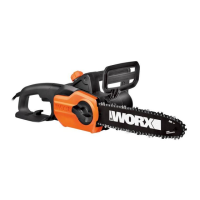
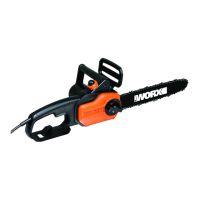
This document describes the WORX WG303E Chain Saw, a power tool designed for sawing trees, tree trunks, branches, wooden beams, and planks. It is suitable for cutting with or across the grain of wood but is not intended for sawing mineral materials.
Function Description
The chain saw operates with a chain and guide bar assembly. The chain is driven by a sprocket and moves around the guide bar to perform cutting. An automatic oiler system ensures continuous lubrication of the chain and bar during operation, which is crucial for optimal performance and chain life. The chain saw features a chain stop lever (hand guard) that acts as a safety mechanism, quickly stopping the chain in case of kickback or when activated by the operator's hand. A lock-off button prevents accidental starting, requiring the user to press it before fully engaging the on/off switch. The chain tensioning knob allows for easy adjustment of chain tension, which is vital for safe and efficient operation.
Usage Features
Before use, the chain saw requires assembly of the chain and guide bar. It is critical to ensure the chain is correctly oriented and tensioned. New saw chains will stretch, so frequent tension checks and adjustments are necessary. The oil tank must be filled with recommended bar and chain oil before use, as operating without oil can cause extensive damage. The automatic oiler's function can be checked by observing an oil pattern on cardboard when the saw is running.
When operating, users must wear safety glasses, hearing protection, and other protective equipment like a dust mask, non-skid safety shoes, hard hat, and gloves. The chain saw should always be held with both hands, maintaining a firm grip with thumbs and fingers encircling the handles. Proper footing and balance are essential to prevent loss of control. The tool should not be used while tired, under the influence of substances, or in explosive atmospheres.
For basic felling, limbing, and cross-cutting, specific techniques are recommended. When felling a tree, an escape path should be planned, and the natural lean of the tree, branch locations, and wind direction should be considered. Notching and felling back cuts are performed in a specific sequence to control the tree's fall. Limbing involves removing branches from a fallen tree, with larger lower limbs left to support the log. Bucking a log involves cutting it into lengths, with techniques varying based on how the log is supported (overbucking from the top, underbucking from the bottom).
The chain saw is equipped with kickback safety devices, including a low-kickback chain and a reduced kickback guide bar. To further reduce kickback risk, operators should maintain a firm grip, keep all safety items in place, avoid overreaching, maintain solid footing, and prevent the guide bar nose from touching objects. It is important to cut only one log at a time and avoid plunge cuts with the guide bar nose.
Maintenance Features
Regular maintenance is crucial for the chain saw's long and reliable service. Before any maintenance, the tool must be unplugged from the power source. Users should regularly check for defects such as loose, dislodged, or damaged chain and guide bar, loose fixings, and worn components. Covers and guards should be undamaged and correctly fitted.
Bar maintenance includes cleaning the bar rails every time the chain is removed or if they appear dirty. The inner groove of the bar should be cleared of residue using a wire brush or screwdriver. Oil passages must also be thoroughly cleaned. The guide bar should be replaced if it is worn, bent, cracked, or shows signs of excessive heating or burring. To extend guide bar life, it should be turned 180° when replacing the chain to ensure even wear. The drive sprocket should be checked for wear and replaced if damaged.
The chain should be sharpened professionally or using a sharpening kit according to the manufacturer's instructions. The sprocket also requires lubrication; grease should be injected into the lubrication hole until it appears at the outside edge of the sprocket tip. The sprocket should be rotated to ensure complete lubrication.
For cleaning, the plastic housing should be wiped with a soft brush and clean cloth, avoiding water, solvents, or polishes. All debris, especially from motor cooling vents, should be removed. The cover plate, chain, and chain bar should be brushed clean after 1 to 3 hours of use, and the area underneath the cover plate, the drive sprocket, and chain bar assembly should also be cleaned. The oil outlet should be cleaned with a clean cloth.
When storing the chain saw for an extended period, the chain and bar should be cleaned, and the oil tank must be completely emptied to prevent leakage. The machine should be stored in a secure, dry place, out of reach of children, and in a horizontal position with the oil filler cap uppermost.



 To Next Page

 General
 Weight and Dimensions