10 World Precision Instruments
hen ing the eletde ith a ell late, emmend the lling id
levels:
• Apical well – 250 µl
• Basal well – 750-1000 µl (when using a Corning 347x plate).
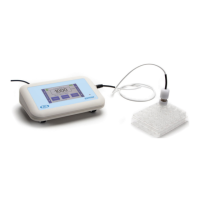
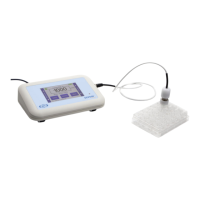
Place the electrodes into the well so the outer tip passes between the outer edge of
the insert and the inner well of the insert. Release the electrode so that it stands free,
then after a few seconds record the reading. Slide the cable on the table toward the
plate and electrode to prevent tipping.
Theory of Operation
The EVOM3 system uses a four electrode sensor, two for current sourcing and two for
voltage measurement.
The EVOM3 passes a known constant current through the membrane on two
electrodes and measures the voltage needed to pass that current on the other two
electrodes and computes resistance using Ohms law. The polarity of the current
changes from positive current to negative current 12.5 times per second. This polarity
hange aid leaing a hage n the memane and negate an ltage et de
to the membrane potential or from the electrodes. The amount of current and voltage
i l (, ) t minimie an tie timlatin and t eent the migatin
of metal ions.
Main Display
Touch to short electrodes
Preview the plate by its
layout
File name, defined in the
storage options menu
Current cell in plate Battery indicator
Range (V, mV, Ω, KΩ)
Press to record and index
to the next well. Press and
hold to open the storage
options menu
Fig. 6—The main EVOM3 display.
A negative resistance number will appear in red test. This can be caused by a faulty
electrode in media, (see "Troubleshooting" on page 29) or a blank setting that is
over the measurement (see "Blank Handling Page" on page 13).



 To Next Page