42 World Precision Instruments
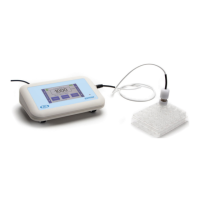
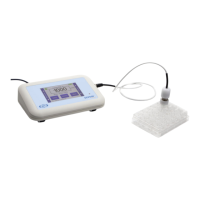
Fig. 54—Electrodes in solution
Unit Area Resistance
As the resistance is inversely proportional to the area of the tissue, instead of
reporting resistance, typically the product of the resistance and the area is calculated
and reported. The unit area resistance is independent of the area of the membrane
ed and ma e ed t mae data tained m inet dieent ie
NOTE: Resistance readings for 24 mm or larger diameter inserts obtained by using
the EVOM3 with the STX electrodes should not be converted to unit area resistance.
The EndOhm is recommended for these larger inserts. The unit area resistance is
tained mltiling the mete eading the eetie ae aea the filte
membrane. The dimension is Ω-cm
2
. The resistance is inversely proportional to the
surface area. Thus, the larger the membrane, the lower the resistance.
Reitane a nit aea Reitane (Ω) etie emane ea (m
2
)
ee manating eifiatin the atila inet
nit ea m
2
The unit area resistance is independent of the area of the membrane used and may
e ed t mae data tained m inet dieent ie
Continuing with the previous example, in which the R
true tissue
Ω, i an eetie
membrane diameter (d) was 6.5 mm, the unit area resistance would be:
Reitane etie emane ea Ω
2
Ω * 3.14* 3.25* 3.25 / 100
Ω * 0.331 cm
2
Ω-cm
2
.
2024 Ω is the resistance of a unit area of 1 cm
2
(TEER).



 To Next Page