
 Need help?
Do you have a question about the AA4C AA-2PFP45 and is the answer not in the manual?
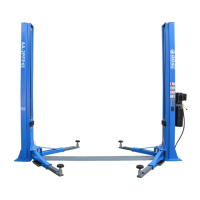
Details the fixed structure of the 2-post lift, including posts and base.
Describes the moving units, comprising carriages, chains, cables, and arms.
Explains the lifting unit, consisting of hydraulic cylinders and related components.
Lists the components of the hydraulic power unit, including motor, pump, and tank.
Outlines the various safety devices incorporated into the lift system.
Provides overall dimensions and key measurements of the lift.
Details the specifications of the electric motor used in the lift.
Lists the specifications for the hydraulic unit pump.
Specifies the type and quality requirements for hydraulic oil.
Refers to the electrical diagram for system understanding.
Illustrates the connection diagram for hydraulic oil hoses.
Defines the maximum vehicle weight and size limitations for the lift.
Specifies the maximum dimensions of vehicles that can be safely lifted.
Provides clear explanations of risks, safety devices, and correct usage procedures.
Lists unauthorized uses and disclaims liability for misuse.
Defines the safety area and operator position during lift operations.
Operator and fitter must observe accident prevention legislation and manual instructions.
Highlights specific safety notices for areas with high electric shock risk.
Examines risks to operator/fitters and protection devices.
Discusses longitudinal and lateral vehicle movement risks and how to avoid them.
Warns against moving the vehicle while it rests on support plates.
Emphasizes correct vehicle positioning and adherence to load capacity.
Details risks during lifting and installed safety devices for protection.
Explains the function of safety wedges and limit switches in preventing descent.
Identifies risks to personnel during lift operation.
Describes the risk of crushing for the operator during descent.
Details the risk of crushing for personnel in the lift area.
Warns about impact risks at head height and precautions.
Addresses risks associated with vehicle movement during operations.
Explains causes of vehicle fall risk, like incorrect positioning.
Discusses slipping risks due to oil spillage in the surrounding area.
Emphasizes keeping the area clean and managing oil spills.
Details risks of electric shock and precautions for electrical components.
Discusses component reliability and the importance of maintenance.
Covers risks arising from improper or unauthorized uses of the lift.
Provides safety instructions for performing maintenance and repair work.
States that installation must be done by authorized specialized personnel only.
Lists essential checks and requirements before installing the lift.
Details the necessary clearances and site suitability for installation.
Specifies lighting requirements for the installation area.
Defines the specifications for the concrete floor installation base.
Provides instructions for assembling the lift components.
Emphasizes that assembly must be performed by authorized personnel.
Details the steps for assembling the lift posts.
Instructions for connecting the hydraulic system components.
Details the procedures for connecting the electrical system to the lift.
States that electrical connections must be made by skilled personnel.
Checks to perform before connecting the electrical system.
How to check and ensure correct motor rotation direction.
Steps for assembling the lift arms onto the carriages.
Crucial safety warning to cut off power before arm assembly.
Instructions for installing the cover plates.
Steps for installing the spring screw into the basement.
Lists all tests and checks required before the initial start-up.
Details mechanical tests to verify assembly and functionality.
Specifies electrical tests to ensure proper connections and grounding.
Checks for the operation of key devices like limit switches.
Verifies hydraulic oil level and checks for leaks.
Tests the motor's rotation direction for correct operation.
Procedures for setting up the lift after installation.
States that setup operations must be performed by authorized service technicians.
Checks performed without a load to verify lift functions.
Final tests performed with a vehicle load to confirm safety and stability.
Describes the control devices and their functions.
Explains the function of the up push button for lifting.
Details how to use the lowering lever to descend the lift.
Outlines the step-by-step sequence for operating the lift.
Instructions for the lifting procedure, including safety wedge engagement.
How to park the lift at the desired height using the safety wedges.
Procedures for safely lowering the lift and vehicle.
Essential safety precautions to be followed during maintenance.
States that maintenance must be performed by skilled personnel only.
Prohibits maintenance or lubrication of moving parts.
Important notes for ensuring proper cable maintenance.
Outlines the schedule and requirements for periodic maintenance.
Clarifies that frequency refers to normal operating conditions.
Critical safety rule: maintenance only when lift is stopped and locked.
Checks to perform after the machine has been installed.
Monthly maintenance tasks for the hydraulic power unit.
Instructions for checking the hydraulic circuit for oil leaks.
Three-month maintenance checks for the hydraulic pump and synchronous systems.
Checks for synchronous systems, safety wedges, and wear.
Six-month maintenance checks for hydraulic oil and synchronous cables.
Procedure for replacing hydraulic plant oil.
Annual maintenance checks for general, electric, and hydraulic systems.
Guide for troubleshooting issues, emphasizing safety precautions.
Lists common problems and their corresponding solutions.
Chart indicating lubrication points and frequency.
Detailed table of common lift problems, causes, and solutions.
Guidelines for the proper disposal of used hydraulic oil.
Procedures and safety precautions for machine demolition.
General safety precautions when replacing parts or making repairs.
Steps to follow when ordering replacement spare parts.
Lists available spare parts with their codes and names.
Outlines the warranty terms and conditions for the automotive lift.
 General
| Brand | AA4C |
|---|---|
| Model | AA-2PFP45 |
| Category | Lifting columns |
| Language | English |

 To Next Page