USER’S MANUAL
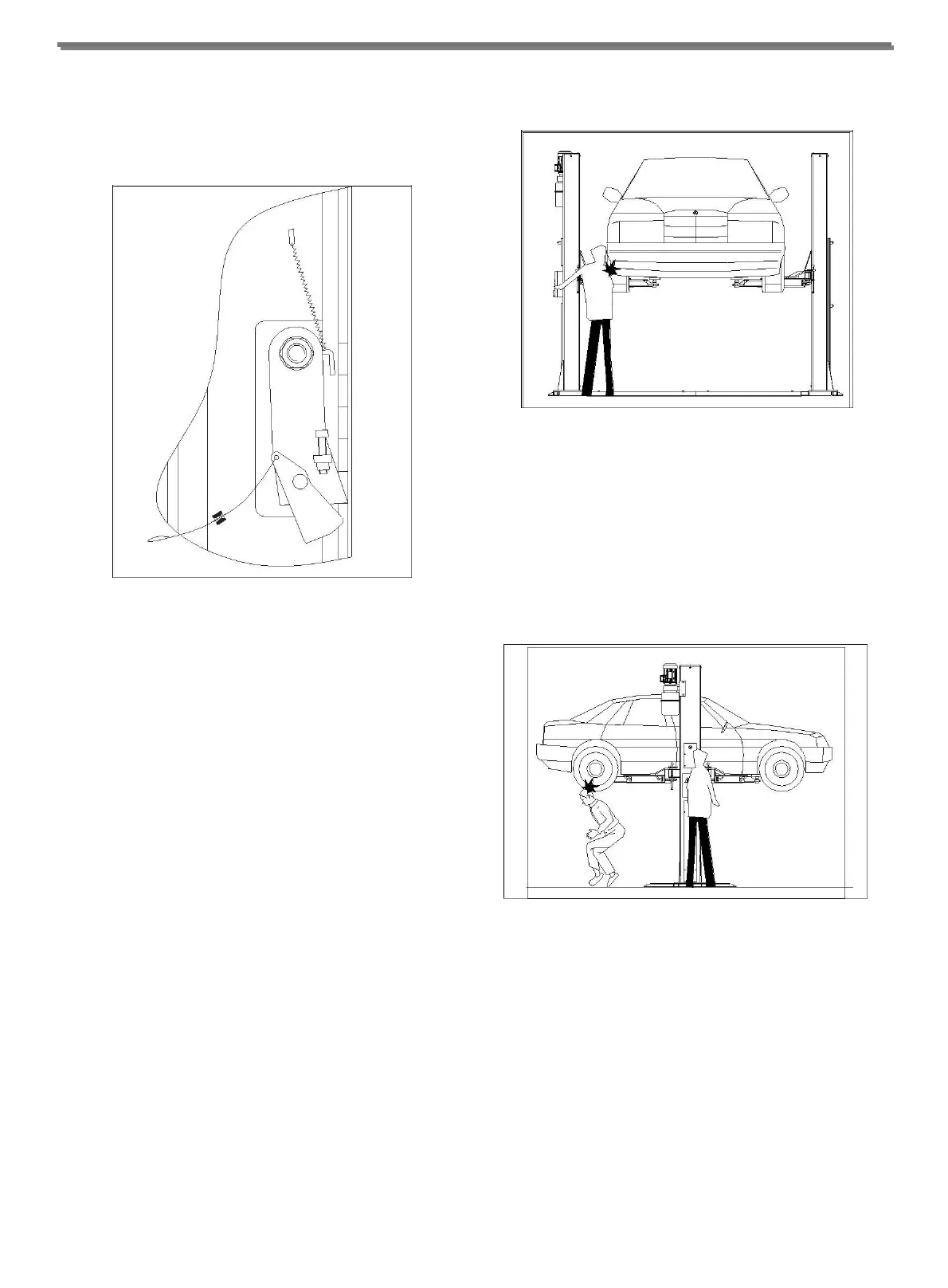
◆ If the hydraulic cylinder breaks, the safety wedges
will trip (Fig. 16), located inside the posts. The
wedges are pushed by the spring and immediately stop
the carriage preventing their descent.
structure. During this phase, the operator must remain in
the command zone. (Fig. 17)
Fig. 16
◆ If the moving part exceed its travel distance, on the
upper part of the command post there is one limit
switch and is usually set working by the “actuator”
(Fig. 14) on the command side carriage. If the first
limit switch did not work, the second one would trip
after 3sec of carriage run.
◆ In case of total breakdown of the limit switches, the
carriage will stop a few millimeter higher. Because the
hydraulic cylinders come to end stroke, will cause the
maximum pressure valve (on hydraulic unit) to trip.
Fig. 17
3.6.2 RISK OF CRUSHING (PERSONNEL)
When the platform and the vehicle are descending,
personnel are prohibited from entering the area beneath the
moving parts of the lift. (Fig. 18) The lift operator must not
start the maneuver until it has been clearly established that
there are no persons in potentially dangerous positions.
3.6 RISKS OF PERSONS
This paragraph illustrates risks to which the operator,
maintenance worker, or any person near the operating area
of the lift may be exposed in the case of impeccable use of
equipment.
3.6.1 RISK OF CRUSHING (OPEARATOR)
Possible if the operator controlling the lift is not in the
specified position at the command panel. When the
platform and the vehicle are descending, the operator must
never be partly or completely underneath the moving
Fig. 18
3.6.3 RISK OF IMPACT
Caused by the parts of the lift or the vehicle that are
positioned at head height. When, due to operational reasons,
the lift is immobilized at relatively low elevations (less
than 1.75m from the ground) personnel must be careful to
avoid impact with parts of the machine not marked with
special hazard coloring. (Fig. 19)
-8-


 To Next Page