CHAPTER 4 – TRANSPORTATION, STORAGE AND DISPOSAL 72
4.4 Lifting and transportation
4.4.1 General notes on transportation
Observe the following points when transporting
the cabinet:
• The cabinet can be transported using a crane or
a forklift.
• Drive components can be damaged during
transportation. Therefore, transport the cabi-
net in an upright position.
• When transporting the cabinet, ensure that no
dirt enters. Keep the doors closed. Metallic dust
in particular can cause damage and lead to mal-
function when the cabinet is powered up.
4.4.2 Using a crane
• Use lifting equipment (eg, web slings, chain
slings, round slings, safety hooks, shackles )
that corresponds to the weight of the cabinet.
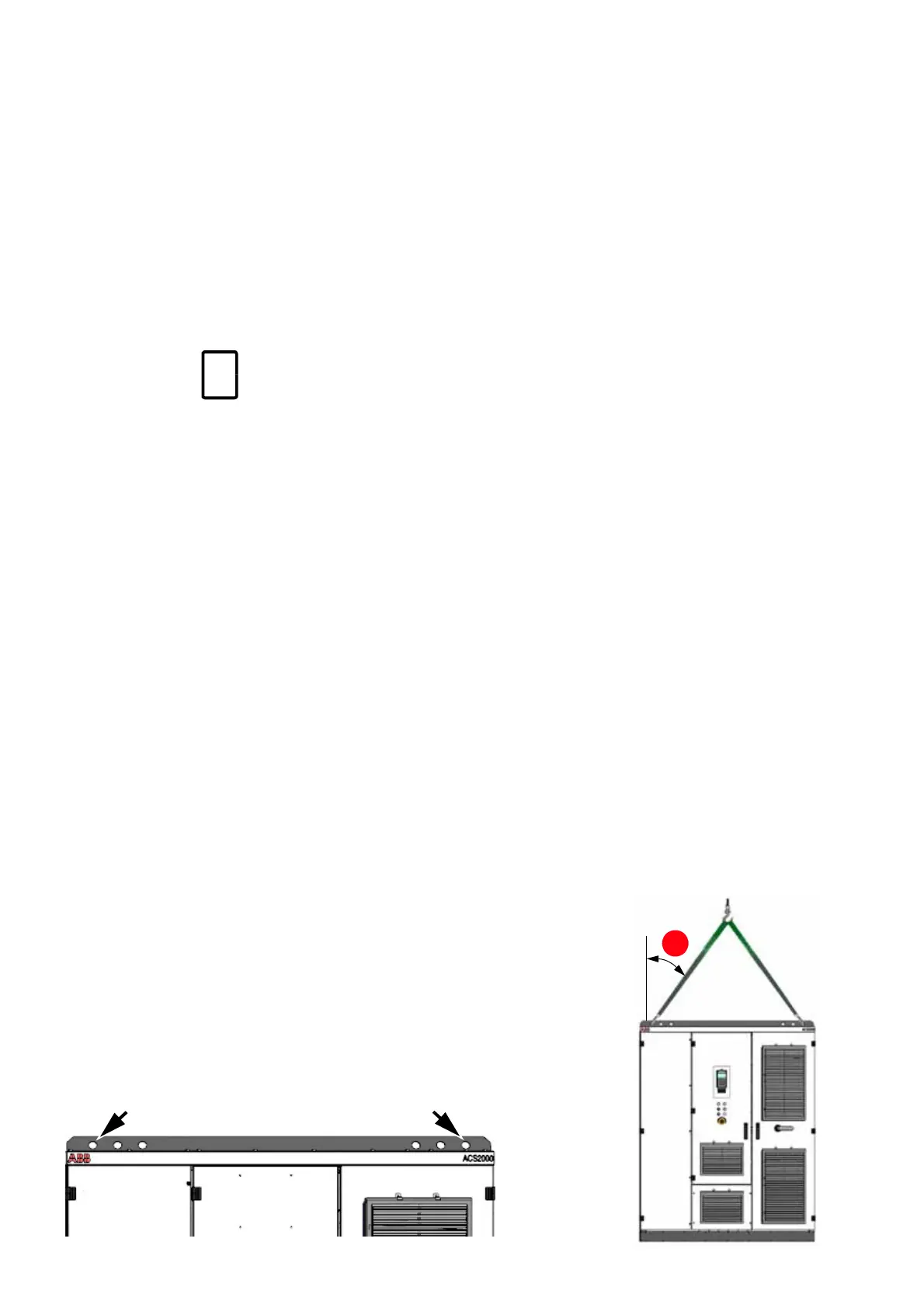
• Attach a sling to the outer holes of the rails
(arrows).
The rails can be removed after the cabinet has
been installed at its final location.
• Do not pass a sling through the hole.
To attach a sling, use appropriate safety hooks
or shackles
• Verify that the slope angle (1) is appropriate to
the weight of the cabinet.
• Observe the center of gravity.
• Lift the cabinet slowly and steadily to the
required clearance height maintaining the cabi-
net in upright position.
• Check the horizontal position of the cabinet.
Reposition the slings if necessary.
It is recommended to have the following
information at hand before transporting
the cabinet:
• Appendix C – Mechanical drawings
provides details on dimensions,
weight, and of center of gravity of the
cabinet.
• 10.6 Corrective maintenance provides
instructions if the door of the AFE-INU
compartment cannot be opened.
4-2 Transporting the
cabinet by crane


 To Next Page