16
CABLE CONNECTIONS
Before you connect the Virus to an AC outlet and the rest of your equipment, ensure that all of the
devices are switched OFF. If your Virus does not have a build-in keyboard, then connect the MIDI
OUT of the desired MIDI send device (keyboard, computer, hardware sequencer, etc.) with the MIDI
IN of the Virus.
Connect the audio outputs of the Virus with the signal inputs of your audio system. In order to
receive a signal, as a minimum you must connect the output OUT 1 R/MONO. However, we recom-
mend you also connect the output OUT 1 L so you are able to enjoy the stereo sounds of the Virus.
Once you have established the desired cable connections, make sure the main volume controls of
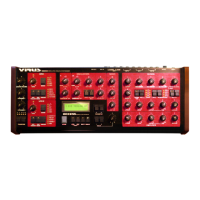
all the connected devices (Virus: MASTER VOLUME, located at the upper left hand of the control
panel) are dialed to the lowest possible setting. Switch the devices on in the following sequence:
the MIDI send device (computer, master keyboard, etc.) first, then the sound generators (Virus and
the other signal sources), followed by the mixing console and finally the amplifier.
Now while you are sending notes on MIDI Channel 1 of the Virus, turn the master volumes of the
connected devices up in the same order that you switched the devices on. Be sure to keep on eye
on the signal level indicators of your mixing console.
LISTENING TO THE FACTORY SOUNDS
The program memory of the Virus was loaded with sound programs (SINGLE PROGRAMs) and
sound combinations (MULTI PROGRAMs) before it left the factory. To hear the SINGLE PROGRAMs
(and gain an initial impression of the possibilities your new instrument has to offer in terms of
sounds), first make sure your MIDI source is sending on MIDI Channel 1.
Press the SINGLE button. A number, a letter, number and name appear in the display. These indi-
cate the the MIDI Channel, the current Program Bank (A to D) as well as the number and name of
the current sound program. Now if you play notes you should be able to hear this sound and a
≤
note (the round dot at the end of the note staff is solid black) should appear in the display every time
you press a key and release a key. If you do not hear a sound but you see a half note (blank note
head) check to see if you are sending on the wrong MIDI Channel.
Press the VALUE button to call up the 128 single programs of Bank A in sequence. (The VALUE pot
is inactive in this operating mode.) In order to hear the sound programs in banks B, C and D, simply
use the PARAMETER/BANK buttons to step from one program bank to another.
You’ll find that some sound programs are labeled with the abbreviations ”INP” or ”VOC”. These use
the external audio input as a signal source for the filter section (INP) or vocoder (VOC). This means
that you won’t hear anything until you route an audio signal into the external audio inputs.


 To Next Page