26
Filter Routing
The final parameter we’ll discuss for the time being is FILTER ROUTING. This feature offers several
filter routing options which allow you to operate the filters in series, i.e. patch one after the other in
the signal chain, or in parallel, which means side by side in the signal chain
Regardless of which FILTER ROUTING option you chose, the SATURATION stage is always post-Fil-
ter-1, i.e. after Filter in the signal chain.:
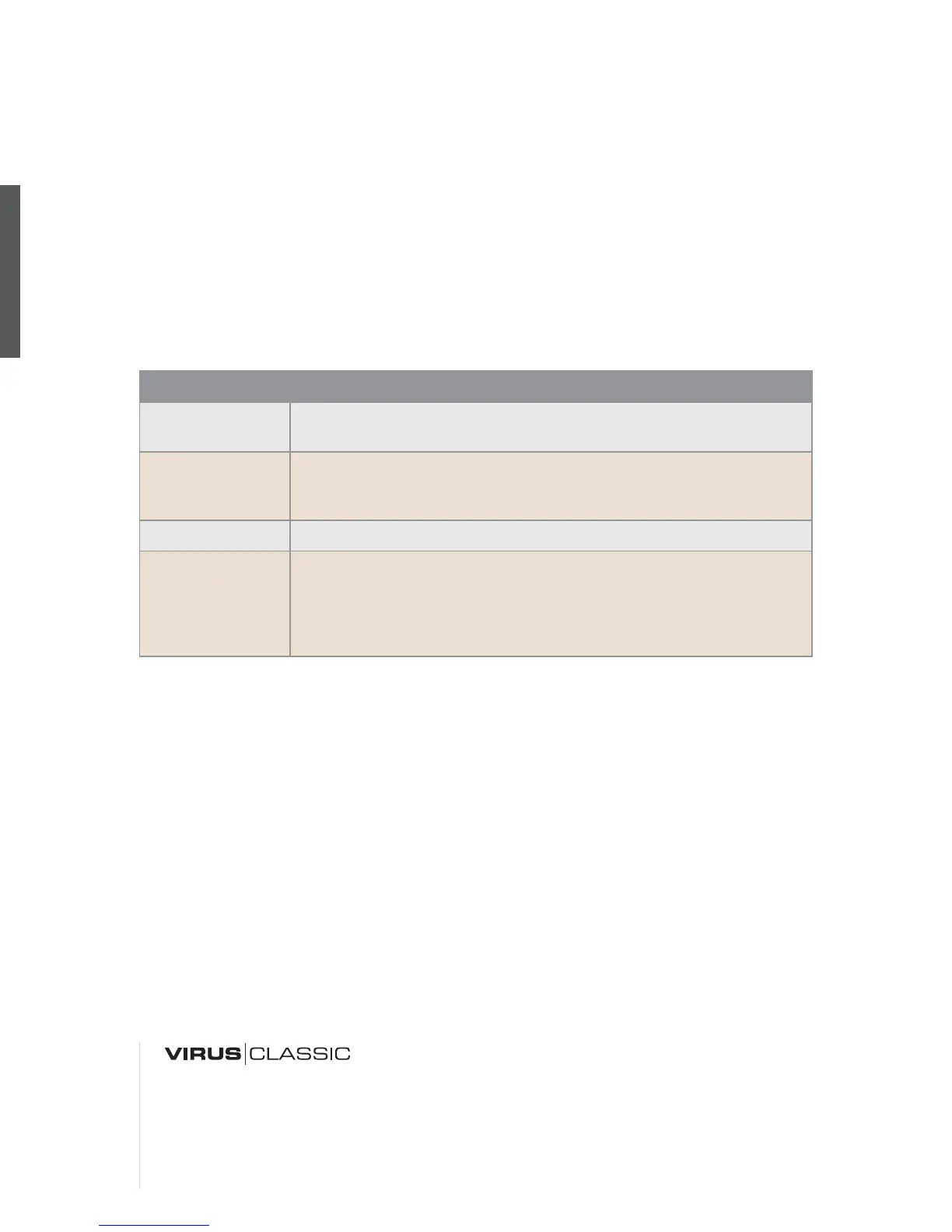
Mode Description
SER-4
The filters are switched in series; with two poles each (12dB/Okt.), both fil-
ters have the same slope for a total of four filter poles (24dB/Okt.).
SER-6
The filters are switched in series; Filter-1 has four poles (24dB/Okt.), Filter-2
has two poles (12dB/Okt.) so the overall slope is equivalent to six poles
(36dB/Okt.).
PAR-4
The filters are switched in parallel and feature two poles each (12dB/Okt.).
SPLIT
The filters are switched in parallel and feature two poles each (12dB/Okt.).
Additionally, they receive independent input signals (more on this later).
Each of the two oscillators routes its signal into one of the two filters whose
signals can be spread in the panorama via a parameter called UNISON Pan
Spread.


 To Next Page