User Manual Tags 3-5
3. If you find that a zone’s coverage is at unacceptable levels (too small,
too big, extends too far in one direction), look for factors that may be
affecting the zone (food carts, medical equipment, and/or building
construction).
4. If you cannot locate any immediate causes, contact your system
maintenance technician for further assistance.
When finished, deactivate the Test Tag using an S-TAD.
Identifying Foreign Tag-Activating Sources
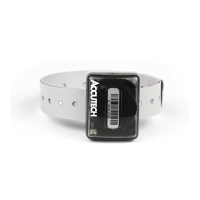
In addition to verifying proper zone coverage, an LED Tag (Figure 3.3) can be
used to identify foreign Tag-activating sources to help preserve your Tags’
battery life and prevent nuisance alarms.
Monitored zones emit a Tag-activating signal called the TX Activation Field.
When a Tag enters a zone’s Tx Activation Field, it is activated. The system
detects the activated Tag and takes appropriate action response.
However, there are sources that can activate a Tag other than a TX Activation
Field. When Tags are activated by these “foreign” sources, battery life is
depleted and/or nuisance alarms can be caused. Therefore, identifying these
sources will prolong Tags battery life and prevent nuisance alarms.
To identify activating sources with a Test Tag, use the following instructions:
1. Using an S-TAD, activate the Test Tag.
NOTE: Once activated the Test Tag’s LED will change state when it is
in a TX Activation Field. Therefore, to verify the Test Tag is active,
turn on the TAD and place the Test Tag near it. The Test Tag’s LED
will change state since an S-TAD has a small TX Activation Field
associated with it.
2. With the Test Tag in your hand, slowly investigate each area for
possible activating sources*. The Test Tag’s LED will illuminate
when it detects an activating source. Note each activating source and
keep Tags away from those sources.
3. When finished, deactivate the Test Tag using an S-TAD.
*Some activating sources can be:
Computer Monitors
Unshielded computer cables
Television Sets
Medical Monitoring
equipment
X-ray and other imaging
equipment
Fluorescent Lighting
Wireless Communication
Devices



 To Next Page