©2018 ACP, Inc.
Cedar Rapids, IA 52404 Page 41 of 80
Part No. 16400033
Original Instructions
Service Test Mode
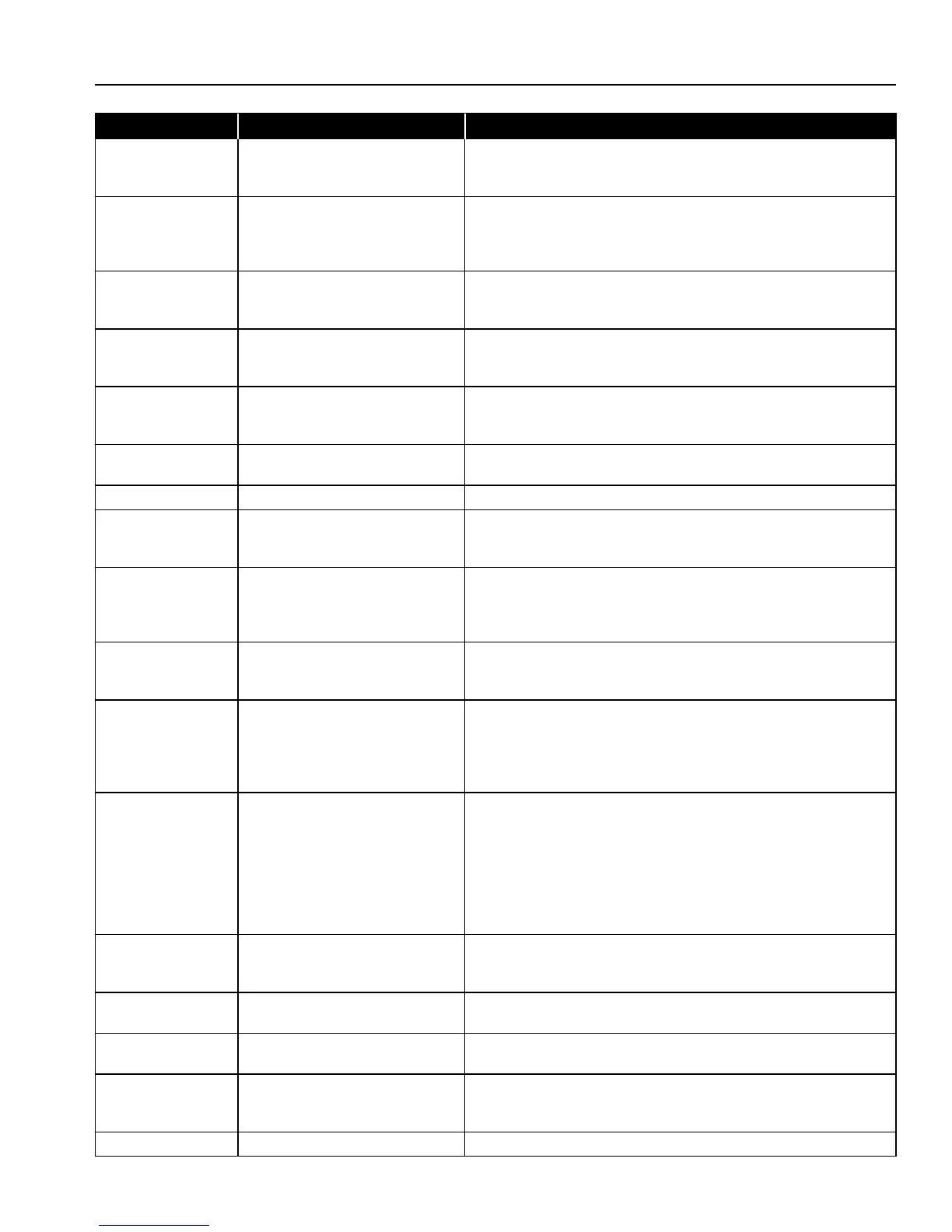
Service Mode Purpose Comments
Oven Information Provide service provider with
Door Cycles and Magnetron Tube
Hours of operation.
Press and the following will display:
Door Cycles:
Tube Hours:
Software Version Displays the version of software
and rmware installed in the
control.
Press and the following will display:
SW:
EE:
App:
Magnetron 1
Right Side
System can be started and
stopped by pressing the Start or
Stop Icon.
The current amperage being drawn by the HV system. 5 -12 amps
is considered normal. Look for consistent reading with Magnetron 2
and Convection Heater. This circuit is protected by Fuse F3.
Magnetron 2
Left Side
System can be started and
stopped by pressing the Start or
Stop Icon.
The current amperage being drawn by the HV system. 5 -12 amps
is considered normal. Look for consistent reading with Magnetron 1
and Convection Heater. This circuit is protected by Fuse F4.
Both Magnetrons Both systems can be started and
stopped by pressing the Start or
Stop Icon.
The current amperage being drawn by BOTH HV systems. Look for
consistent readings with Convection Heater. These are protected by
Fuses F3 & F4.
Convection Heater Heater can be stopped and started
by pressing the Start or Stop Icon.
The current amperage being drawn by the Convection Heater. 7-15
amps is considered normal. This circuit protected by Fuse F5.
Radiant Heaters Not Used for this model.
Convection Fan
Low
Convection Fan Motor Low Speed
can be stopped and started by
pressing the Start or Stop Icon.
The current amperage being drawn by the Convection Fan Motor
on low speed. <2 amps and fan motor operating noise is considered
normal. This circuit is protected by Fuse F2.
Convection Fan
High
Convection Fan Motor High
Speed can be stopped and
started by pressing the Start or
Stop Icon.
The current amperage being drawn by the Convection Fan Motor on
high speed. <3 amps and a high speed fan motor operating noise is
considered normal.
Cooling Fan Motors can be stopped and
started by pressing the Start or
Stop Icon.
The current amperage being drawn by both the Cooling Fan Motors.
1-3 amps is considered normal. A failed Cooling Fan motor will likely
result in a G2 Error Code.
Antenna Motor The Antenna Motor can be started
by pressing the Start Icon.
NOTE: The Stop Icon will not stop
the Antenna Motor.
USE RADIANT RTD READING ONLY.
The Radiant RTD is located between the Magnetrons on top of the
oven. To reset maximum temperature reading, press and hold the
Max Radiant RTD for several seconds - temperature will change to
then current temperature sensed.
RTD Resistive Thermal Devices (Temp
Sensors)
Press and the current temperature
sensed by the RTD along with the
maximum temperature recorded.
MRX OVENS ONLY HAVE ONE RTD AND MAXIMUM READING
IS NOT USED. “NON USED” READING WILL BE 656 or 657 –
USE RADIANT RTD READING ONLY.
The Radiant RTD is located at the back center of oven. The
Convection RTD is located on the upper left by the Convection
Element. To reset maximum temperature reading, press and hold
the Max Convection RTD for several seconds—temperature will
change to the current temperature sensed.
Memory Attached Memory Devices Press and the following will display:
USB Present or Absent
SD Card Present or Absent
Error History Chronological List of Errors
experienced by the Control.
Press and the following will display:
Error Code Date, Time, and Code (see Error Code List in this section)
Voltage Switching Displays the voltage as sensed by
the Control.
Pressing has no eect.
Temperature Oset The degree of oset programmed
into Control to synchronize
Control to cavity temperature.
Press and the following will display: The amount of temperature
oset programmed by the factory
Pin Code Displays the 4 Digit Pin Code Pressing has no eect.



 To Next Page