
 Need help?
Do you have a question about the ADJ FOCUS PROFILE and is the answer not in the manual?
Provides contact information for ADJ service and support across different regions.
Instructions for ordering spare parts for ADJ products through their online portal.
Outlines specific warranty durations for different categories of ADJ products.
Lists the circumstances under which the fixture should be serviced by qualified technicians.
Details the necessary DMX cable types, connectors, and pin configurations for reliable operation.
Explains the use of terminators to prevent signal errors and interference in DMX chains.
Provides guidance on adapting 5-pin XLR DMX cables for use with 3-pin DMX fixtures.
Defines the fixture's IP20 rating, specifying its resistance to solid objects.
Advises maintaining a safe distance from flammable materials to prevent fire hazards.
Guidance on electrical hookups and limitations for multi-unit daisy chaining.
Warns against exposing the fixture lens to direct light beams which can cause internal damage.
Details how to attach mounting clamps and safety cables for secure overhead installation.
Highlights the need for professional expertise and safety checks for rigging operations.
Describes the three operational mounting orientations: upside-down, sideways, and flat.
Specifies the upper limit for ambient temperature to ensure optimal fixture performance.
Explains how to use buttons (MODE, UP, DOWN, ENTER, LEFT, RIGHT) to access and adjust settings.
Describes the use of the internal battery for powering the control panel and display.
Instructions on how to invert the screen display using the RIGHT button.
Options for setting DMX channel modes: Basic 36, Standard 40, or Extended 51.
Covers status settings, fixture ID, protocol settings, and fan adjustments.
Configuration options for different dimming modes and speed adjustments.
Selection of dimming curve types: Linear, Square, Inverse Square, S-Curve.
Options to reset various motors and effects, such as Pan/Tilt, Color, and Gobo.
Controls for display inversion, screen saver delay, and locking the control panel.
Detailed parameters for manual control of Pan, Tilt, Color, Gobo, and more.
Lists parameters for manual control of Gobo, Shutter, Dimmer, Prism, Focus, Zoom, and Iris.
Settings for internal programs, including speed and fade parameters for programs 1-5.
Configuration for internal programs 6 and 7, covering speed and fade.
Information regarding power-on times, LED run times, and resets.
Details on monitoring LED temperatures, fan speeds, and base temperatures.
Accessing error logs, resetting error logs, and checking the current software version.
Guidance on assigning DMX starting addresses to ensure correct fixture response.
Illustrates DMX address assignment for 36, 40, and 51 channel modes.
Details the DMX channels and values for Pan and Tilt movement and fine adjustments.
Specifies DMX channels for Cyan, Magenta, Yellow, and CTO color mixing.
Lists DMX values corresponding to various Kelvin color temperature presets.
Further details on color selection, color wheel rotation, and effects.
DMX channels for selecting rotating gobos, continuous rotation, and shake effects.
DMX control for gobo rotation, indexing, and fine adjustments.
DMX channels for selecting fixed gobos, their rotation, and shake effects.
DMX control for shutter operations, including open, closed, strobe, and pulse effects.
DMX channels for controlling dimmer intensity and fine adjustments.
DMX channels for Prism 1 and Prism 2 effects, including indexing and rotation.
DMX channels for adjusting focus, zoom, iris diameter, and fine-tuning these effects.
DMX control for animation wheel indexing and rotation speed and direction.
DMX channels for controlling frame rotation, position, and speed.
Lists DMX values for selecting various frame macros (Macro1 to Macro28).
Details DMX values for frame macros Macro29 to Macro31.
DMX channels for selecting dim modes and dimming curve types.
DMX control for special functions and setting the LED refresh rate.
Lists DMX values for various refresh rates from 900 Hz to 1260 Hz.
Lists DMX values for refresh rates from 1270 Hz up to 10,000 Hz.
DMX control for LED refresh rate, blackout during movement, and color/gobo changes.
DMX options for resetting motors, setting fan modes, and idle states.
DMX control for internal programs and enabling/disabling CT mode.
Details rise and down times for different dimming curve ramp effects.
Graphical representations of Linear, Square, Inverse Square, and S-Curve dimming modes.
Guidelines for cleaning the fixture, including what not to use (solvents, ammonia).
Recommendations for regular inspections, checking screws, deformation, and cables.
Step-by-step guide for replacing the fixture's fuse using a flat head screwdriver.
Detailed instructions for updating fixture software using a USB flash drive.
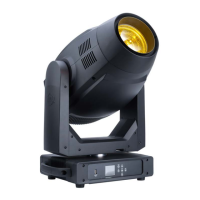
Details the LED engine, lumen output, and lux values at specific distances.
Lists the fixture's effects, color mixing, and gobo types (rotating and static).
Covers DMX modes, RDM, panel type, resolution, connectors, and thermal/acoustic ratings.
Provides physical dimensions, weight, electrical/thermal specs, and safety approvals.
 General
| Light Source | LED |
|---|---|
| Beam Angle | 6 ~ 45 degrees |
| Control Protocol | DMX512, RDM |
| Gobo Wheel 1 | 7 rotating gobos |
| Gobo Wheel 2 | 7 rotating gobos |
| Focus | Yes |
| Zoom | Yes |
| Iris | Yes |
| Frost | Yes |
| Dimming | 0-100% |
| Pan | 540 degrees |
| Tilt | 270 degrees |
| Gobo Rotation | Yes |
| Strobe | Yes |
| Power Supply | AC 100-240V, 50/60Hz |


 To Next Page