72
6. Press the EDIT button to exit edit mode;
7. Press the EXT SYNC button to enable external synchronization.
Note: The EXT SYNC button cannot be turned on until you have
selected a synchronization source. If the EXT SYNC button is
pressed when both the Locate Reference and the Clock Source are
set to Internal, the following display will briefly appear:
Must select
external source
Because there are so many different combinations of external and
internal synchronization available, the following chart can be used to
distinguish the importance of each.
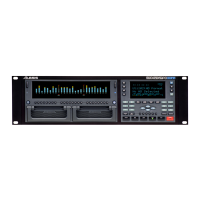
• Locate Reference = Internal; Clock Source = Internal: This is the
setup for using no external synchronization, where the BRC
provides its own location and clock information, and is therefore
the master of your system. This setup is equivalent to when the
EXT SYNC button is off.
• Locate Reference = Internal; Clock Source = 48 KHz Input: This is
the setup to be used when recording from an Alesis AI-1, where its
48 KHz clock signal is begin fed to the BRC. The BRC in this
scenario will still use its own internal locate reference.
• Locate Reference = Internal; Clock Source = Video Input: Use this
setup when you wish to synchronize the BRC’s clock to either
composite video or black-burst video sync. The BRC will
automatically recognize the type of video signal (NTSC, PAL or
SECAM) and its sample clock will be in sync with video, although
the BRC will not be locked to the video’s position. This setup is
also useful when you wish to use the BRC to stripe SMPTE to the
audio track of the video tape. The BRC is sample-locked to the
video sync while striping the tape with SMPTE, generating 29.97
fps or 29.97 fps Drop-Frame for NTSC or 25 fps for PAL or SECAM
(see section 5.0D). By striping the video tape in this manner, the
SMPTE on the tape will now be frame-locked to the video frames.
• Locate Reference = Internal; Clock Source = SMPTE Input: This is a
form of “direct SMPTE lock”. This is because, although the clock
information is coming from a SMPTE source, the BRC ignores the
locate reference and uses its own internal locate information. This
can be useful when the SMPTE source has sections which
suddenly jump in time (example: from 01:34:42:03 to 03:23:10:14),


 To Next Page