%5HY
10.4 Example
The following example shows how to calculate Peukert’s number and capacity from a configured battery string.
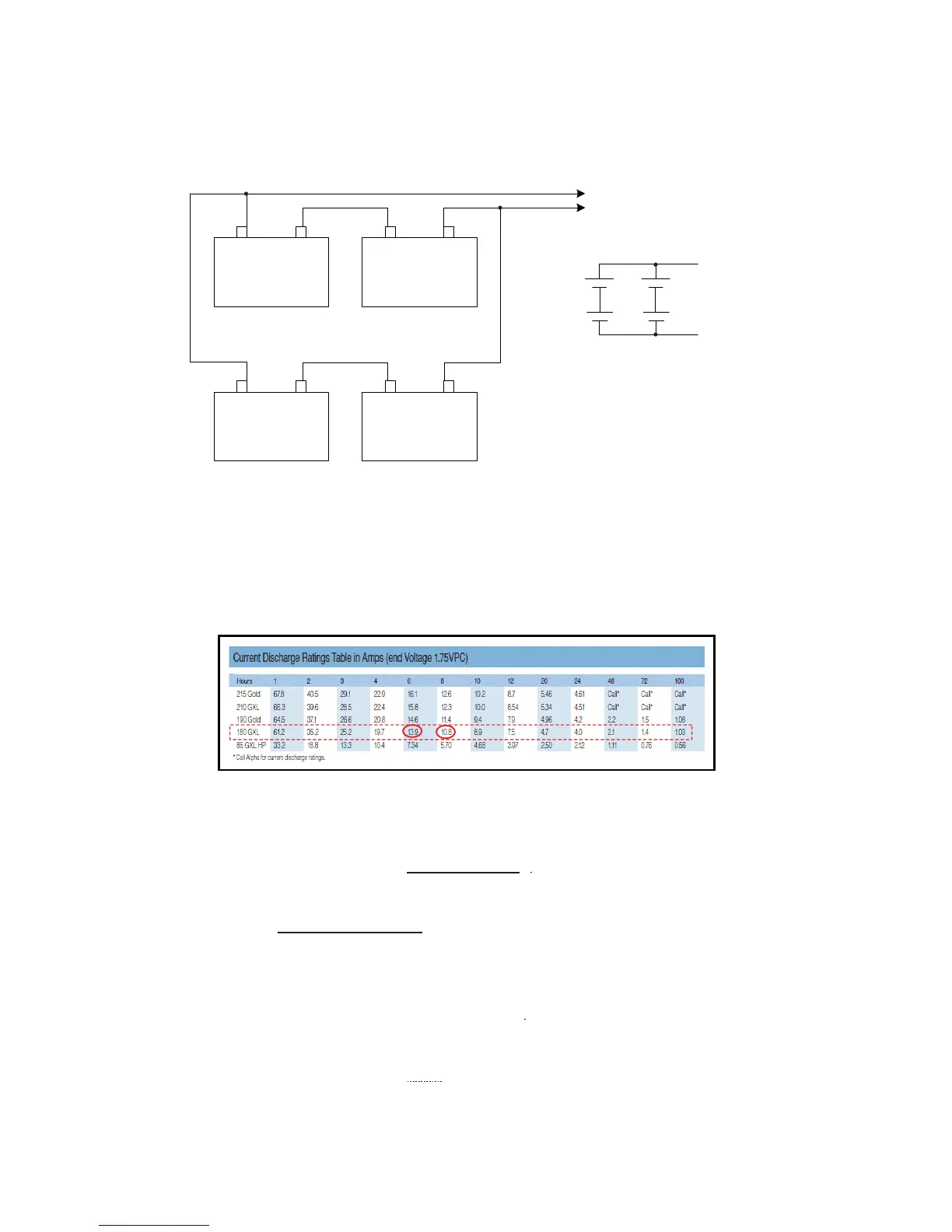
Consider four Alpha 180GXL batteries connected and configured as shown in the figure below. Two of the four
batteries are connected in series, and the two series strings are connected in parallel to the 24 V DC output.
*;/
9'&
*;/
9'&
*;/
9'&
9'&
*;/
9'&
ŷŷ
ŷ
ŷŷ
p
n
q
o
)LJXUH ² %DWWHU\VWULQJH[DPSOH
The Peukert’s number and capacity for the above configuration can be determined as follows:
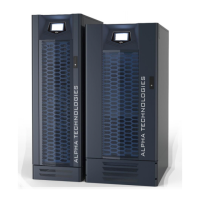
1. Obtain the data sheet of the selected battery. See table below.
2. Find the current discharge ratings table in the data sheet. From the table, pick two current discharge values
(I
1
and I
2
) that are closest to the calculated load current value. Look up the two discharge hours (R
1
and R
2
).
3. From the table, I1 = 13.9A, I2 = 10.8A, R1 = 6 hrs, R2 = 8 hrs.
From Equation (1) earlier:
n = = 1.14
Log (8/6)
Log (13.9) - Log (10.8)
Peukert’s number = n =
Log (R
2
/R
1
)
(Log (I
1
) - Log (I
2
))
From Equation (2) earlier
Peukert’s capacity = (I
1
)
n
x R
1
per battery
= (13.9)
1.14
x 6
= 120.55 Ah per battery
(3)
4. The Peukert’s capacity for the series combination (Batteries #1 and #2) is 120.55 Ah.
5. The Peukert’s capacity for the parallel combination (Batteries #1, #2 and #3, #4) is 2 x 120.55 Ah = 241.10 Ah..


 To Next Page