27
© 2014 Dectro International. All rights reserved.
Settings
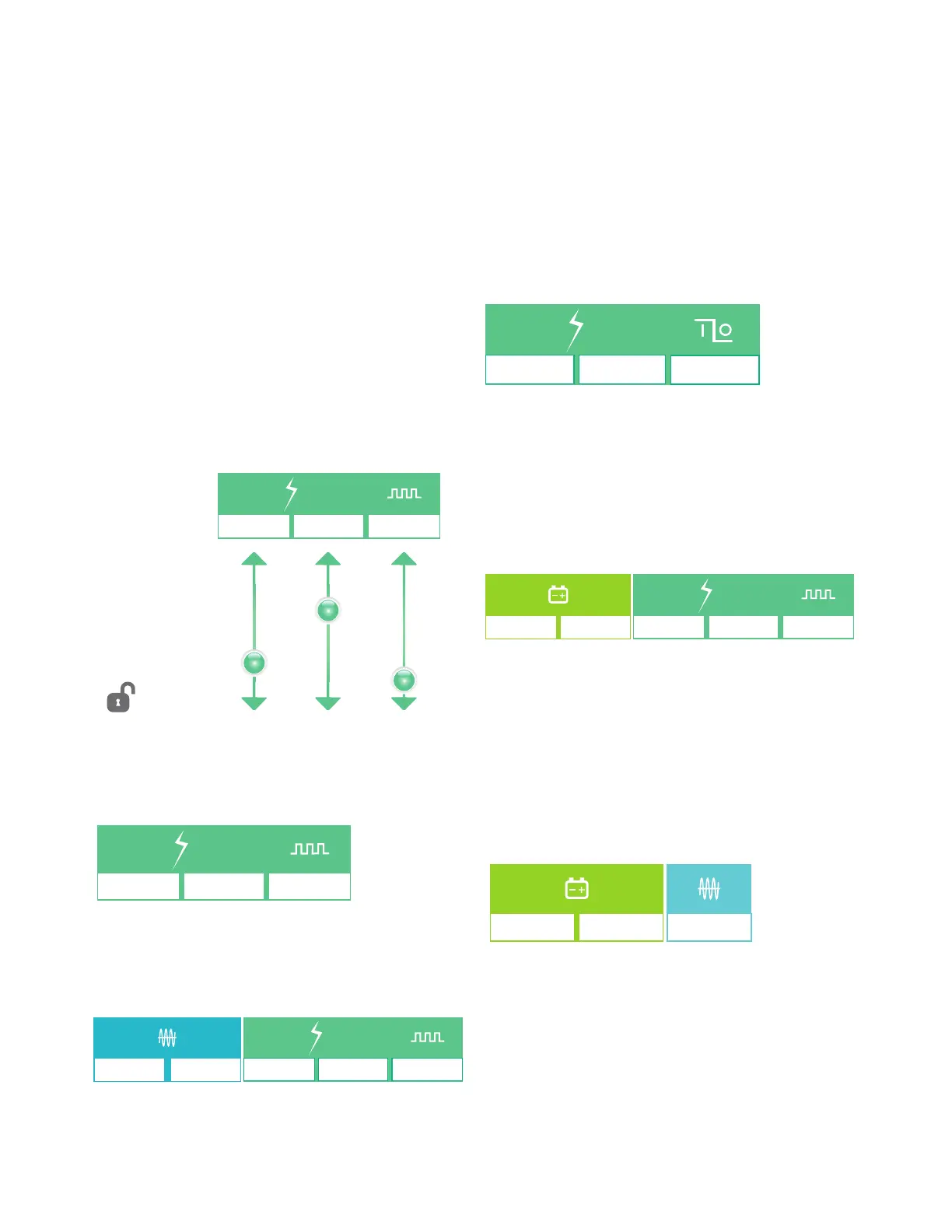
(Time, intensity, number of impulses, etc.)To modify
the settings, drag the circle along the arrow shaft
from top to bottom. You can also press directly on
the arrow up or down to increase or decrease the
value of a unit one at a time. It is also possible to
change the value for each setting by touching the
number for the time or intensity, which will open
a numerical keypad in order to enter the desired
value. The settings you are able to modify vary
from one mode to another. Once you are satisfied
with the settings, press the padlock in the bottom
left corner of the display or the pedal to lock-in your
selection. If you want to change the settings again,
you must first press the padlock to unlock the ope-
ration.
0.029 s 66 %
1 X
PicoFlash, MeloFlash
Transit time and impulse intensity for thermolysis;
number of impulses.
0.029 s 66 %
1 X
MultiPlex
Transit time and impulse intensity for thermolytic
heating, transit time and impulse intensity for ther-
molysis; number of thermolysis impulses.
5 %1.4 s
0.029 s 66 %
1 X
Synchro
Transit time and intensity setting of pico-impulses,
time/delay factor. (This factor allows you to choose
the selected length of each of the pico-impulses
and the thermal relaxation time between each pico-
impulse in milliseconds. The shorter the thermal
relaxation time between each impulse, the more
intense the heating will be.)
0.13 s 54 %
2/1
PicoBlend
Transit time and intensity setting of galvanic cur-
rent; transit time and intensity setting of thermolysis
impulses; the number of thermolysis impulse. It is
possible to perform an electrolysis treatment using
only galvanic current by inputting "0" impulses for
thermolytic heating.
7 s 0.45 mA
0.029 s 66 %
1 X
OmniBlend, EvoluBlend
Transit time and intensity setting of galvanic current,
the intensity of thermolytic heating (the computer
automatically calculates the intensity and length of
time of the heating according to the chosen set-
tings for galvanic current-actual value is displayed).
It is possible to perform an electrolysis treatment
using only galvanic current by inputting "0%" for
thermolytic heating.
7 s
5 %
0.45 mA


 To Next Page