32
Apogee Ensemble Thunderbolt | User’s Guide
Built In Mic
Ensemble features a built-in mic on the front panel that can be recorded, or used for the Talkback function (page
34)�
Recording the Built-In Mic
Ensemble’s Built-In Mic can be recorded into your computer in the same way as the other inputs on the
Ensemble�
• Because Ensemble requires inputs to be assigned as pairs, the Built-In Mic is assigned to channels 9/10�
• Even though the mic assigned to two channels, it is not stereo� Instead the mono signal is duplicated to both
channels�
• In your DAW, set the track’s Input Source to Channel 9 or Channel 10�
• The Built-In Mic gain is controlled from the Mix View of the Primary window in Apogee Control (page 45)�
Analog Audio Outputs
Ensemble provides 16 analog outputs for connecting to your external gear�
Monitor Out L1 & R2
Ensemble’s Monitor Out L1 & R2 are designed to connect to studio monitor speakers� These outputs
are controlled by the Output Controller knob, but can be set to a xed line-level output via the Device
Sidebar of the Apogee Control software� See the Monitor Control Center section on page 36 for more
information on conguring these outputs.
• Balanced 1/4 TRS outputs
• Can be congured as a xed line-out
• Can be set to +4dBu or -10dBV via the Apogee Control software (page 49)
Analog Out 3-10
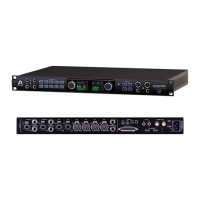
Ensemble provides additional balanced analog outputs via a 25-pin d-sub connector�
Connect an analog out breakout cable to this connector to access these outputs�
These outputs are set as xed line-level outputs by default, but outputs 3-10 can be
adjusted by the Output Controller knob when multiple speaker sets (page 36) or 9�1 surround monitoring (page
37) is enabled� See the Monitor Control Center section on page 36 for more information on conguring these
outputs�
• Balanced 25-pin D-Sub Output
• Can be set to +4dBu or -10dBV via Apogee Control (page 49)


 To Next Page