Need help?
Do you have a question about the Areva MiCOM P921 and is the answer not in the manual?
Provides crucial safety instructions for handling and operating the MiCOM relay to prevent damage and ensure user safety.
Details procedures for safe installation, commissioning, and maintenance of the MiCOM relay, including electrical isolation and grounding.
Outlines the operational requirements for the MiCOM relay, ensuring compliance with electrical and environmental standards.
Provides guidelines for the safe removal, disposal, and recycling of MiCOM relays and their components, adhering to environmental regulations.
Lists the technical specifications for the MiCOM relay, covering insulation levels, environmental conditions, and product safety compliance.
Provides general information on handling and precautions for protective relays, including receipt and electrostatic discharge (ESD) awareness.
Details essential precautions for handling electronic equipment to prevent damage from electrostatic discharge (ESD).
Describes methods for mounting MiCOM relays, including individual and rack mounting options, and test block placement.
Provides instructions for safely unpacking relays to prevent damage and loss of components, emphasizing careful handling.
Outlines recommended storage conditions for relays to maintain their integrity, focusing on protection from dust and moisture.
Introduces the MiCOM P921-P922-P923 relays, highlighting their features, modular design, and comprehensive protection capabilities.
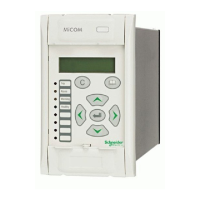
Describes the front panel of the relay, including the LCD display, keypad, and LEDs, explaining their functions and layout.
Details the rear view of the MiCOM P921, P922, and P923 relays, illustrating the terminal layout and connections.
Explains how to identify the MiCOM relay model, including cortec code, serial number, voltage ranges, and communication protocol.
Provides step-by-step instructions for correctly energising the MiCOM relay, including system and power supply connections.
Guides users on accessing and navigating the relay's menu structure, including password protection and setting modifications.
Describes a quick check procedure to verify the voltage measurement accuracy of the relay.
Explains how to establish local communication with the MiCOM relay using a PC and appropriate software (MiCOM S1 access).
Provides detailed wiring and connection diagrams for various configurations of MiCOM relays.
Lists contact details for AREVA's After Sales Service Department for product information and support.
Details the configurations for analogue voltage inputs (VTs), including phase-neutral and phase-phase connections with residual VT.
Describes the front port (RS232) and rear port (RS485) connections for communication with the MiCOM relay.
Provides the case dimensions for MiCOM P921, P922, and P923 relays, including panel and flush mounting details.
Specifies the electrical ratings for the MiCOM relays, including voltages, auxiliary supply, and frequency.
Details the burdens for voltage circuits, auxiliary supply, and optically-isolated inputs, indicating power consumption.
Defines the setting ranges for various protection functions, including undervoltage, overvoltage, and frequency.
Outlines the product's compliance with electrical and atmospheric environmental standards and tests.
Lists the ANSI/IEEE test requirements that the MiCOM relays meet for surge withstand and electromagnetic interference.
References the low voltage (safety and insulation) directive EN61010-1:1993, ensuring product safety compliance.
Provides definitions and notations used throughout the user guide for clarity and understanding of relay parameters.
Explains the different user interfaces available (Keypad/LCD, Front Port, Rear Port) for accessing relay information and settings.
Details the menu structure and column organization for the MiCOM P921 relay.
Details the menu structure and column organization for the MiCOM P922 relay.
Details the menu structure and column organization for the MiCOM P923 relay.
Covers general settings for MiCOM relays, including OP.PARAMETERS, password, description, reference, software version, frequency, inputs, and outputs.
Guides users through configuring the relay's protection, connection, VT ratios, LEDs, alarms, and input settings.
Explains how to access and interpret measured values for phase and line voltages, and frequency from the relay.
Details rear and front communication port management, including Courier, Modbus, and IEC60870-5-103 interfaces.
Describes the configuration and settings for various protection functions like undervoltage, overvoltage, and frequency.
Explains how to configure control functions such as trip output relays, latch outputs, blocking logic, and auxiliary outputs.
Details how to access and manage records functions for MiCOM P922 and P923, including CB monitoring, fault records, and disturbance records.
Explains how to display and interpret electrical system and relay hardware/software alarms indicated by the relay's default display and LEDs.
Provides guidelines for inspecting protective relays upon receipt to ensure no transit damage has occurred.
Details essential precautions for handling electronic components and printed circuit boards to prevent damage from electrostatic discharge (ESD).
Recommends proper storage conditions for relays, emphasizing protection from dust, moisture, and ambient conditions.
Provides instructions for carefully unpacking relays to prevent damage and ensure all parts are accounted for.
Describes methods for mounting MiCOM relays, including rack mounting and panel mounting options.
Guides users on selecting appropriate cable and connector types for MiCOM relay terminals, including medium/heavy duty connections and RS485 port.
Provides an overview of commissioning numeric relays, emphasizing verification of hardware function and application settings.
Advises users to familiarize themselves with the relay's menus and settings before commissioning.
Lists the minimum and optional equipment required for commissioning MiCOM relays, including test equipment and software.
Details checks to ensure the relay is undamaged, functioning correctly, and that input measurements are within tolerances.
Ensures that all protection, control, and logic equation settings are correctly applied to the relay.
Describes on-load checks to verify the accuracy of voltage measurements and system phase order.
Ensures all tests are complete, external wiring is reconnected, and records/alarms are reset before putting the relay into service.
Provides recommendations for periodic monitoring and maintenance checks to ensure the relay's continued correct operation.
A template for recording commissioning test details, including operator information, substation name, and relay settings.
Covers checks to ensure the relay is undamaged, correctly rated, properly earthed, and that wiring is correct.
Verifies that application-specific settings and programmable logic equations have been correctly applied and validated.
Details on-load checks for test cables, wiring, and voltage input parameters to ensure correct operation.
Provides default and configurable settings for various relay functions like password, wiring, protection, and VT ratios.
Details the configuration of logic inputs, timer delays in logic equations, and output relays/LEDs.
Lists the settings for various protection elements, including undervoltage, overvoltage, residual overvoltage, and frequency.
Covers checks related to CB supervision, disturbance records, and measurements.
Explains how to access and interpret disturbance records and measurement data from the relay.
Details the parameters required for remote communication using Modbus, Kbus/Courier, or IEC60870-5-103 protocols.
 General
| Application | Power System Protection |
|---|---|
| Frequency | 50/60 Hz |
| Storage Temperature | -40°C to +85°C |
| Humidity | Up to 95% non-condensing |
| Type | Protection Relay |
| Current Rating | 1 A / 5 A |
| Rated Current | 1 A / 5 A |
| Communication Protocols | IEC 61850, Modbus, DNP3 |
| Power Supply | AC or DC |
| Protection Functions | Overcurrent, Earth Fault, Overvoltage, Undervoltage |
| Enclosure | IP54 |


 To Next Page