Viron eQ Salt Chlorinator With Bluetooth | Installation and Operation Manual
Page 13
chlorine in your pool.
CyA is used to extend the life of chlorine when
the chlorine is manually added in the form of a
tablet, granules or liquid and it is not monitored
by a measuring device. This reduces the quantity
and cost of chlorine used and maintains a residual
chlorine in the pool even though manual dosing
may take place every 2 or 3 days.
At most, CyA should be managed and kept within
a range of 10 to 20 ppm when used in conjunction
with the eQ chlorinator installed with the Chlorine
Sensor. Ongoing use of Trichlor or Dichlor will
continue to raise the level of CyA causing a
reduction in the activity of the chlorine and may
cause your eQ Chlorinator to continue to raise the
chlorine levels to excessive levels in order to reach
the chlorine set point (ORP).
If supplementing chlorine is required, it is advisable
to use small amounts calcium hypochlorite or liquid
chlorine which does not use any CyA.
As a guide, the following set point ORP levels can
be used as a starting point to achieve a consistent
and reasonable chlorine level.
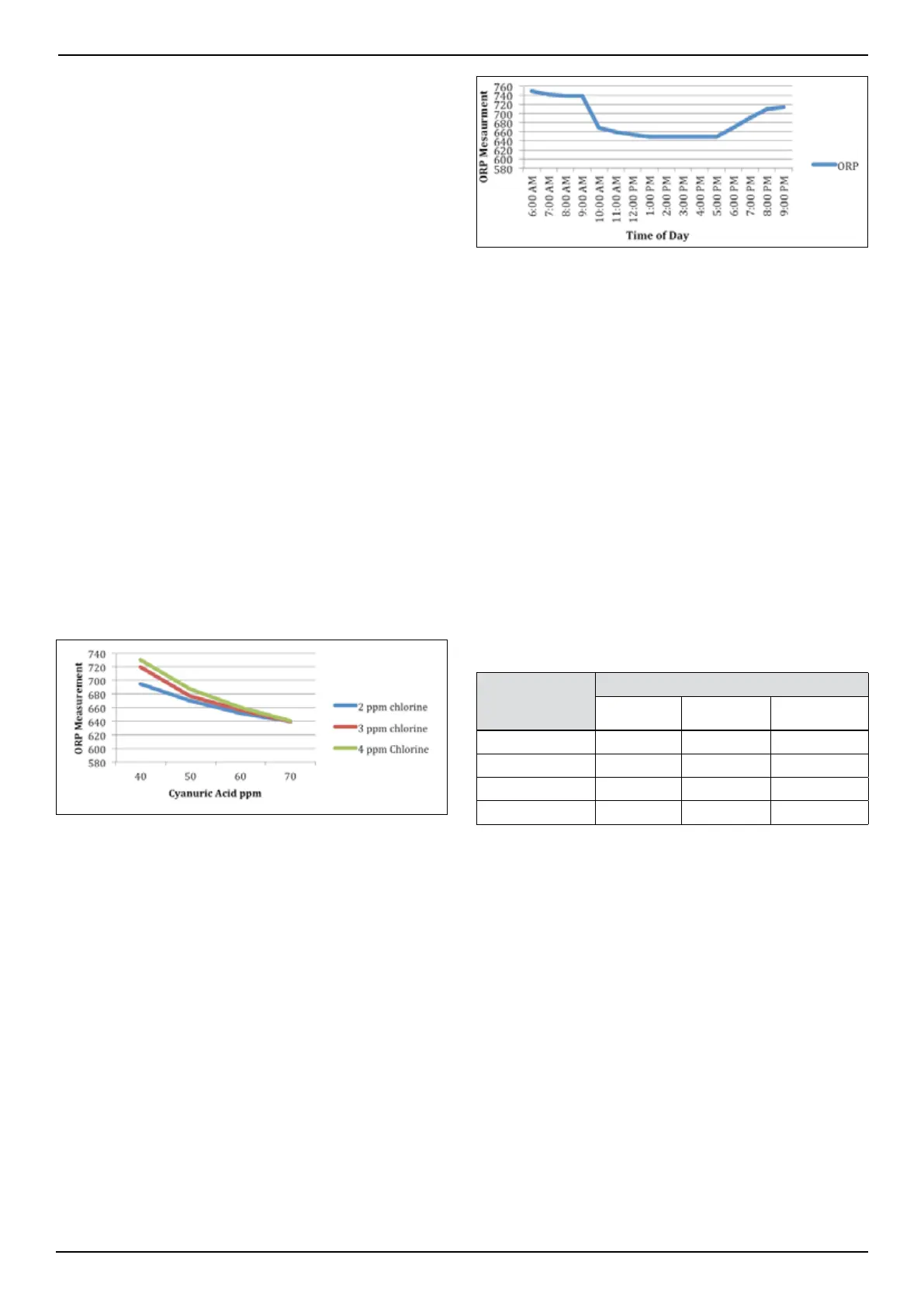
Chlorine efficiency or activity is reduced even when
low levels of CyA is present.
Figure 12. Effects of CyA on ORP Measurements
Total Alkalinity (TA) buffers pH or keeps the pH
relatively stable. The pH of your pool water is
crucial to making your chlorine highly effective,
even when the chlorine is present in low levels.
Measuring and adjusting your TA on a regular basis
will help reduce acid consumption and help keep
your pH level in check. Variable pH will also create
variable ORP readings with high pH meaning your
eQ Chlorinator will produce more chlorine to reach
the set point ORP level than it would otherwise
need.
Figure 13. Effects of Sunlight Assisting CyA Bond
CyA (STABLISER) adds to the TA reading. If CyA
levels of in excess of 50 ppm are present, it is
good practice to divide the CyA by 3 and subtract
the result from the TA reading. Therefore if CyA is
60, and TA is 200, subtract 20 (CyA 60/3) from 200
for a TA reading of 180.
CyA bonds to chlorine more effectively in sunlight
hours. Therefore ORP readings will be lower in
sunlight hours than at night. As the chlorine bonds
with CyA during sunlight hours, the ORP may drop
more than 100 mV. This means the e-Q chlorinator
will drive higher levels of chlorine during sunlight
hours as the chlorine is temporarily bonded with
CyA. After sunset, the CyA bond with chlorine
will reduce, freeing up the chlorine to oxidize with
bacteria and exhibiting an increased oxidization
potential reading on the e-Q chlorinator.
Cyanuric Acid
Level
Chlorine Level
2ppm 3ppm 4ppm
0 700 mV 725 mV 750 mV
10 550 mV 600 mV 625 mV
20 500 mV 525 mV 550 mV
>50 350 mV 400 mV 450 mV
This graph serves as an approximation only.
NOTE: Constants - pH at 7.6 and TA at 180 ppm
Table 4. Guide to Adjusting ORP Set Point
6.4.3 pH Level
Keep the pH level between 7.0 and 7.4 for
fibreglass pools and 7.2 to 7.8 for other pools.
6.4.4 Total Alkalinity
The ideal range is between 80 and 120 ppm.
6.4.5 Salt Level
The correct salt level is important to cell life and
the effective operation of your chlorinator. Salt level
should be maintained around 4,000ppm but should
never be allowed to fall below 3,000ppm. Although
salt is not consumed by the Chlorinator, salt is lost


 To Next Page