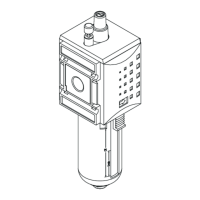
The device manual describes the MINI-REG, MIDI-REG, MAXI-REG series of products, which are air filter-regulator-lubricator units. These units are designed to manage and condition compressed air for various applications, ensuring optimal performance and longevity of pneumatic tools and systems. The manual provides comprehensive instructions for installation, operation, maintenance, and recycling, emphasizing safety and proper handling throughout.
Function Description:
The MINI-REG, MIDI-REG, and MAXI-REG units serve as essential components in compressed air systems, performing three primary functions: filtering, regulating, and lubricating.
-
Filtering: The filter module removes contaminants such as particulate matter and moisture from the compressed air. This is crucial for protecting downstream equipment from damage and ensuring clean air delivery, which is vital for the efficient operation of pneumatic tools and processes. The manual stresses the importance of installing filters, regulators, and lubricators in a vertical position and adhering to the marked flow direction on each module to ensure effective filtration.
-
Regulating: The regulator module controls and maintains a consistent output pressure, regardless of fluctuations in the inlet pressure. This ensures that pneumatic tools and systems receive air at the specified operating pressure, preventing over-pressurization that could lead to damage or inefficient operation. The pressure setting mechanism involves pulling the cap upwards, turning it to adjust the pressure, and then pressing it downwards to set. For security, the pressure regulator valve can be locked to prevent unauthorized changes to the pressure setting. This involves pressing the cap down, turning the upper wheel to the locked position to extend safety hooks, and then attaching a padlock.
-
Lubricating (if applicable): For units equipped with an oil-mist lubricator, this module introduces a controlled amount of oil into the compressed air stream. This lubricates pneumatic tools and components, reducing friction and wear, thereby extending their lifespan and improving performance. The manual advises checking the oil-mist lubricator for sufficient oil and correct oil amount setting during pre-start-up checks.
The units are designed for modular assembly, allowing for flexible configurations to meet specific system requirements. Coupling kits are used to connect individual modules, with specific tightening torques provided for MINI, MIDI, and MAXI models to ensure secure assembly.
Usage Features:
The MINI-REG, MIDI-REG, MAXI-REG units are designed for straightforward operation and integration into compressed air systems.
- Compressed Air Connection: The manual provides clear warnings regarding the handling of compressed air, emphasizing the need to shut off air supply before adjustments, drain hoses, and disconnect tools when not in use. It also highlights the importance of using the correct hose size and air pressure, and not exceeding the maximum air pressure to prevent severe damage and bodily injury. Cleanliness of hoses and couplings is also stressed before connection.
- Assembly Direction: Proper installation is critical, with explicit instructions to install filters, regulators, and lubricators in a vertical position and to follow the flow direction marked on each module (Inlet: 1 (IN), Outlet: 2 (OUT)). Incorrect installation or flow direction is identified as potentially hazardous.
- Mounting Options: The units can be mounted using a wall bracket, with instructions detailing the insertion of a sealing ring, placing the bracket onto the module, and pushing on the coupling element from the front, followed by tightening screws to specified torques. Additionally, a mounting plate and control panel nut can be used, guiding the module through the plate's hole and securing it with the control panel nut, again with model-specific tightening torques.
- Gauge Mounting: Instructions are provided for mounting the pressure gauge, involving turning it into the gauge thread with an open-end wrench until the seal is screwed on, and then aligning it by turning clockwise or counterclockwise within a specified range, adhering to a maximum screwing-in torque.
- Pressure Setting and Locking: The process for setting the pressure is simple: pull up the cap, turn to adjust, and push down to set. For security, the pressure regulator valve can be locked using a padlock, preventing unauthorized adjustments.
- Shutting off Pressure: For units with an optional ball valve module, pressure can be shut off by turning a knob 90° clockwise, which also exhausts air from the module through a G3/4" connection.
- Ball Valve Locking: The optional ball valve module can also be secured with a lock to prevent unauthorized opening. This involves pulling out a shut-off plate (MIDI/MAXI) or pressing a film hinge downwards (MINI), and then attaching a padlock. Up to three locks can be used.
Maintenance Features:
Maintenance of the MINI-REG, MIDI-REG, MAXI-REG units primarily focuses on cleaning and ensuring proper assembly and settings.
- Cleaning the Module: The manual provides a crucial "NOTICE" regarding cleaning: "Do Not Use Solvents and Aggressive Cleaning Agents." It explicitly states that such agents can damage the polycarbonate container of the unit. Instead, users are instructed to clean polycarbonate components only with a slightly damp cloth, using only water and, if necessary, a mild cleaning agent without chemical additives.
- Pre-Start-up Checks: Before operating the system, a series of checks are recommended to ensure safe and correct functioning. These include:
- Checking all connections for secure fit.
- Checking all modules for proper assembly.
- Checking the oil-mist lubricator (if existing) for sufficient oil and correct oil amount setting.
- Checking the pressure regulator for correct setting.
- Checking the filter module for properly equipped filters.
- A general warning is issued that "Incorrect installation could damage the unit and cause serious injury," reinforcing the importance of these checks.
- Warranty and Service: The product warranty is 12 months after first use, or 13 months after delivery, covering defects but excluding normal wear and tear. The warranty relies on correct use, maintenance, and repair, with repairs only performed by Atlas Copco workshops or Certified Service Partners. Atlas Copco also offers extended warranty and preventive maintenance through ToolCover contracts.
- ServAid Portal: For technical information, including installation, operation, and service instructions, spare parts lists, and accessories, users are directed to the ServAid portal (https://servaid.atlascopco.com), which is continuously updated.
- Safety Data Sheets (MSDS/SDS): Information on chemical products sold by Atlas Copco can be found on their website (www.atlascopco.com/sds).
- Recycling: At the end of its service life, the product must be recycled properly. Users are instructed to dismantle the product and recycle components according to local legislation. Batteries, if present, should be handled by a national battery recovery organization.

 Need help?
 General



 To Next Page